
Solar panels and seawater have never gotten along. Salt spray works its way into the wiring, wave motion flexes the frames until the cells microcrack, and an array lying flat on open ocean is basically a surfboard with electronics bolted to it. That is why nearly every floating solar farm you have read about sits on a reservoir, a quarry lake or a canal, where the water mostly just lies there and behaves.
A Dutch-Norwegian company called SolarDuck has spent the last two years arguing with that premise about 7.5 miles off the coast of The Hague. But the money it just picked up is not for a bigger version of the same thing. On June 26 the Netherlands Enterprise Agency handed SolarDuck and the country’s maritime research institute €3.2 million, roughly $3.6 million, to design a platform whose customers will not be on shore at all. They will be sitting on the seabed.
The pitch is a power socket in the middle of the ocean
The thing being designed is the Offshore Floating Power & Utility Hub. The research program paying for it is called Steady Seas, and the partner is MARIN, the Maritime Research Institute Netherlands.
It is one platform, built to be lifted and moved to the next job when this one ends, carrying storage and auxiliary systems so the output does not stop when the sun goes down. What it sells is not just electricity. SolarDuck lists communications and other utility services alongside the power, and all of it goes to gear sitting a long way from anything.
Nothing gets sent to shore. The grid is not the customer here.
Right now that hardware gets fed one of three ways, all of them awkward. You run a power cable out from shore. You run an umbilical from a host platform. Or you park a diesel generator on something floating nearby and keep topping it up.
Every one of those costs real money before it delivers a single watt. A cable or umbilical run is a long marine installation job, and one dragged anchor can end it. Diesel means a permanent fuel logistics chain and emissions somebody now has to account for.
The customer list SolarDuck is aiming at is specific: offshore monitoring systems, carbon capture and storage projects, and subsea oil and gas hardware. Its claim is that the hub takes cost out across the life of a CCS or tie-back project. A tie-back, if the term is new to you, is a well piped back to a host platform some distance away rather than getting a platform of its own.
Don Hoogendoorn, SolarDuck’s chief technology officer, said in the announcement carried by pv magazine that the program gives the company the means to “engineer and validate robust answers before the solution is deployed at sea.”
A flat panel in the North Sea is a bad idea
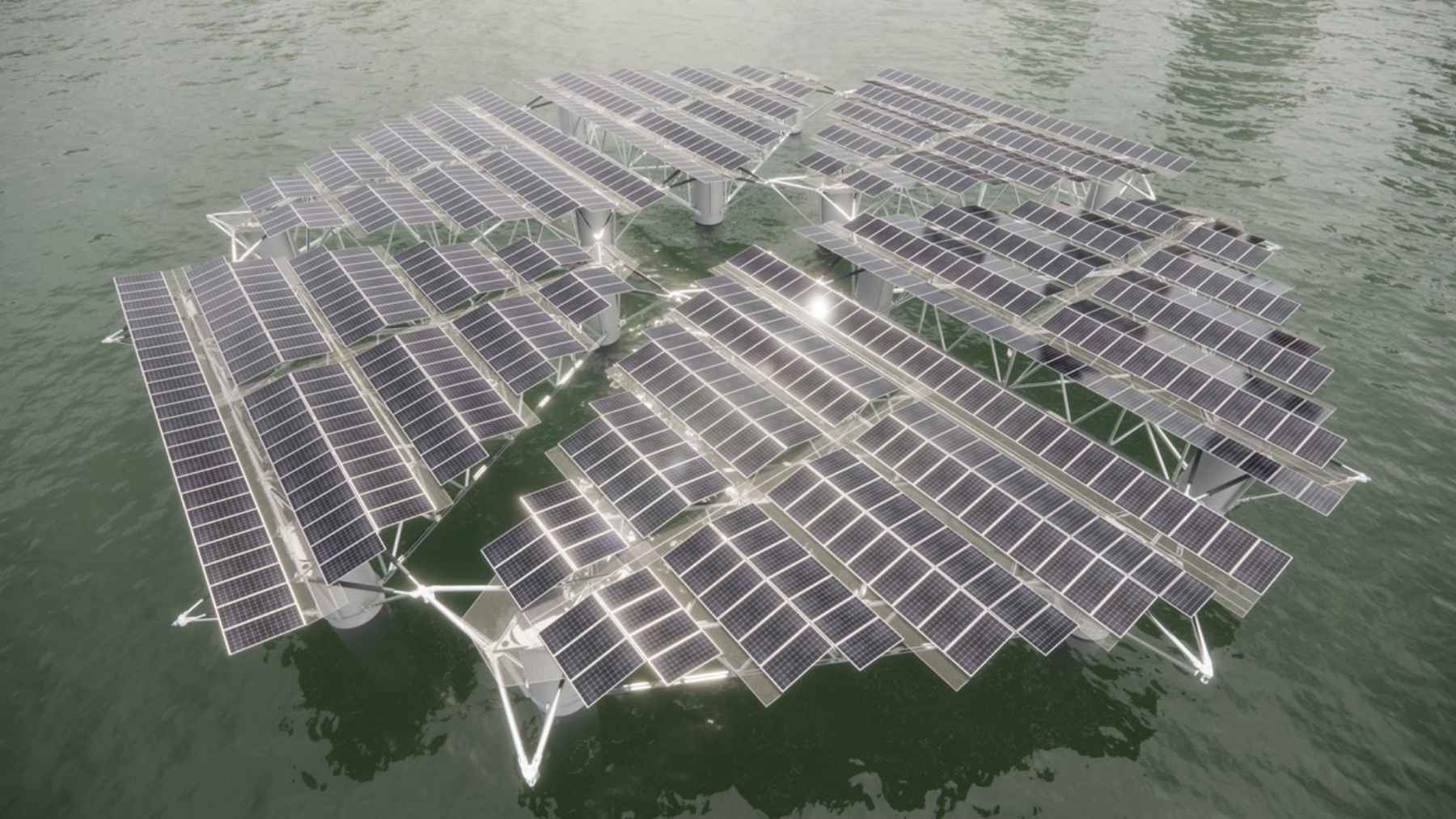
SolarDuck’s answer to the wave problem is geometric. Its platforms are triangles built as semi-submersible structures, and the panels ride several meters clear of the surface instead of on it.
The company’s own description, repeated in RWE’s project write-up, is that the platform floats above the water “following the waves like a carpet,” keeping the electrical gear dry, clean and stable and protecting the structure underneath.
That is the entire engineering case. A flat float takes the wave. An elevated deck lets most of the wave pass beneath and only feels what comes up through the columns.
One alternative is to not float at all. China switched on a gigawatt-scale plant in Shandong in late 2025 by driving nearly 3,000 steel platforms into a shallow seabed, which is brute force and only works where the water is a few meters deep.
The other alternative is to stay somewhere calm. Dutch developers have been covering quarry lakes with panels for years, including a 27.4 MW array near Zwolle where researchers bolted shellfish cages underneath to see what moved in. Neither approach helps if the thing you need to power is a long way out, in deep water, with nothing nearby to plug into.
Merganser has been out there since July 2024
The hardware doing the arguing is a pilot called Merganser, and it is the reason anyone is funding the rest of this.
Six interconnected platforms, 520 kWp between them, went into the water in July 2024 at the North Sea Farmers test site, roughly 12 kilometers off Scheveningen and moored in about 66 feet of water.
More than 180 sensors have been logging what the structure is doing since: how the frames are loaded, what the connectors and mooring lines are taking, how the electrical side behaves. The Dutch research institute Deltares has run a separate ecological survey underneath the whole thing.
Before any of it went in the water, Bureau Veritas signed off on the design with a prototype certification it says had never been granted to an offshore floating solar technology before. It is cleared for waves up to 11.6 meters, about 38 feet, on a 10-year directional return period, at a site 21.5 meters deep. SolarDuck’s own project page aims higher, listing the six platforms as designed for a North Sea 50-year storm wave of 13.5 meters, roughly 44 feet.
Merganser was funded under DEI+, the Dutch subsidy line that pays for pilot and demonstration projects meant to cut CO2. It has now sat through two North Sea winters. That is the data set Steady Seas is built on.
MARIN gets to try to break it in a tank first
MARIN is the other half of the grant, and it has the unglamorous job. The institute runs hydrodynamic analysis, numerical simulation and physical basin testing on scale models, and its findings are what turn a concept into something an offshore operator will insure.
Most of the questions live underneath. William Otto of MARIN said the institute will study wave build-up below the platform, plus the loads an extreme sea puts through the structure and the way the platform’s geometry drives how it moves.
Wave build-up is the awkward one. The whole premise of an elevated deck is that the sea passes below it. If water stacks up under there in a big enough storm, the design’s main advantage turns into its main load path, and you either find that out in a test tank or you find it out offshore with somebody’s gas field depending on it.
MARIN has done this for SolarDuck before. In early 2025 the company tested an updated platform design in MARIN’s Offshore Basin, a tank measuring 45 by 36 meters and 10.2 meters deep, and it later ran a campaign with 54 interconnected platforms, a real-world equivalent of roughly 6 MWp.
The first customers are oil and gas
If you want to know where SolarDuck thinks the money is, look at who it hired to advise it. In March 2026 the company set up an advisory board with two members: Neil Kavanagh, formerly chief scientist at Australian gas producer Woodside Energy, and Tore Moe, vice president geomarkets and senior energy advisor Australia at Norwegian Energy Partners.
Neither of those is a solar resume. Both are offshore hydrocarbons.
There is a straightforward reason for it. The equipment that most urgently needs power far from shore belongs to the oil, gas and carbon-storage business, and increasingly to the robots those industries leave behind. Saipem’s Hydrone-R has been living on the seabed of the Norwegian Sea, recharging in a docking station bolted to the bottom instead of going home to a support vessel every few days. Something has to power that garage.
The economics already work in shallower water. A Norwegian salmon farm above the Arctic Circle now takes more than 90% of its power from floating solar, and the diesel generator that used to run around the clock has mostly gone quiet. Those pens sit in sheltered water with a boat ride to shore. Doing the same job over a gas field is a different order of problem, and that gap is what the €3.2 million is for.
What €3.2 million actually buys
It buys a design. Steady Seas ends with a basic design and a validated set of answers about mooring, motion and how the platform talks to subsea hardware. There is no Power Hub in the water, no announced site and no date.
The company says it is lining up Joint Industry Projects, the shared-cost consortiums the offshore sector uses to spread the risk on unproven kit, to put the hub through real conditions once the research phase closes. It has not said who is in them. The only SolarDuck hardware currently sitting in the North Sea is a 520 kWp pilot whose two-year monitoring campaign, the one announced back at installation, runs out around now.
Two years of North Sea data is a real asset, and it is the reason a design grant for a platform nobody has built yet got written up as news at all. It is also not a power hub, and to SolarDuck’s credit the company is not describing it as one.