
Your car’s dashboard almost certainly wasn’t built inside your car. It turned up at the assembly plant as one finished piece with the wiring, the vents and the screen already in it, and somebody bolted the whole thing in at a single station. Seats work the same way.
Nuclear plants have mostly not been built like that. They get stick-built, which means the pipe, the steel and the cable show up as parts and get fitted together on site, in the order the drawings say, by people standing in the room with tools. It’s slow and expensive. It’s also a decent chunk of why American reactor projects have the reputation they do.
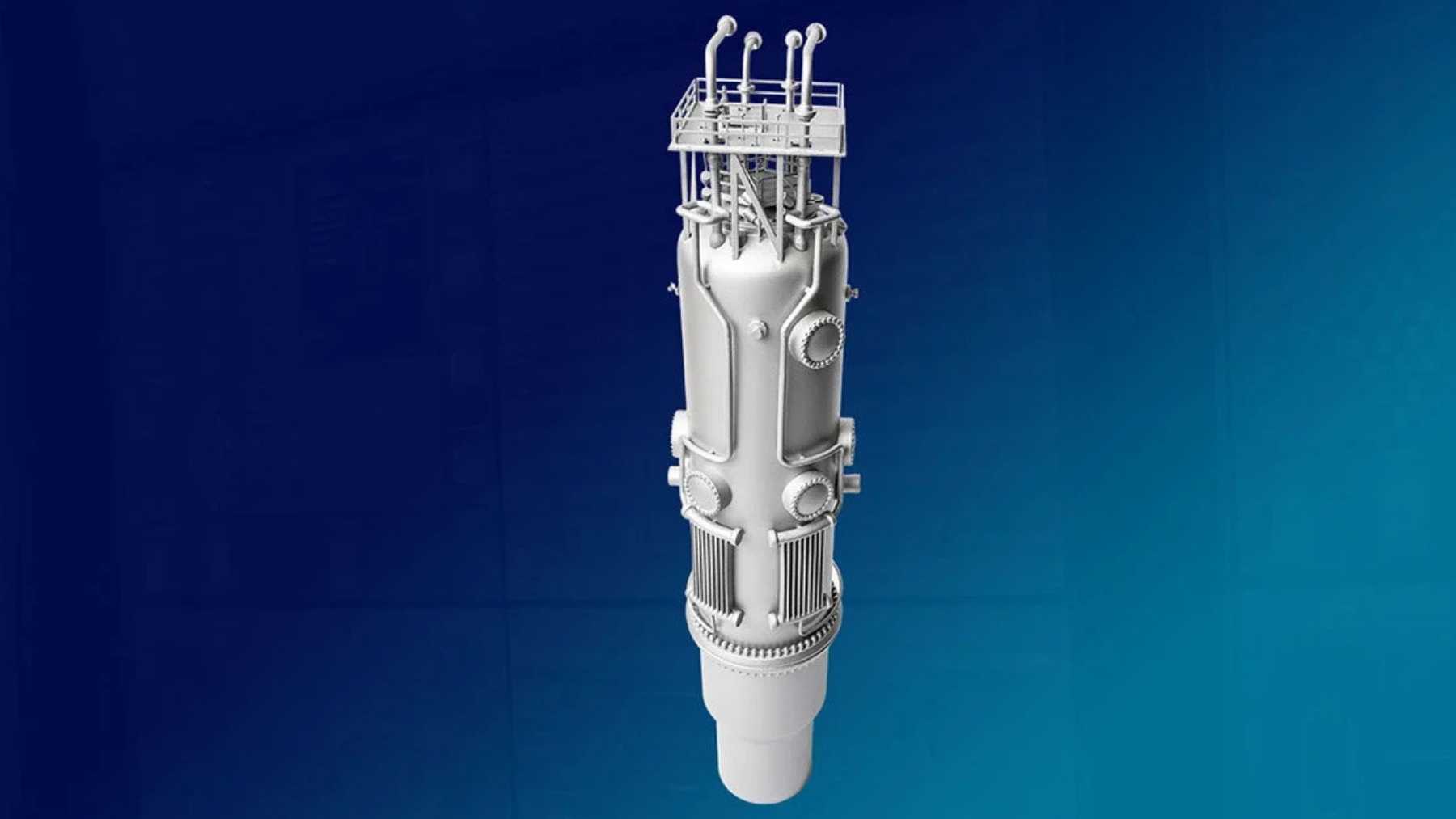
So a company in Albuquerque, New Mexico has spent close to two years trying the car version on a reactor. Kairos Power put out a writeup on September 10 of how its second Engineering Test Unit went together, and ETU 2 is the first machine in the series built as modules rather than as one big thing welded in place.
There’s no fuel in it and there never will be. I’ll come back to that.
So what’s a skid?
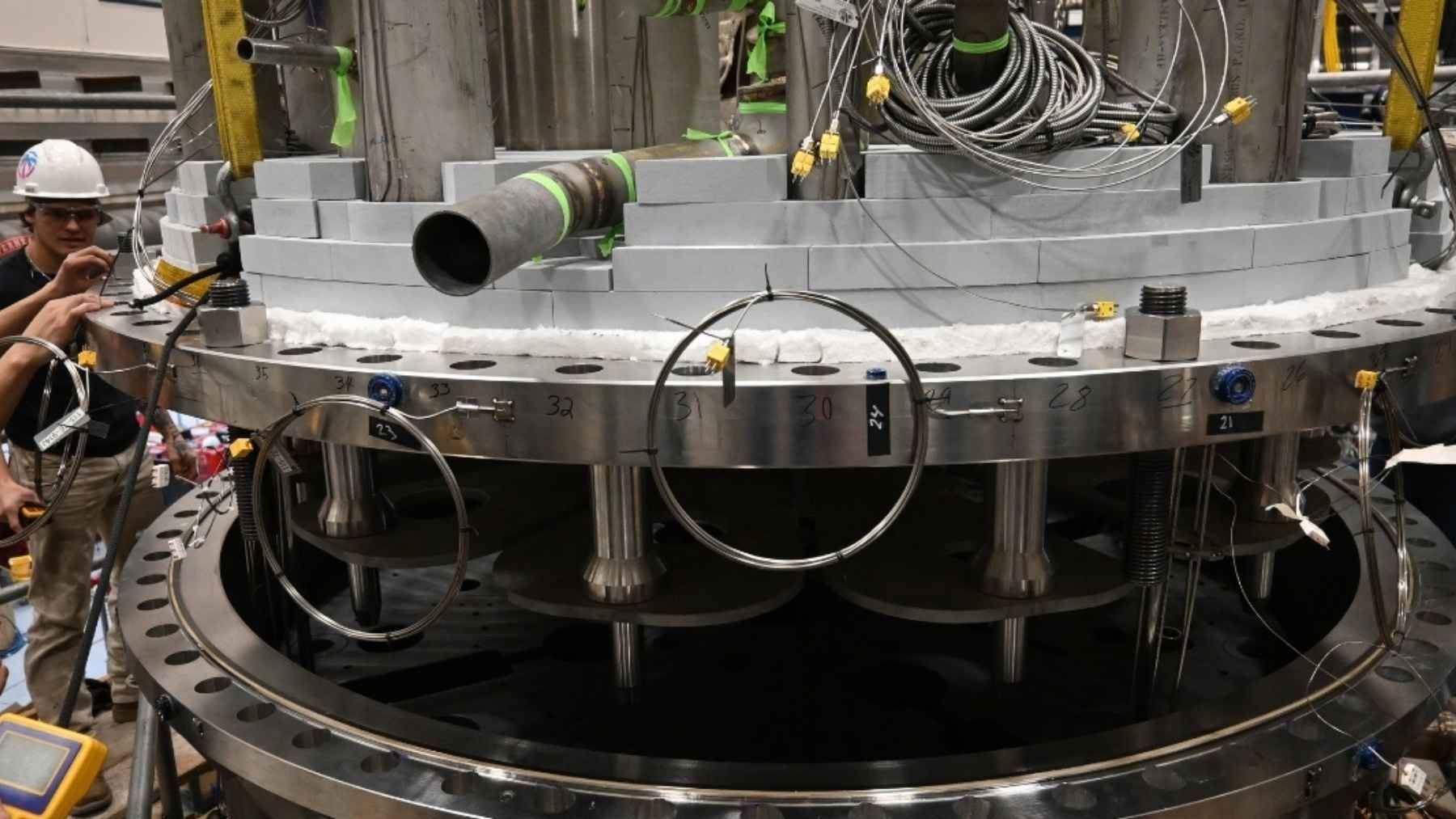
A skid is a steel frame with a job. Kairos puts the equipment, the piping, the supports, the electrical cable and the connection points for one system onto one frame, builds it in a shop, tests it there, then ships it. ETU 2 is made of more than 30 of them, sized so a truck or a railcar can carry them.
You get two things out of working that way. The hard work moves indoors, where the light is good and nobody’s welding off a scaffold. And several systems can be built at once instead of in sequence, because none of them is waiting on the one before it to be finished in the room.
If you’ve ever watched a kitchen remodel stall because the electrician can’t start until the plumber’s out, you already understand the problem they’re trying to get rid of.
The catch is the room. Kairos says the space inside the ETU 2 enclosure pushed its design team to pack more equipment and pipe onto each module than it otherwise would have, which is what left enough clearance to walk around them once they were in. That’s a fairly honest thing to admit about a first attempt, and it’s the kind of constraint you only find by building the thing.
So why build a full-size fake reactor at all?
The first one was built the old way
Because that’s where you find out which of your own systems argue with each other, somewhere it can’t hurt anybody. ETU 1 sat on the same Albuquerque campus and wasn’t modular at all. It was a full-scale, electrically heated stand-in for the reactor, and by the numbers it did its job.
According to the Department of Energy, it logged more than 2,000 hours of pumped salt operations across about six months, loaded with roughly 13 short tons (12 metric tons) of Flibe, 30,000 surrogate fuel pebbles and more than 300 graphite reflector blocks. It peaked at 1,247 degrees Fahrenheit and 3,000 gallons a minute, and it was decommissioned in 2024.
Flibe is the coolant. It’s a mix of lithium fluoride and beryllium fluoride that sits there as a solid at room temperature and does nothing useful until you melt it, which is why these machines spend their whole working lives hot.
Two lessons from that first unit show up in the new one. Chemistry monitoring and control were spread across several systems in ETU 1, and for ETU 2 they’ve been pulled into one dedicated skid and tank, which the team then validated with a water testing campaign before any salt was involved. The system that moves molten salt in and out of the reactor also recirculates Flibe now, something ETU 1 couldn’t do, using a new centrifugal auxiliary pump mounted on its tank.
Most of the hardware is made in-house
Kairos built the majority of ETU 2’s components itself in Albuquerque, and that includes the awkward ones: the primary salt pump, the reactor shutdown safety system and the reactor vessel, which carries an ASME U stamp. That vessel was the first one the company ever built itself, and it went in on January 30, 2025. Kairos stood up a dedicated shop to do it, with plate rolling, cutting, automated welding and machining.
The stated goal behind all that vertical integration is for 80 percent of what ETU 2 costs to come from raw materials or parts you can buy off a shelf. That’s a target, not a result. I can’t find anywhere the company has published where it actually landed.
Making your own salt pump is arguably the most interesting line on that list. It’s the kind of thing you’d normally hand to a specialist supplier, and the moment you do that you’re back to waiting on somebody else’s shop and somebody else’s schedule.
The build crew changed how it worked too. Instead of finishing one skid before starting the next, the team installed components, heaters, instruments and insulation across several skids at the same time, so hitting a snag on one didn’t stop the others. Josh Christian, a senior manufacturing manager at the company, called that parallel progress “eye-opening compared to the ETU 1 build process.”
So where is ETU 2 right now?
In pieces, though connected ones. Crews laser-mapped the enclosure and set reference points before anything went in, so every module had a mark to land on. They worked out an installation order that kept the welding and electrical connection points reachable as the room filled up.
Once a skid was down, all that remained was joining the pipe and cable between it and its neighbors. That’s where the time comes off, because on ETU 1 the pipe routing had to follow the sequence of the build itself, one length at a time, in the order the machine went up.
The crews are now testing individual systems, meaning heaters, controller connections and the screens the operators will actually use. After that comes integration testing, which is turning valves, running inert argon gas through everything and watching temperatures and pressures to confirm the hardware behaves before anyone adds heat. Then hot argon testing, which pushes the system toward something closer to real operating conditions.
All of this is running later than the company suggested in the spring. Co-founder and chief technology officer Ed Blandford said in April that ETU 2 was close to startup, per the American Nuclear Society, and Kairos said around the same time it expected commissioning to begin later in the summer. The September 10 writeup still has integration underway and hot argon testing ahead of it. None of that is shocking on a first-of-a-kind build. I’d just rather have the dates than the adjectives.
Kairos also hasn’t put a date on hot argon testing, hasn’t said what the skids weigh or how big they are, and hasn’t said how much integration is left. On a writeup whose entire argument is that modules go together faster, I’d have liked a number attached to “faster.”
And the thing in that building still isn’t a reactor in the way you’re probably picturing. There’s no nuclear fuel in it, it won’t generate a watt, and nothing inside it splits an atom. The point is the hardware and the people who have to assemble it, which is also true of the third unit over in Tennessee, where a crew stood up precast concrete walls around a mockup cavity and ran robot arms across the top of it.
Nobody’s going to prove cheap nuclear power inside a test building in New Mexico, and I don’t think Kairos is pretending otherwise. What ETU 2 can settle is smaller than that. Can a company that has never shipped a commercial reactor draw a module, build it in one place, truck it somewhere else and have the bolt holes line up when it gets there? Oak Ridge has a couple of other outfits trying the factory route, so Kairos isn’t the only one asking.
That’s where these skids are headed. Kairos says the reactor equipment modules for Hermes 2 will be fabricated in Albuquerque and shipped to Oak Ridge for installation, and that plant broke ground on April 17 on a footprint built to put up to 50 megawatts onto the Tennessee Valley Authority grid.