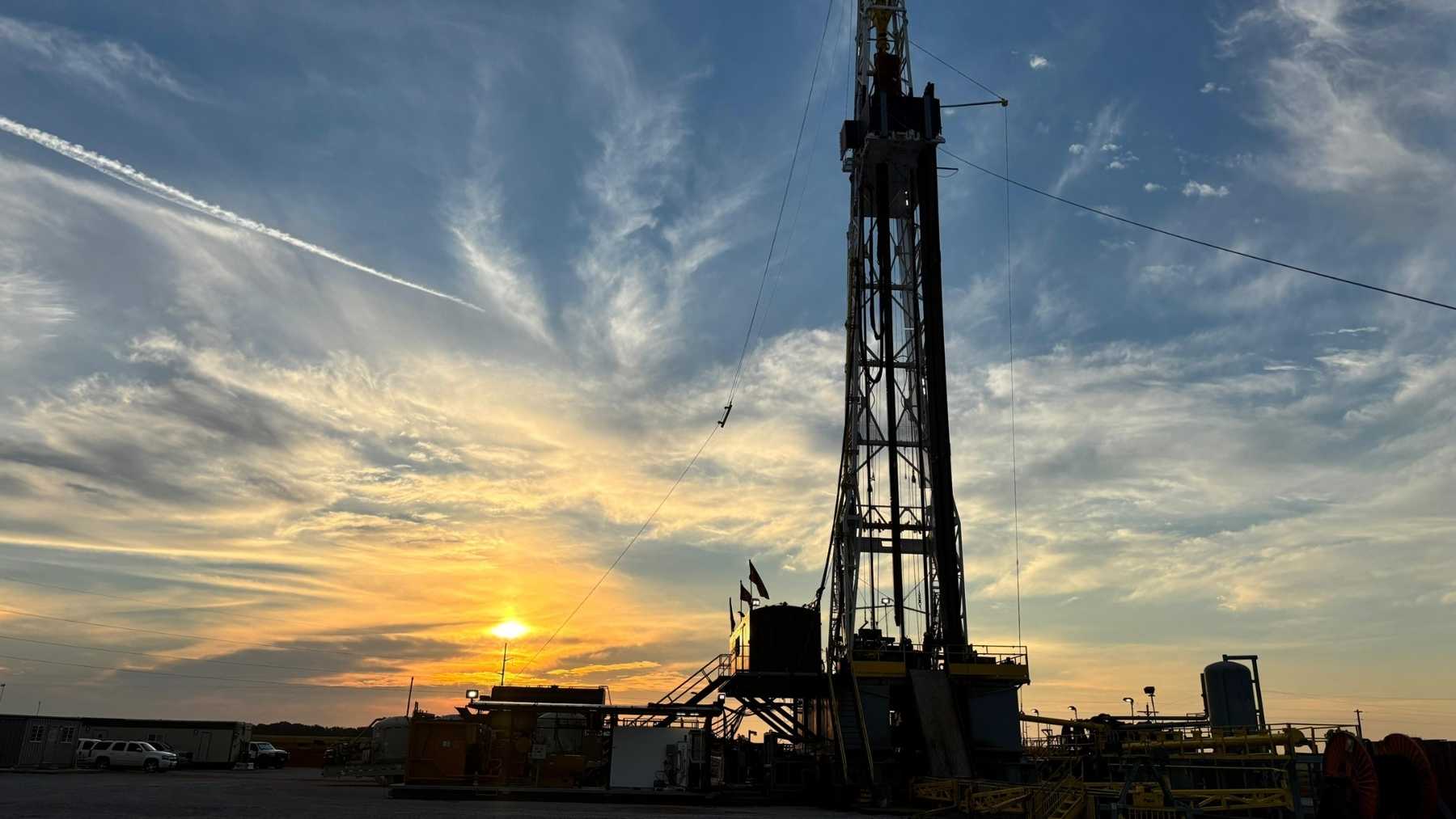

There’s no real mystery to a drill rig in western Oklahoma. The Anadarko Basin underneath it has been giving up oil and gas for more than a century, and drillers out there once pushed a well down to 31,441 feet, the deepest hole on the planet at the time. So when a full-size rig spudded a fresh hole in the basin on August 12 (rig talk for the day a well officially starts), with Baker Hughes equipment on location and oil companies helping cover the bill, you’d be forgiven for assuming it was business as usual.
Not this one, though. This rig is coring dust.
The project is called DeepDust, and it runs under the International Continental Scientific Drilling Program, with the University of Oklahoma’s Lynn Soreghan as the contact scientist and funding from the National Science Foundation plus its German and Japanese counterparts. What it’s chasing is Permian rock: windblown dust and lake beds that piled up across this corner of the world more than 250 million years ago and slowly hardened into stone. The ICDP describes the site as one of a kind globally, because this stretch of Oklahoma holds a continental record that runs through the entire Permian.
Here’s why anyone would spend rig time on that. During the Permian, Earth climbed out of a deep ice age and into a hothouse, and it’s the only time that’s happened while the planet carried a fully built-out land biosphere. Dust settled out of the sky year after year and got buried, so every layer in that pile is a record of what the air was carrying and roughly when. We’ve pulled this kind of time capsule apart before, between a drill core in Australia that came up carrying gold and the European team coring ancient ice in Antarctica, and this one sits on the same shelf.
So how’s the drilling going?
Quickly, from the looks of things. The top 1,000 feet of the hole went down the ordinary way, with Schlumberger logging that section on August 14 before the science part began. The first core hit the deck on August 16. By August 25 the crew had already passed 1,000 feet of core recovered, and in a September 15 update the ICDP reported cores coming up from 4,314 feet with recovery “close to 100%.”
Quick explainer if you’ve never stood on a rig floor. A normal bit chews rock into fragments and flushes them up with the drilling mud. A core bit cuts around the rock instead, so a long cylinder of it rides up intact, a bit like pushing a straw down through a layer cake. Recovery is the share of that cylinder that actually reaches the surface in one piece, and it’s where coring jobs usually bleed, because soft rock washes out, jams or crumbles on the trip up. And a lot of what DeepDust wants is mudstone, not exactly the sturdiest stuff you can core.
That 98.5 percent comes with an asterisk
The project’s own counter puts the totals at 4,134 feet drilled, core cut across 2,618 feet of that, and 2,579 feet recovered. That works out to 98.5 percent of everything the crew tried to core, and 62.4 percent of the hole overall.
So it isn’t one unbroken column of rock, and the ICDP doesn’t claim it is. Some stretches had to be drilled destructively, and on those intervals two of the project scientists spent September 6 in the mud-logging shack bagging cuttings instead, which is the consolation prize of the coring world. Still, as far as I can tell, 98.5 percent recovery across half a mile of cored hole is a spectacular result. You won’t find a stat like it in a normal well file, because in the oil patch the rock is usually just what stands between the bit and the pay zone. Here, the rock is the product.
So what does 250-million-year-old dust actually look like when it lands on the catwalk?
Mud shot through with small salt veins, per the photo the project posted from the site on August 20. Which tracks, because the ICDP describes a Permian landscape here that featured acid lakes, punishing heat and staggering amounts of airborne dust, and salt is exactly what a dying lake leaves behind.
Oil companies are helping pay for it
Now for my favorite detail: the partner list. Crawley Petroleum, Mewbourne Oil Company and Duncan Oil Properties put actual money in. Devon Energy and Continental Resources sit on the project as key advisors. Basin Engineering, Power Rig, Baker Hughes and SLB show up under in-kind contributions and discounts. So a climate-history hole in the middle of oil country is going down with oil-industry cash, oil-industry hardware and oil-industry know-how, and frankly that’s probably the only way a hole like this gets drilled in Oklahoma at all. Deep coring is expensive, and the people who know how to make hole fast and cheap all learned it chasing hydrocarbons.
A couple of things the paperwork doesn’t cover, by the way. The ICDP hasn’t published a target depth for the well, so I can’t tell you how much deeper this goes. It also lists Power Rig as an in-kind contributor without saying outright whose rig is doing the turning, and I couldn’t find a make or model for it anywhere on the project pages.
For now the crew keeps pulling rock. The project’s daily log posted its latest photo from the site on September 20, morning shift walking out to the floor, and the September 15 numbers still stand: cores from 4,314 feet down, with barely anything left behind in the hole.