
California’s Department of Water Resources issued a press release on September 30 regarding some valves. Valve news doesn’t usually travel much farther than a few engineering offices in Sacramento, and I get why.
But these valves sit at the bottom of Oroville Dam, which DWR says is the tallest dam in the country. The two newest ones weigh roughly 160,000 pounds apiece and got into the dam on a barge. And the system they’re part of has had a strange couple of decades, including a test that knocked five state workers off their feet.
So why does a 770-foot dam need a drain at the very bottom?
There’s a fourth way out of Lake Oroville
If you know the name Oroville, it’s probably from February 2017. Big storms filled the lake quickly; the main spillway began breaking apart. Water poured over the emergency spillway and tore up the hillside below it, and about 188,000 people downstream were told to leave.
Those spillways are two ways out of the lake, and Hyatt Powerplant’s turbines are a third. The fourth is the one DWR just rebuilt: the river valve outlet system, which you’ve almost certainly never seen since it’s buried at the base of the dam.
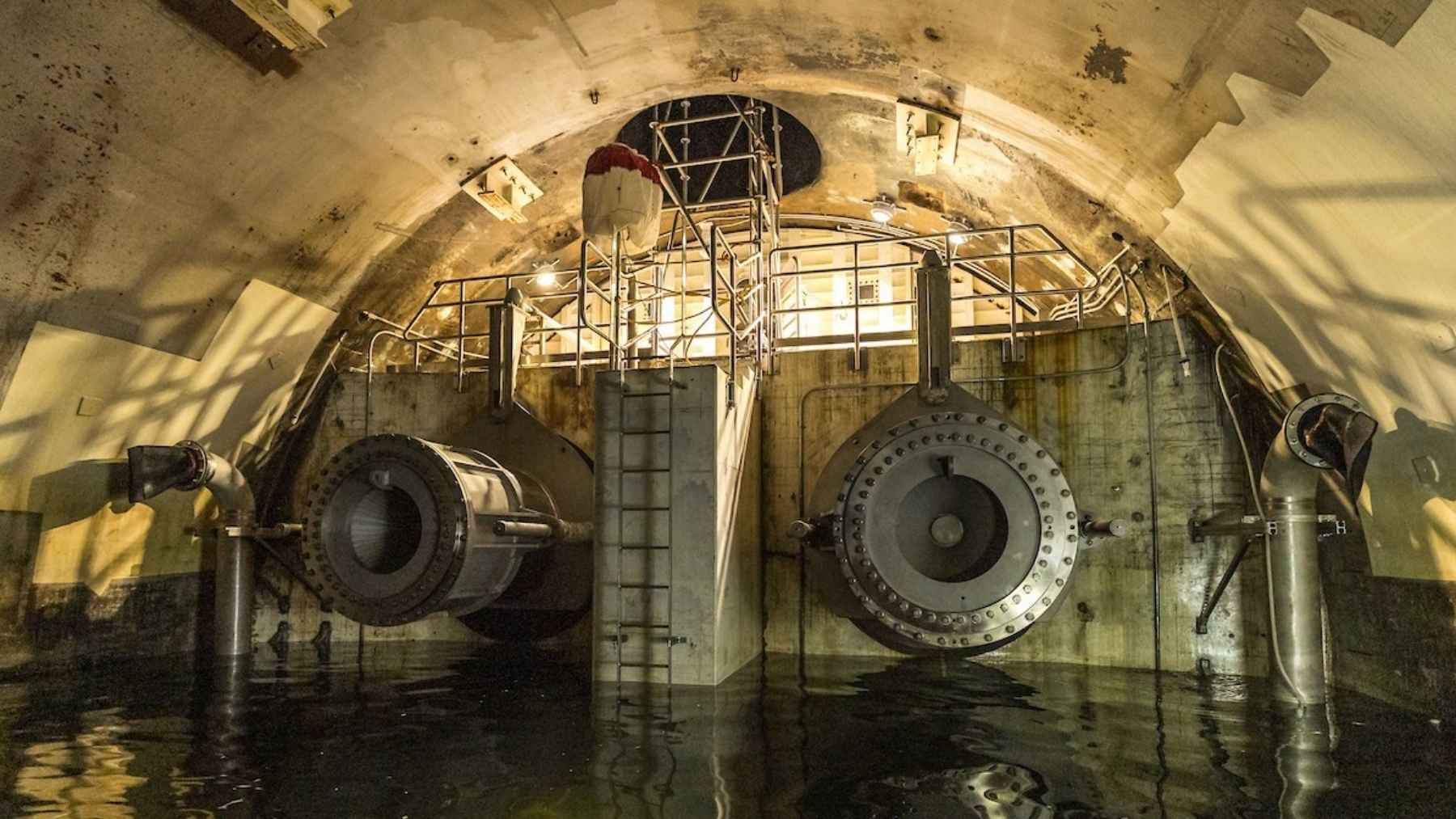
When the dam went up, the Feather River ran around the construction site through two tunnels about 35 feet across. One was sealed off with concrete once the dam was done, and the other got a pair of 6-foot pipes with valves running through its plug. Which means they’re the lowest way out of the lake.
That’s actually pretty crucial information. If the lake drops below Hyatt’s intakes, the river valves are the only thing left that’ll let water out. And a deep lake stays a lot colder at the bottom than at the top, so those pipes double as a cold-water tap. Chinook salmon and steelhead spawn in the river below the dam, and when a hot, dry summer warms it up, water from the lake bottom is how DWR cools it back down.
DWR leaned on exactly that in August 2021. The lake hit a record low, Hyatt went offline for the first time ever because of low water, and the river valves kept the Feather flowing, with the river and the pools below the dam running between 48 and 58 degrees, according to DWR’s update that month.
The last full-open test didn’t go well
Water doesn’t exactly trickle out of those valves, as you’d probably guess with that much lake pushing on it. Before the dam was even finished, the Bureau of Reclamation tested a scale model of the outlets for California and figured the jets would hit the tunnel walls at up to about 136 mph. To tame them, the design placed a ring around the tunnel’s interior just past the valves.
That ring had been damaged back when the dam was finished, according to Water Deeply’s reporting. Cal/OSHA, California’s workplace safety agency, would later find that DWR supervisors had ignored a 1993 warning from UC Davis engineering experts never to open the valves all the way. In April 2009, DWR took the ring out without consulting the state’s Division of Safety of Dams, which was supposed to sign off first.
On July 22 of that year, five DWR workers went down into the valve chamber for a test that would take the valves all the way open. According to the investigation, as Water Deeply quoted it, DWR “wanted to determine the destructive effects.” That’s a pretty bold goal for a test with people standing in the chamber.
Accounts of what happened next don’t quite match. The Cal/OSHA report, as ABC10 summarized it, says a breakaway wall got sucked down into the tunnel at 85 percent flow, and the lights went out. Water Deeply described winds of hurricane force tearing a steel bulkhead loose and pinning the workers against the equipment until coworkers shut the water off. All five survived. One spent four days in the hospital with a head injury, a broken leg, and a broken arm.
How does water make wind, anyway?
Water moving that fast drags a lot of air with it. The lab’s model had the jets drawing in about two and a half times as much air as water at full flow, which is why the tunnel had a large air vent above the valves. The same report notes that the amount of air the jets need depends on whatever’s deflecting them downstream, so pulling the ring out basically changed the conditions the outlet was designed for.
I’m not a hydraulic engineer, though, and the link to Cal/OSHA’s own summary no longer works. So I’m relying on ABC10 and Water Deeply’s reporting. Just trying to be transparent here.
Cal/OSHA cited DWR six times, five of them as serious violations, and initially fined the department $141,375. An appeal later knocked out two of the serious ones.
Working valves wouldn’t have saved the spillway
The river valves weren’t much use for years after that. A drought finally forced a fix, and it took years and a new ring in the tunnel to get them back to full flow. Then, in early January 2017, DWR took them out of service again for fire-safety work at Hyatt, spokesman Ted Thomas told Water Deeply. The spillway started coming apart a few weeks later.
So would working valves have helped? Not enough, according to DWR. Thomas put the system’s full design capacity at 5,400 cubic feet per second with the lake full, while storms at times pushed more than 100,000 cubic feet per second into the lake. At those peaks, a fully working system would’ve been letting out about 1 bucket for every 20 that came in. The outage was frankly bad timing, more than anything else.
That capacity number comes from the original design, by the way, and I couldn’t find an updated one for the rebuilt system.
The new valves went in by barge
DWR started looking hard at rebuilding the whole system more than a decade ago, project manager Jason Brabec told KRCR, and ordered the new valves three years before construction started so they’d be ready when the tunnel was. The first job, according to a DWR briefing to the California Water Commission, was putting a bridge crane into the tunnel for materials and valves, plus a bulkhead to seal off the work area so Hyatt could keep generating.
Then came the valves.
DWR photographed one of the new ones riding a barge up the river toward the dam, past the foot of the main spillway, the same spillway that came apart that February. Brabec told KRCR the barge carried the equipment through the tunnel, and then the chamber was pumped dry for the installation. Everything else had to fit through a roughly 20-by-12-foot opening.
Floating an 80-ton valve into a dam sounds a bit improvised, I’ll admit. But when the tunnel already has river water in it, I suppose you use the river. We’ve covered the spherical valves TVA rebuilt inside a Tennessee mountain, which weigh almost 200 tons apiece, compared to Oroville’s 80, but those didn’t have to leave the mountain.
The old valves have been in there since the 1960s, and they aren’t going anywhere. DWR kept them as an emergency backup, and the new ball valves, both 72 inches across, sit right after them, one per line, with new fixed-cone valves at the very end.
If you’ve never had a reason to care, a ball valve (engineers call the big ones spherical valves) is basically a giant version of the quarter-turn shutoff on your washing machine hookup. It’s a ball with a hole through it. A fixed-cone valve is the business end, spraying the water out in a wide, hollow cone so its energy spreads out before it hits the tunnel.
The new ball valves are rated for 400 psi, and Brabec expects the system to see about 290 at most. For a sense of scale, the tires on your car probably run somewhere around 35. He figures they’re good for 75 years or more, though he told KRCR there’s no way to know that for sure.
The valves have been ready since June
The whole job cost $235 million, according to DWR. It also ran long. Commissioning wrapped up in June 2026, more than a year and a half after the fall 2024 finish DWR had projected in that briefing, and KRCR reports crews were still cleaning up into September. DWR hasn’t said what pushed the date back. For a job threaded through a tunnel at the bottom of a working dam, I’d call that pretty forgivable.
The rebuilt valves haven’t been needed since commissioning. Brabec told KRCR on October 5 that, given the lake’s location, he doesn’t expect DWR to use them this year.