
Nuclear reactors are big, and that is most of the reason there are not more of them. France’s most powerful unit sits on the Channel coast inside a building sized around a 425-ton pressure vessel, and almost every safety system in there exists because the water inside is under enormous pressure and would love nothing more than to become steam.
A startup in Grenoble has spent three years on a reactor that does none of that. No pressure. No pumps. No control rods.
And when World Nuclear News reported its licensing filing in January, it put the machine at four cubic meters. That is about 141 cubic feet, or the interior volume of roughly six household refrigerators.
The company is Stellaria, spun out of France’s Alternative Energies and Atomic Energy Commission and Schneider Electric in 2023. On July 16 it signed a memorandum of understanding with Unitel Group and a consortium called Energie Hub to deploy several of these reactors, one phase at a time, into Fos-sur-Mer.
Fos is the industrial basin west of Marseille, and it is one of the largest in Europe. It is also the first place anyone has publicly named as a home for the thing.
Four cubic meters is the entire pitch
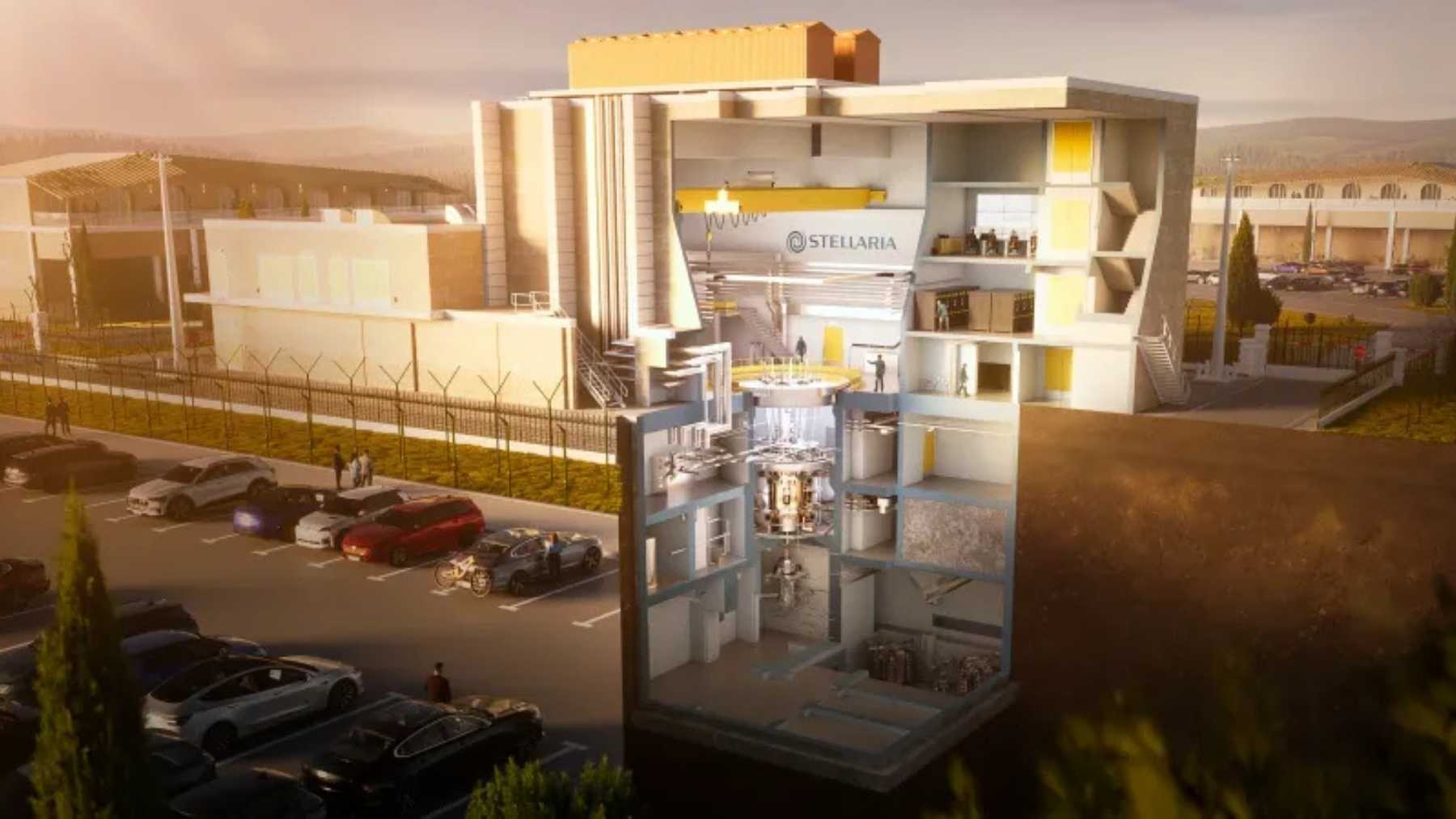
The reactor is called the Stellarium, and the number to hold onto is the volume, because everything else follows from it. Stellaria is not building a shrunken version of a conventional plant. It is building a fast-neutron reactor whose fuel is a liquid, and that changes what the hardware has to survive.
The fuel is a chloride salt. Fissile material goes into sodium chloride, chemically the same family as the salt on your table, and the mixture is heated until it runs like water and sustains a chain reaction. This matters more than it sounds, because most molten salt work over the past 60 years has used fluoride salts. Chloride puts the reactor in a fast spectrum instead of a thermal one.
Nothing in the core is under pressure, so there is nothing to burst. The salt moves by natural convection rather than pumps, which spares Stellaria from engineering a pump that can live in a corrosive bath of molten salt for two decades. There are no control rods either. When the load drops, the salt heats up and expands, the neutrons find fewer atoms to hit, and the reaction slows itself down.
Stellaria says it holds eight patents on all this: five of its own, one of those shared with the CEA, plus an exclusive license on three more the agency developed while incubating the company.
The whole assembly is buried several meters underground and wrapped in four containment barriers instead of the three most reactors get. Three of those are steel and the outer one is concrete.
Ten tons of plutonium and a twenty-year sit
Here is where the small number stops being cute. To make 250 megawatts of electricity across a twenty-year cycle, Stellaria’s own technical FAQ says the core will hold 9.4 metric tons of plutonium, which is about 10.4 US tons. Run it for three cycles and 18.8 metric tons will have passed through, because the first load gets reprocessed after twenty years and comes back.
The reactor is meant to eat a diet nobody else wants. Uranium, plutonium, mixed oxide, minor actinides, thorium. Minor actinides are the part that matters, since they are the long-lived leftovers that current reprocessing does not recover and that get vitrified into glass and stored.
Stellaria describes the Stellarium as a liquid-fueled reactor capable of “destroying more waste than it produces”, which is a large claim and one no regulator has yet signed off on.
The design is what the company calls an isogenerator. It breeds new fuel at the same rate it burns the old, holding a one-to-one ratio, which is how it goes twenty years without a refueling shutdown.
The waste story has a twist that Stellaria puts in its own documentation, to its credit. The main waste product is the vessel itself. After twenty years it has soaked up enough fission products that it has to come out and be replaced, so the reactor’s biggest piece of trash is the reactor. The company estimates a full service life of 26 years, twenty running and six to remanufacture the salt.
The Dutch have arrived at a version of the same conclusion from a different direction, with a core designed to be pulled and swapped every five to ten years rather than lasting the life of the building.
Fos-sur-Mer signed a memorandum, not a construction contract
The July agreement is worth reading carefully, because a memorandum of understanding is not a permit and it is not a purchase order.
Unitel Group is a technology and digital infrastructure company, and in 2022 it co-founded a think tank with the French State called Laboratoire Fos-Berre to study how Europe’s biggest industrial basins might power themselves in future. Energie Hub is the consortium Unitel then built to actually develop, finance and run that infrastructure. Stellaria brings the reactor.
What the three of them signed up for is a phased rollout of several Stellarium units, an AI-driven platform to manage generation and demand across the site, the structuring of project financing, and the groundwork for a dedicated company to own and operate it. That is a serious list. It is also entirely paperwork.
No Stellarium has a construction license anywhere. The only French filing Stellaria has made covers the 100-kilowatt experiment, not the commercial machine. And the company’s own FAQ page, last updated in March, still says the location for the first Stellariums has not been determined.
Stellaria was the second of eleven French startups working on small or advanced reactors to reach the licensing stage, behind Jimmy Energy, which is six years into a reactor with no turbine at all and still without a signed buyer for its steam. That is the pace this sector actually moves at.
A California company already has a reservation
The American thread here runs through data centers, which is the reason a French salt reactor is worth your attention at all.
In November 2025, Equinix signed a pre-order agreement with Stellaria and took the first power capacity reservation on the Stellarium. Equinix is headquartered in California and rents server space to most of the internet, and it has been shopping for atoms across several developers as AI loads climb.
The catch is the calendar. Stellaria plans to start deploying in 2035, so nothing Equinix reserved arrives this decade. It is a hedge on a technology, not a power contract for next year.
Money has shown up ahead of the hardware, though. Stellaria closed a $26.2 million round in July 2025, co-led by American impact fund At One Ventures and Supernova Invest, with Schneider Electric, Technip Energies, Exergon and the CEA’s investment arm alongside. France 2030 added €10 million in public funding on top, and Orano is the consortium partner on fuel salt production.
Nine years of things that have to go right
The roadmap Stellaria publishes runs like this. It wants first fission in 2029, then Alvin starting up at Cadarache in 2030 to prove the neutronics and the thermal-hydraulic coupling behave the way the models say they will.
After that the facility gets modified around 2032 to house MegAlvin, a 10-megawatt prototype. Then, in 2035, a commercial Stellarium.
The Alvin application went to the minister in charge of nuclear safety on December 19, 2025, and landed with France’s nuclear safety and radiation protection authority the same day. It runs to roughly 15 documents and more than 1,000 pages, covering the safety case, severe accident analysis, earthquake and flooding and aircraft impact, the environmental assessment, and the decommissioning plan.
Founder and president Nicolas Breyton said the filing meant the company had moved “beyond the concept stage”. He is right about that. It is also a long way from beyond the concept stage to a reactor buried under an industrial port outside Marseille.
Molten salt has a habit of humbling people, and Stellaria knows it. The prototype is named for Alvin Weinberg, the physicist who ran Oak Ridge and pushed molten salt reactors in the 1960s, and whose technology then went nowhere for half a century because salt chemistry and corrosion are brutally hard problems. Stellaria’s answer to corrosion is a materials program that has not yet run a reactor for twenty minutes, let alone twenty years.
Still, the volume is the thing. If a reactor really can be four cubic meters and sit under a factory rather than beside a river, the industrial map changes for everybody, and Fos-sur-Mer is where somebody finally wrote it down. What they wrote down was a memorandum. The concrete is nine years out, and nobody has poured any.