
Nuclear plants get built to last. Sixty years is the number utilities plan around now, and every part sitting in the hot, radioactive half of the machine is expected to make it to the end of that run.
It is a punishing standard, and it is most of the reason molten salt reactors have spent half a century stuck in laboratories. Hot salt with fission products dissolved in it is rough on metal, and nobody has ever licensed an alloy to sit in the stuff for six decades.
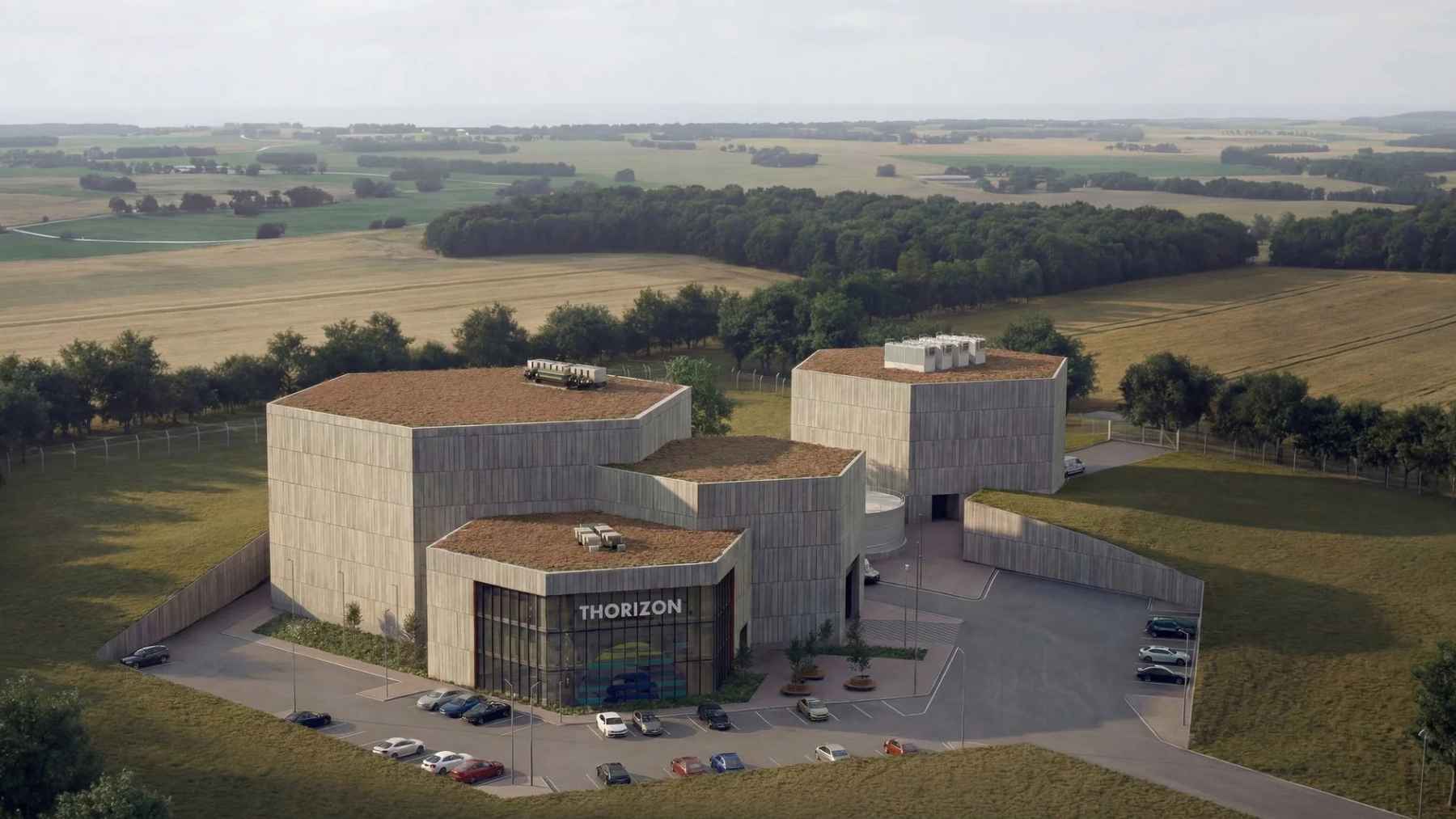
A Dutch company called Thorizon stopped arguing with the salt. Its reactor, Thorizon One, keeps the core inside a set of sealed cartridges that get pulled out and replaced every five to ten years. The metal only has to survive that long, which means the engineers can reach for materials already qualified in existing reactors instead of inventing a new one and spending a decade proving it.
On July 16 the Dutch government put money behind finding out whether that actually holds. Thorizon, along with VDL Groep, NRG PALLAS, TU Delft and TNO, was awarded a 4 million euro grant under MOOI Kernenergie, the first national subsidy scheme the Netherlands has ever aimed specifically at nuclear research.
Over three years, that money buys two things: the first full-scale non-nuclear prototype of a cartridge, and corrosion testing of the materials in molten salt at up to 650 degrees Celsius, which is 1,202 Fahrenheit. “Europe needs abundant, clean energy to strengthen its competitiveness and strategic autonomy,” said Kiki Lauwers, chief executive of Thorizon, in the announcement. Underneath the politics, what the grant funds is a metallurgy question.
The core is the part they intend to throw away
Thorizon One is designed to produce 250 megawatts of heat and 100 megawatts of electricity, which the company puts at roughly 250,000 households or a single data center. The fuel is a mix of long-lived elements recovered from reprocessed used nuclear fuel plus thorium, dissolved into molten salt that circulates at close to ordinary air pressure instead of the roughly 150 atmospheres inside a conventional water reactor.
The cartridge is the part nobody else is doing. Rather than one large vessel holding the fuel salt for the life of the plant, the core is split into standardized modules built in a factory, shipped in, installed, and pulled back out on a five to ten year cycle.
Thorizon argues that this handles two separate headaches with one decision. Corrosion stops being a sixty-year problem, because no piece of metal has to last longer than one cartridge. And used fuel handling gets simpler, because the salt leaves the site sealed inside a transportable unit bound for a central reprocessing facility, instead of going through a chemical plant bolted onto the reactor building.
There is a safety claim attached, and it is worth stating carefully. The company says the reactor only makes power while salt is being pumped through the cartridges, so stopping the pump drops the core below criticality on its own. Thorizon describes the design as walk-away safe. No regulator has licensed it yet, and nothing nuclear has been built.
Salt was never the hard part. The container was.
None of this chemistry is new, and the origin is American. Oak Ridge National Laboratory ran its Molten Salt Reactor Experiment from 1965 to 1969 and showed that a reactor could run on liquid salt at high temperature and normal pressure. Then the United States put its money into solid-fuel uranium reactors, the program wound down, and the concept sat mostly untouched for fifty years.
What killed the commercial versions was rarely the physics. It was the plumbing. Fuel salt is a corrosive, intensely radioactive liquid that has to be circulated through pumps, pipes and heat exchangers for decades, and the material science for a sixty-year exposure has never been settled to a regulator’s satisfaction.
Thorizon’s answer is to change the unit of the problem. If the exposed hardware is a consumable with a ten-year ceiling, the qualification burden drops to something existing alloys can plausibly meet. That is a design argument rather than a proven result, and the whole point of the corrosion loops now being funded is to turn one into the other.
The physical work has already started. On June 1, European Climate and Green Growth Commissioner Wopke Hoekstra opened a component test site at the High Tech Campus in Eindhoven, part of a project with VDL Groep and DEMCON that carries an 8 million euro budget, half of it from the province of Noord-Brabant. Everything there gets tested in hot salt with no nuclear fuel anywhere near it.
The fuel is somebody else’s nuclear waste
This is where the design gets genuinely awkward to copy. Thorizon One is not meant to run on freshly enriched uranium. It is meant to run on the long-lived elements separated out of used fuel from conventional reactors, blended with thorium, which is why the company keeps describing its machine as a way of shrinking Europe’s waste pile rather than adding to it.
That only works if somebody reprocesses the used fuel first, and reprocessing is an industry, not a step. France has one. Thorizon lists Orano among its partners. The United States does not have a commercial equivalent, which is the single biggest reason this particular reactor could not simply be lifted and dropped into Ohio.
Washington has been trying to close that gap. In February the Energy Department’s Office of Nuclear Energy awarded more than $19 million to five American companies working on used fuel recycling: Alpha Nur, Curio, Flibe Energy, Oklo and Shine Technologies. Projects run up to three years and each recipient has to put in at least 20 percent of the cost.
The department’s own framing is blunt about what is being left on the table. Less than five percent of the energy in American nuclear fuel gets extracted before the fuel is pulled and stored, and DOE estimates recycling could lift resource use by 95 percent while cutting waste volume by 90 percent.
“Used nuclear fuel is an incredible untapped resource in the United States,” said Ted Garrish, assistant secretary for nuclear energy. Nobody in the US is doing it commercially yet.
The material is not hypothetical. Something on the order of 95,000 metric tons of used commercial fuel is sitting in pools and dry casks at reactor sites across the country, per the Energy Department’s own inventory, with no permanent repository to send it to and no commercial route to burn it again.
America is building molten salt reactors, and neither one works like this
Two US projects get lumped into the same category as Thorizon and they are not the same machine. Kairos Power’s Hermes 2 in Oak Ridge, the first molten salt reactor cleared for construction in America, uses solid fuel pebbles sitting in a bath of salt. The salt is coolant only. Pull the fuel out and you are holding an object.
Natura Resources is going the other way with MSR-1, a liquid-fueled reactor going into a science building in Abilene, Texas, where the uranium is dissolved into the salt and fuel and coolant are the same fluid. That is closer to Thorizon, minus the cartridge, minus the waste-derived fuel, and minus the thorium.
And the only thorium-loaded molten salt reactor actually operating anywhere is a 2-megawatt Chinese experiment on the edge of the Gobi Desert, which is a research machine rather than a power plant. Four projects, four different bets, and the disagreement is mostly about what you do with the salt when it stops being useful.
There is no steel in the ground yet
The Dutch roadmap looks solid on paper and it is worth reading for what it actually commits to. On April 17, eight parties signed a memorandum of understanding covering the whole program: Thorizon, utility EPZ, research organization NRG PALLAS, the provinces of Zeeland and Noord-Holland, regional agencies Impuls Zeeland and ROM InWest, and state investor Invest-NL.
A memorandum is not a construction contract. EPZ has agreed to investigate becoming owner, licensee and operator of the commercial reactor. NRG PALLAS has stated its intention to host and operate the nuclear demonstrator at Petten, on a site that already holds a research license, which is the cleverest part of the schedule and the reason the timeline looks as short as it does.
Borssele is the obvious place to put it. The site has run the country’s only commercial nuclear plant since 1973, a pressurized water reactor of about 485 megawatts, and EPZ has spent five decades learning the permitting ground there. “EPZ has operated the Borssele site for over 50 years,” chief executive Marco Muilenburg said when the agreement was signed.
Then there is the money, and the money is the honest weak spot. Building the commercial reactor alone is expected to cost more than half a billion euros, and the parties to the agreement put cumulative investment across the full roadmap at over a billion.
Thorizon said in March 2025 that it had raised 42.5 million euros in total. The plan is to close the rest with European Investment Bank financing, EU support under the IPCEI framework, and new strategic investors, none of which is signed.
This is also a company of roughly 50 engineers split between Amsterdam and Lyon, spun out of the Dutch nuclear research institute in 2018, that has never operated a reactor. Its own website says construction starts in the early 2030s, which is a slightly softer way of saying the same thing the roadmap says.
What makes the cartridge worth watching is not the 2034 date, because 2034 dates in nuclear have a poor record. It is the sequencing.
If the corrosion data comes back badly, Thorizon finds out in a lab in Eindhoven for 4 million euros rather than inside a licensed nuclear building for half a billion. Turning the core of a reactor into a serviceable part is a strange idea, and it is a very cheap idea to be wrong about.