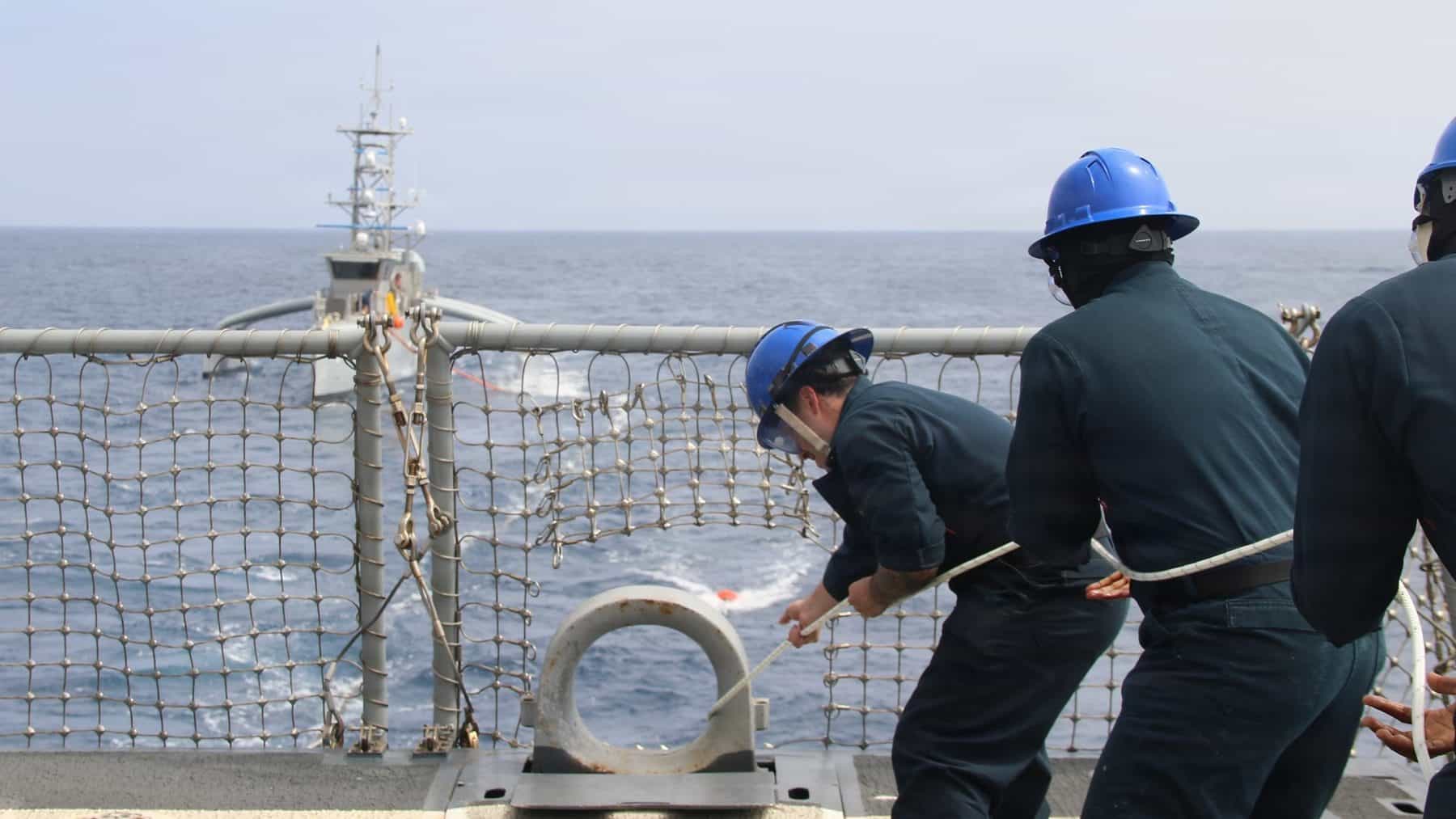

- 2 MONTHS AGO · MILITARYA 38-foot drone boat that once spent 192 hours alone at sea came up behind a float towed by a Navy ship off Virginia, pushed a fuel probe into it, took on 400 gallons over dozens of hookups and let go each time, and somebody was steering the probe on every one
- 1 MONTH AGO · MILITARYAn 85-ton American patrol boat ran at the head of a pack of drone boats in Michigan, sent drone aircraft up and took one back aboard while still moving, on a hull that draws less than 5 feet of water and tops 40 mph on two waterjets
- 1 MONTH AGO · MILITARYA 145-ton drone ship with nobody aboard is crossing the Pacific with a 1,092-foot aircraft carrier headed to relieve the one backing operations against Iran, the first strike group ever to sail with a crewless escort, and it has to keep pace for months without a mechanic
- 1 MONTH AGO · MILITARYAn 18,750-ton submarine, the biggest America ever built, came home for the last time after firing in the strikes on Iran, and the week she tied up the Navy signed for nine attack submarines that haul 40 cruise missiles apiece, four of them to match the 154 she carried alone
- TODAY · THIS ARTICLEA 145-ton drone trimaran sailing with an aircraft carrier took fuel over a destroyer’s stern with sailors climbing aboard to hook up the hose, because no ship in the strike group can lift it, and the Navy has to top it up at sea for the rest of the cruise
Most people have seen the standard Navy refueling photo at some point. Or maybe I’m just a dork. But two gray ships steaming side by side at matched speed, maybe 150 feet of water between them, with hoses strung across on cables while sailors in helmets haul on lines.
That’s how a destroyer gets its diesel from an oiler, and it’s been the routine for about a century.
The Seahawk can’t do any of that. Nobody’s on board to catch a line, and at 135 feet it’s a lot of boat to put alongside a 505-foot destroyer with no one steering it from a bridge.
So on September 11, somewhere in the Pacific, the Navy tried it the other way around. The destroyer USS Chafee ran a fuel hose off its flight deck, the Seahawk tucked in behind it, and sailors climbed onto the drone to hook it up, according to Navy photos released on September 22 and reported by USNI News.
Why go to all that trouble for a prototype? Because this particular prototype is now sailing with an aircraft carrier. And a carrier group doesn’t turn around so the little guy can go home for gas.
So why can’t they just hoist it aboard?
Plenty of Navy drones get stowed and craned. The small boats, the underwater vehicles, anything that fits in a well deck or hangs off a davit. The Seahawk is in a different size category altogether.
The Navy’s own fact file lists Sea Hunter and Seahawk at about 135 feet and 142.3 metric tons at full load, and Leidos, which built it, puts the loaded displacement at 145 long tons. That’s roughly 325,000 pounds of composite trimaran.
(A trimaran, if you haven’t been around one, is a long, narrow main hull with a slim float on each side to keep it from rolling over. That hull shape lets a boat this skinny cross an ocean.)
No ship in the strike group has a crane or a deck for that. Maritime Executive called this the first time a deployed carrier group has sailed with an unmanned vessel too large to stow on a ship, and I’d say that’s the more interesting “first” here.
A drone that lives on its own hull has to be treated like an escort: fueled at sea, kept in formation, and babysat. Which is where the Chafee comes in.
A hose over the back of a destroyer
The pictures show the fuel line coming off the Chafee’s amidships refueling station, running aft along the ship to the flight deck, and then dropping over the stern to the Seahawk trailing behind. USNI News noted the line was tied off with ropes and cushioned with pads along the way, which sounds improvised because it basically is.
Astern refueling is an old technique for feeding a boat that can’t safely hold position alongside a bigger ship, and it’s about the simplest option when the smaller boat has no crew to handle the normal gear.
There is a catch, however. Both times the Navy has done this in 2026, sailors had to board the Seahawk to make the connection. So the “unmanned” vessel takes on fuel the way a manned one does, with people on its deck, at least for a while.
DARPA flagged exactly this problem in a 2024 note: putting people on a drone, even briefly, means designing the boat around their safety, and moving them across in rough seas or high winds is risky. DARPA’s answer is a separate program called NOMARS, which demonstrated a no-sailor fueling rig off California in 2025.
The Seahawk doesn’t have it. The Navy hasn’t said how many sailors went across on September 11, how long the two ships held formation, or how much fuel moved; it released photos, not numbers.
Seahawk is the prototype, not the production boat
If you’ve been following the Navy’s drone-boat plans, you may be picturing the 30 medium drone ships the service ordered in late September from HII, Saronic and Galliano Marine Services. The Seahawk isn’t one of them.
It’s an older animal: the second of two trimarans Leidos built for DARPA and the Office of Naval Research, under a $35.5 million contract awarded in December 2017, and delivered to the Navy in April 2021. Its older sister, Sea Hunter, ran 2,000 nautical miles from Pearl Harbor to San Diego on its own after RIMPAC this summer.
As delivered, the Seahawk was unarmed. Its job was surveillance and towing a sonar to listen for submarines, per Maritime Executive.
Leidos says the boat’s mechanical and electrical systems were set up to run for months without maintenance or a crew, and the company’s September 8 release lists what its autonomy software is supposed to do: avoid collisions under the international rules of the road, steer around designated keep-out zones, switch to backup comms if the main link drops, and hold a waypoint course with the GPS switched off. T
hose are Leidos’s claims about Leidos’s software, so I’d read them as a spec sheet rather than a test report.
Two diesels and 14,000 gallons of fuel. That’s what gives it ocean-crossing range in the first place, and it’s also the reason this story exists: a carrier deployment runs the better part of a year, and no tank runs that long.
The April dress rehearsal
The Chafee wasn’t the first ship to try this. Back in April, off Southern California, the oiler USNS Guadalupe did the same astern transfer with the Seahawk during the Roosevelt group’s final workup, and Military Sealift Command called the demonstration “critical to deployed operations of MUSVs in conjunction with a carrier strike group.”
Capt. Garrett Miller, who commands Surface Development Group One, was blunter at that month’s Sea-Air-Space show. The boat has to keep up with the strike group. “It can’t be an anchor,” he said according to Naval News.
So April proved an oiler could do it, and September proved a destroyer could too. That second one arguably matters more.
An oiler isn’t always around, while destroyers are the ships that’ll be sitting next to the Seahawk every day of the cruise. We covered the deployment itself when the Navy confirmed it in mid-October.
It left eleven days after the carrier
Now for the bit the Navy didn’t exactly advertise. The Roosevelt left San Diego on September 27 with no families on the pier and no announcement, and the Seahawk wasn’t with it.
TWZ reported the drone was still tied up on September 30. According to AIS tracking published by TWZ, it slipped out of Point Loma on October 8, stopped in Hawaii for a couple of days, and pushed on westward on October 16, the same day the carrier pulled into Yokosuka, Japan.
That October 8 date does clarify something. When Acting Navy Secretary Hung Cao told an Army conference on October 14 that the strike group had just deployed on October 8 with a medium-sized unmanned surface vessel, the carrier had already been at sea for more than two weeks.
He was apparently giving the drone’s sailing date, not the carrier’s. Cao called the boat a force multiplier and added, “Imagine having more guns out there,” a fun line for a vessel delivered with no guns at all.
Whether it carries any now is one of the things the Navy hasn’t disclosed.
I also can’t tell you whether the Seahawk is physically with the Roosevelt right now or still running its own leg across the Pacific. TWZ described it as “disaggregated” on October 17, which is Navy-speak for assigned to the group but not in sight of it. For a boat that has to be fueled by one of the group’s own ships, that gap can’t last forever.
We do know where the carrier is, at least. USNI News’ fleet tracker for October 26 has the Roosevelt in the Philippine Sea, in the Keen Sword 27 exercise with Japan, and still lists the strike group as deployed with the Seahawk.
 A 17,500-ton British nuclear missile submarine just came home to its Scottish base after an estimated 217 days hidden underwater, about 12 days longer than any Royal Navy patrol before it, and the Ministry of Defense will not confirm how long the boat was at seaMilitary · 1 day ago
 A 100,000-ton nuclear carrier left her Pacific home port for the last time, rounded South America and tied up in Virginia to be retired, and she is still in commission and landing jets months later because her replacement is late, with her reactors to be emptied once she retires in MarchMilitary · 4 days ago
 A 27,000-ton battleship that once had 45 pumps taking thousands of tons of water out of her hull is having a 32,000-square-foot wood deck finished at a Texas yard she has occupied since 2022, and she’ll move about a mile to a pier where officials hope to open her by the end of 2027Military · 4 days ago