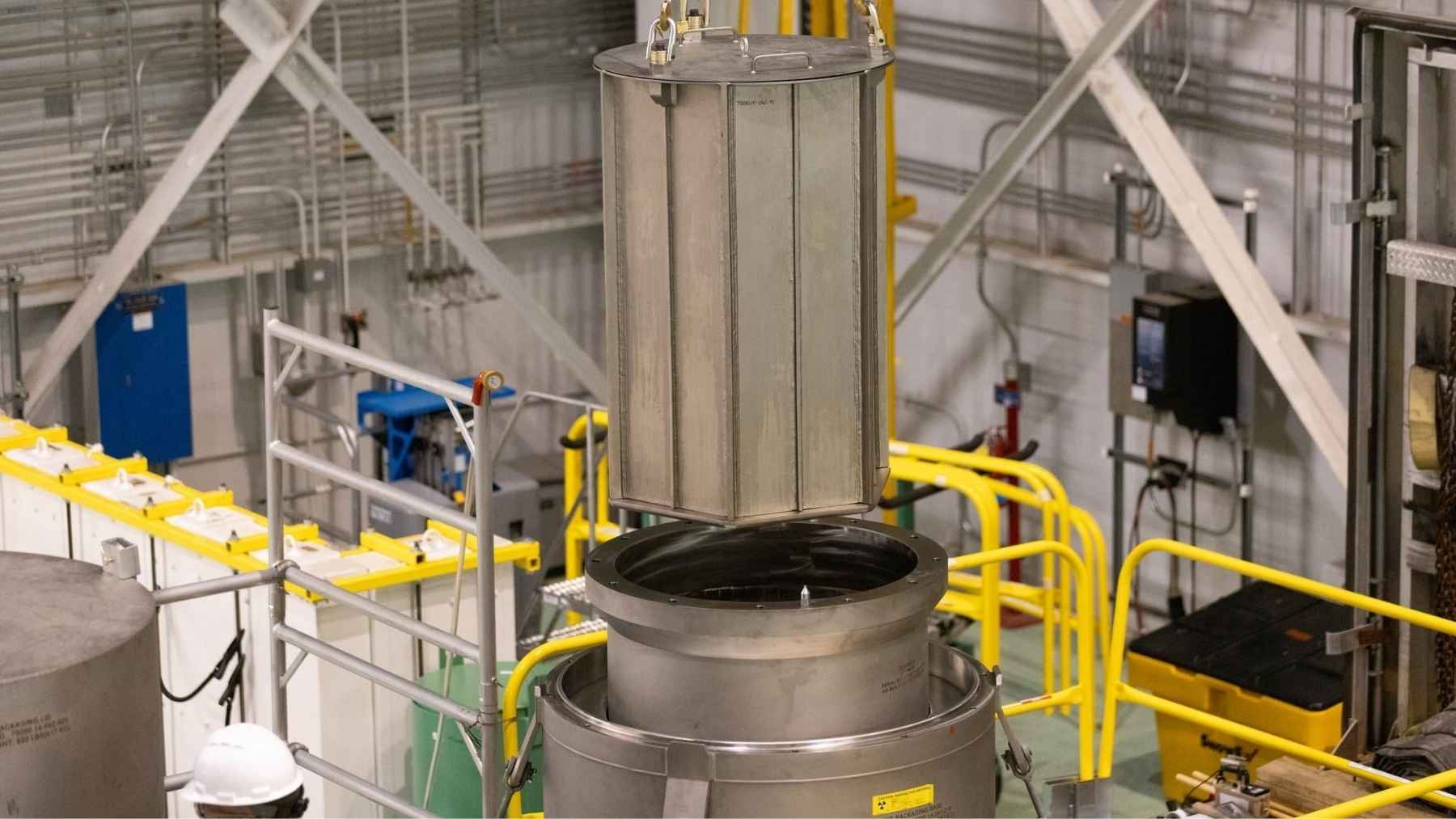

Most of America’s nuclear news this year has arrived with something dramatic bolted to it. A startup’s reactor flew to Utah in the hold of an Air Force C-17 and later went critical in a small town out in Emery County. Three different microreactor designs hit criticality inside a single month, one of them with a core its founder hauled to Idaho in the bed of a Ford F-150.
The reactor the Pentagon actually ordered has been doing none of that. It has been sitting inside a building in Lynchburg, Virginia, getting its core stacked, one piece at a time, for the better part of a year.
That job is finished. BWXT’s public project timeline for Project Pele lists core stacking as complete in June. Next comes a truck ride to Idaho, which for a machine whose entire selling point is that it can be moved, is a bigger deal than it sounds.
Four 20-foot boxes, 1.5 megawatts, and no water doing the cooling
Pele is a transportable nuclear power system built by BWXT for the Department of War’s Strategic Capabilities Office. BWXT says it generates at least 1.5 megawatts of electricity, and the Department of Energy has described the program’s design range as 1 to 5 MWe.
It’s a Generation IV high-temperature gas-cooled reactor, which is the part worth slowing down on. Gas does the cooling, not water. There’s no big water loop to lose, and no cooling pond to dig, which is most of the reason a reactor like this can be packed into steel boxes at all.
The reactor itself fits inside one standard 20-foot shipping container. Add the power conversion, controls and thermal systems and you’re at four of them, each the same eight-foot-wide box that already rides on every truck chassis, rail flat and cargo deck on the planet. BWXT designed the whole stack to survive shock and vibration limits for transport by truck, train or airplane.
The early public spec was heavier than the containers make it sound. Defense News, summarizing the Pentagon’s 2022 outline, described a 40-ton reactor spread across three to four 20-foot containers, running one to five megawatts for up to three years before it needs refueling. Nobody is claiming you throw this in a pickup.
Pele stands for something, and the acronym is the entire pitch
The name reads like a soccer reference and isn’t. Defense News reports the program is named for the Hawaiian goddess of fire and volcanoes, and that the letters also stand for Portable Energy for Lasting Effects.
Which is a slightly grand way of describing a fuel truck problem. Bases in remote places run on diesel, and diesel arrives in convoys that have to be scheduled, guarded and paid for, at prices that get ugly the further out you go.
BWXT’s pitch is that one Pele system offsets up to 1.5 million gallons of diesel and eliminates hundreds of fuel truck deliveries a year. The Pentagon found that argument convincing enough to hand over an initial contract worth about $300 million in June 2022, per Defense News.
Worth being straight about what that buys. Pele is a demonstration, not a fielded capability. There is no Army base with one of these parked out back, and the program has never promised one before the prototype gets tested in Idaho.
The fuel beat the reactor to Idaho by more than a year
On November 5, 2025, BWXT shipped 40,000 TRISO fuel compacts from Lynchburg to the Transient Reactor Test Facility at Idaho National Laboratory, as POWER magazine reported. That’s the full initial core load, sitting in Idaho, waiting on a reactor that is still in Virginia.
TRISO is the fuel that keeps showing up in every one of these stories. A kernel of uranium, carbon and oxygen about the size of a poppy seed gets wrapped in ceramic layers including silicon carbide, and thousands of those particles get pressed into a single compact. Idaho National Laboratory describes those layers as what makes the fuel hold up under heat, radiation and corrosion.
It’s the same basic idea a Tennessee plant is now building 700,000 uranium spheres a year around, in a different shape. Compacts for Pele, billiard balls for pebble-bed reactors, identical particle underneath.
Dr. Jeff Waksman, principal deputy assistant secretary of the Army for installations, energy and environment, called it “real nuclear microreactor fuel delivered at its final destination” rather than a promise to make some later. Which is a fairly pointed thing to say in an industry with a lot of renderings in it.
Losing the race to criticality was never the point
Here’s the awkward part of the timeline. BWXT won a contract in June 2022 that was announced as building the first advanced microreactor in the United States, and then three other American microreactors went critical in June 2026 while Pele was still on the shop floor.
One of them ran on BWXT’s own work. BWXT says Antares Nuclear modeled its fuel on the TRISO compacts built for Pele, and Antares hit the first fueled criticality under the Energy Department’s reactor pilot program on June 4.
The two milestones are not the same thing, though, and the difference is the whole reason Pele has taken this long. Those June events were zero-power criticality tests: the core sustains a chain reaction, physics confirmed, no meaningful electricity produced.
BWXT describes its own mission as building a completely integrated and functioning reactor prototype rather than a physics test or a minimally viable product for low-power testing. Pele is supposed to make usable power on a real electrical grid, for years, after being trucked somewhere. That is a slower thing to build, and a harder thing to fake.
The 2028 deadline belongs to the Army, not just to BWXT
Executive Order 14299, signed in May 2025, directs the Department of War to have an Army-regulated nuclear reactor operating at a domestic military installation no later than September 30, 2028. BWXT states on its own site that Pele will be the first fully tested advanced microreactor power system to power Army equipment and meet that deadline.
Behind Pele sits the Army’s Janus program, which is the part meant to scale. Waksman has publicly cast Pele as the technical jump and Janus as what comes after it, buying commercial microreactors for bases that can’t afford to lose grid power. The Army named nine candidate installations for those reactors in November 2025.
So Pele carries weight beyond its own containers. It is the machine that has to prove a transportable, gas-cooled, TRISO-fueled plant survives being built, moved and switched on before anyone signs for a fleet of them. China, for its part, has claimed a 10-megawatt reactor on the back of a truck, though every figure attached to it so far comes from the developer.
The truck ride to Idaho is the next thing that has to happen
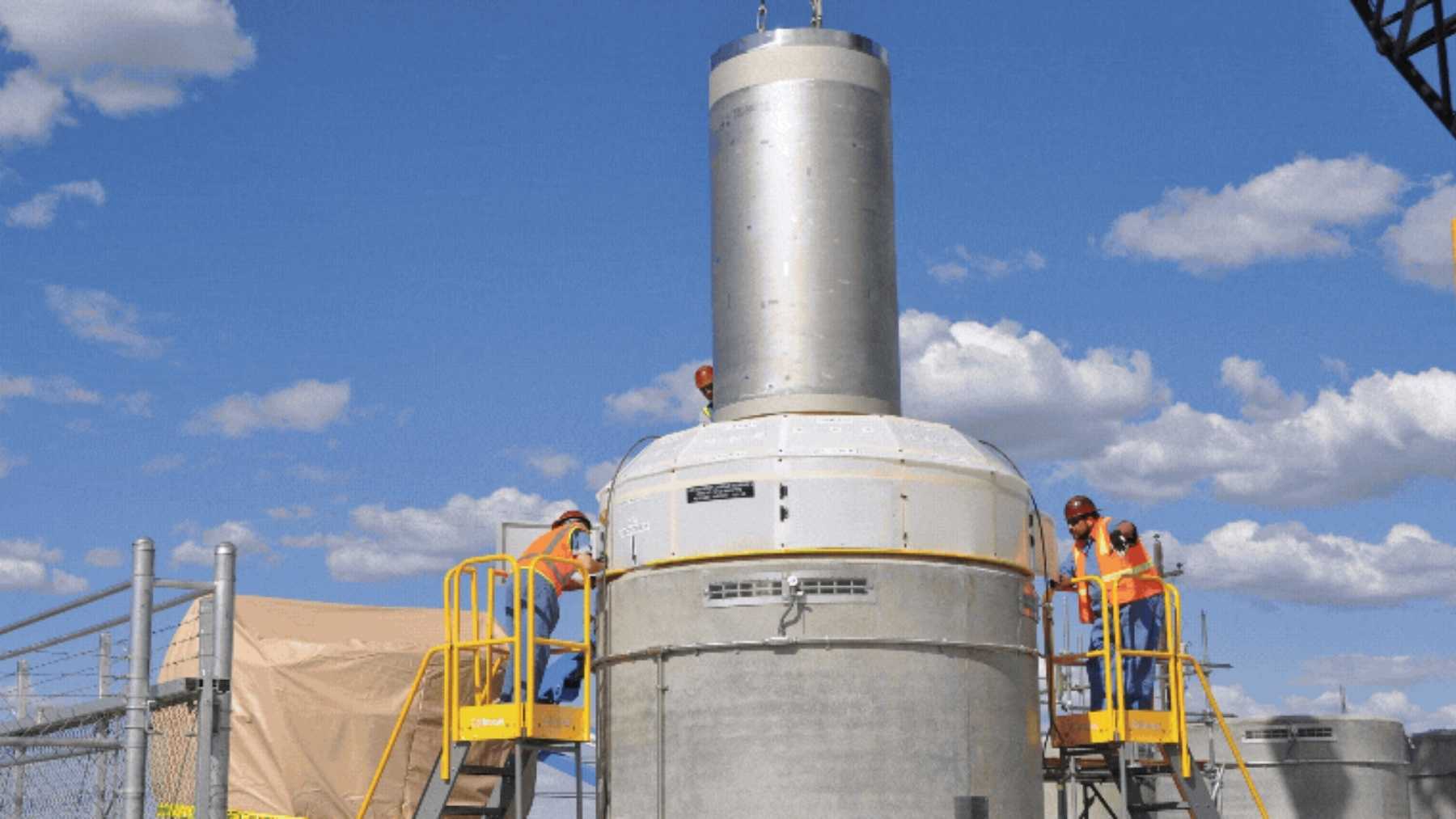
What’s left is unglamorous and specific. The reactor ships from BWXT’s Lynchburg facilities to Idaho National Laboratory. It gets fueled at the TREAT facility, moved to a pad at the lab’s Critical Infrastructure Test Range Complex, set inside a concrete shield structure, and wired into INL’s test microgrid.
Formal system testing is planned to begin as early as 2027, with electricity expected in 2028. Site construction in Idaho started back in September 2025, so the pad is not the thing anyone is waiting on.
None of the remaining schedule is guaranteed. The 2022 contract called for the prototype to be completed and delivered to Idaho in 2024, and BWXT’s own timeline still lists that shipment as something that will happen rather than something that has. Roughly par for first-of-a-kind nuclear hardware, and still worth saying out loud.
But the next visible milestone for the Pentagon’s transportable reactor is a truck pulling out of a parking lot in Virginia with four steel boxes on it. For a machine sold entirely on the promise that it travels, that’s a pretty fair place to be judged.