
When you picture a nuclear reactor, you probably picture the big stuff. Concrete domes, steam drifting off cooling towers, a fence you’re not supposed to get anywhere near. We’ve covered plenty of that lately, from the fuel bundle that tipped over inside the Palisades core to the safety battery that quietly died at a Michigan plant. But the most powerful reactor on any American campus doesn’t look like any of that.
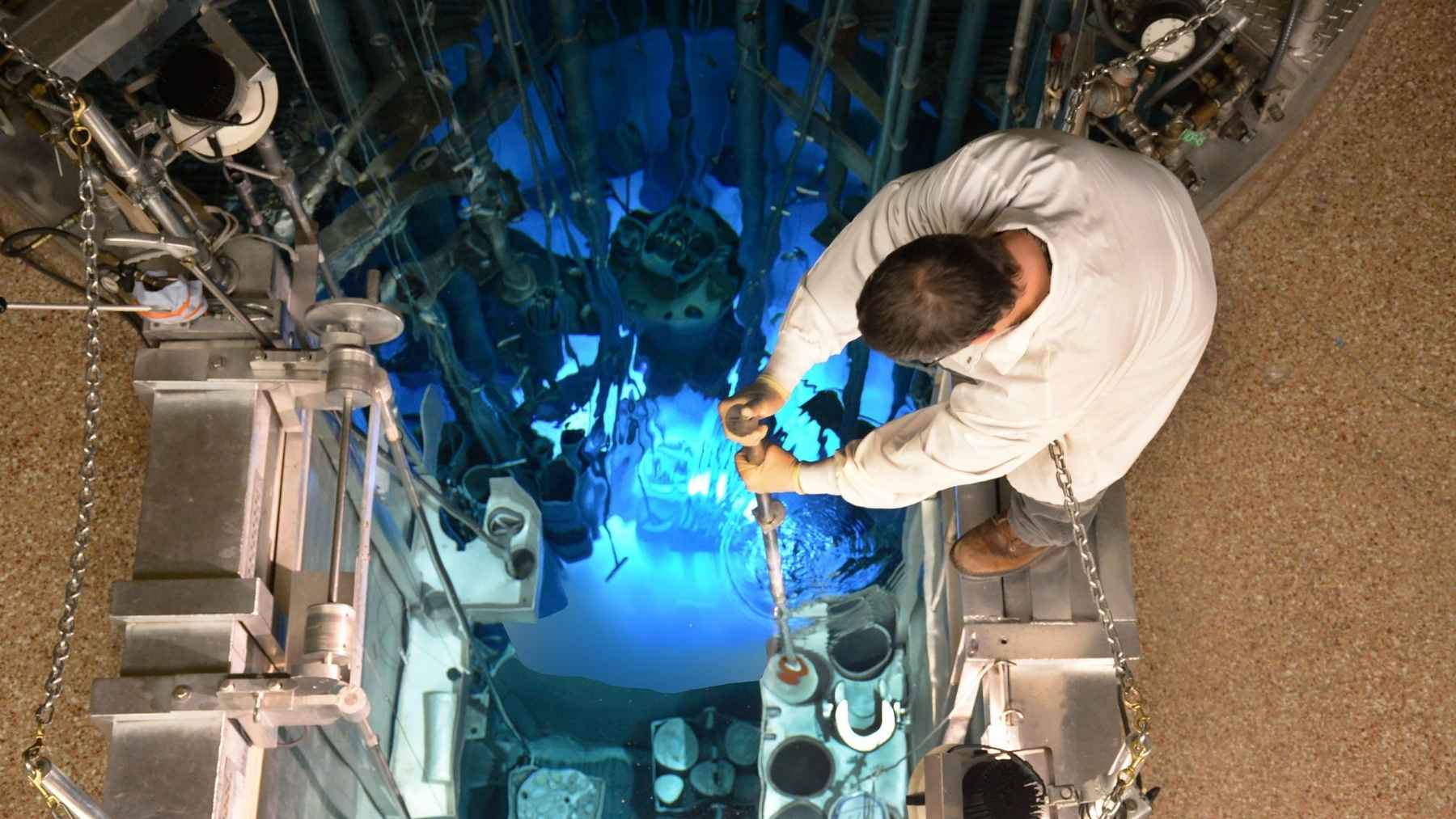
It sits at the bottom of a pool of water 30 feet deep and about 10 feet across, in a building at the University of Missouri in Columbia, glowing blue. And if someone you know has been treated for thyroid, liver or prostate cancer, there’s a decent chance this pool was involved.
So what exactly is down there?
The University of Missouri Research Reactor, which everyone calls MURR, is licensed to run at 10 megawatts of thermal power. Its eight fuel elements sit inside a pressure vessel, and that vessel’s parked inside the aluminum-lined pool. The water isn’t decoration. It’s the shielding. Put enough water between you and a running core and the room above the pool is just a room, which is a big part of why pool reactors are what universities build.
The blue glow is real, by the way. Charged particles coming off the core move through the water faster than light does (light slows down in water, the particles don’t care), and the water responds by glowing blue. Physicists call it Cherenkov radiation. It’s frankly one of the better light shows science has to offer, and this pool produces it six and a half days a week.
The spec sheet reads like it belongs to something much bigger. Each liter of the core puts out 303 kilowatts, and I did the division so you don’t have to: at that density, 10 megawatts works out to a core of about 33 liters, or roughly 9 gallons. Your water heater holds 40 or 50 gallons and runs on about 4.5 kilowatts. This one’s a fifth the size, putting out 10 megawatts.
Here’s where it gets strange. The cooling water leaves the core at 136°F, and a cup of diner coffee runs hotter than that. The primary loop operates at 80 psia, and that “a” matters: it’s pounds per square inch absolute, which counts the atmosphere pressing down on all of us. On the gauge you’d use on your tires, it would read about 65 psi, or roughly double a car tire.
A schedule no power plant would touch
A utility reactor runs flat out for a year and a half or two, then shuts down for weeks to swap fuel. MURR flips that. It runs six and a half days a week, 52 weeks a year, around the clock, with NRC-licensed operators in the control room the whole time. The university says no other research reactor on Earth holds that schedule year-round.
So why would anyone run a campus reactor like a factory shift?
Because the product it makes spoils faster than milk. MURR’s neutrons turn ordinary materials into medical radioisotopes, and a radioisotope is basically a version of an element that’s unstable on purpose. It sheds energy on a fixed clock, and for the medical ones it’s a short clock. Some lose half their punch in a matter of days. You can’t warehouse them. You make them, you ship them, a hospital uses them, and then you make more. A reactor that takes long breaks is a reactor whose customers’ treatments get canceled, so this one essentially never takes a long break.
The university calls itself the only American producer of four isotopes that go into treating cancers of the liver, thyroid, pancreas and prostate, and says radioisotopes from this pool treated 500,000 cancer patients last year. Those are the school’s own figures, but the supply-chain part checks out from the outside too: in March, the Department of Energy announced an agreement making MURR the only domestic supplier of gadolinium-153, an isotope used in medical imaging. It also helps that Missouri sits in the middle of the country, since a package losing potency by the hour appreciates a short flight.
It started on a polo field, at half the power
The origin story is very 1950s. The university started studying the idea in 1955, the state legislature funded it, and construction ran from 1963 to 1966 on a former polo field, on $3.4 million in state money. MURR went critical on Oct. 13, 1966, licensed at 5 megawatts. The bump to 10 megawatts came in 1974, and the machine has pretty much just kept going ever since, through a 20-year license renewal in 2017.
It’s not frozen in 1966, to be fair. The fuel is still highly enriched uranium, and the reactor’s own spec sheet lists a feasibility study on converting to low-enriched fuel as “in process”. There’s also a bigger sibling on paper: NextGen MURR, a planned 20-megawatt reactor the university wants to build at Discovery Ridge in south Columbia. That one’s in design and licensing, with Burns & McDonnell signed on in March to help carry it toward a construction permit application, and the university broke ground on a separate Radioisotope Science Center at the same site on May 13. To be blunt about it, none of that treats a patient yet, and I couldn’t find a public construction start date for the new reactor anywhere. The machine doing the work today is still the 1966 pool.
I get the appeal of the new one. Twice the power, modern fuel, purpose-built for isotopes. But there’s something arguably more impressive about a 9-gallon core in a 30-foot pool carrying that much of America’s nuclear medicine on a machine older than the moon landing.
MURR first went critical at 6:14 p.m. on Oct. 13, 1966. On Oct. 13 of this year, the reactor in the pool turns 60, still running six and a half days a week.