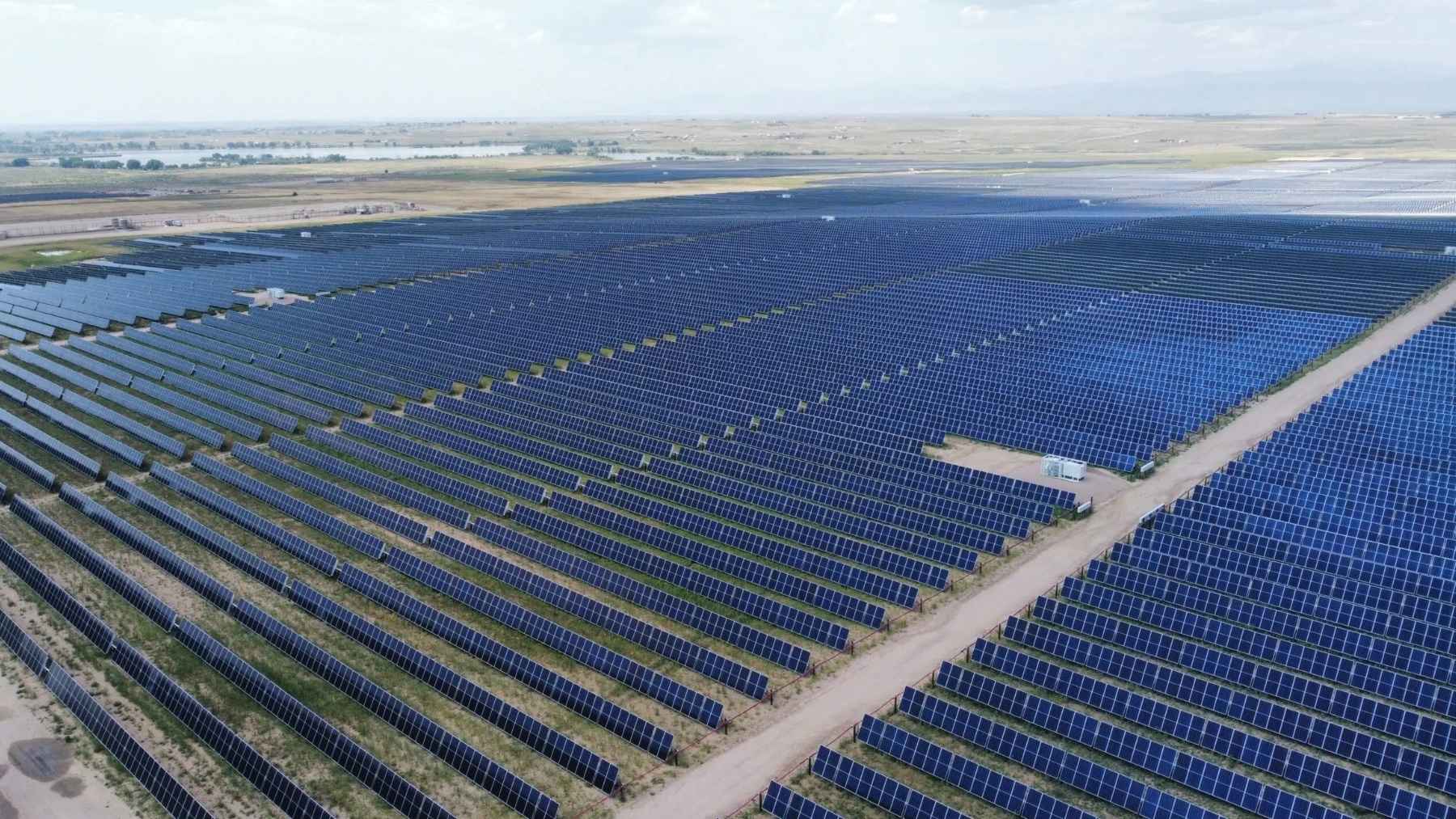

Solar panels stop making electricity when the sun goes down, and that’s right about when a lot of people get home, switch on the TV and crank up the air conditioning.
So the solar farm that’s just started going up in Arizona’s Mohave County is getting its own batteries. And I mean a lot of them. ContourGlobal, the London-based power producer building it, says Project Sterling will have more than 760,000 solar panels and more than 300 battery containers. Tesla’s already signed up to buy about 90% of what it makes.
Sterling’s site is just off old Route 66, on the stretch that runs between Topock and Kingman, and a new 5.2-mile road called Polaris Road is going in to connect the two. Lake Havasu City, the Arizona town that famously bought London Bridge, is about 20 miles to the south, so a London company setting up shop out there feels about right.
The whole project takes up more than 2,000 acres of the Mojave Desert. (Yes, the county spells it Mohave and the desert spells it Mojave. You get used to it.) For comparison, Sterling’s more than 760,000 panels would top the 700,000 that we wrote about sitting on an old Soviet firing range in Germany. Solar’s turned up in odder spots around Arizona, like over an irrigation canal south of Phoenix, but Sterling’s the classic version, with a whole lot of panels spread across open desert.
Figures: ContourGlobal.
Tesla is buying about 1 terawatt-hour a year
Tesla’s deal is a power purchase agreement, which ContourGlobal announced back in July. A power purchase agreement is basically a long-term contract to buy a plant’s electricity at a price agreed up front. It lets a company like Tesla line up a lot of clean power without having to build or run the plant itself.
Under the deal, Tesla gets about 1 terawatt-hour a year, which ContourGlobal says is around 90% of what Sterling will produce. A terawatt-hour is a billion kilowatt-hours, and the kilowatt-hour is the unit on your power bill. Tesla also gets the renewable energy certificates that come with that power, which are basically the receipts that let a company count the electricity as clean.
So where’s all that power going?
Sterling plugs into lines run by the Western Area Power Administration, the federal agency that sells the power from Hoover Dam, among other things. It also has firm rights to send power over the lines into California, and it’ll be pseudo-tied to California’s grid. A pseudo-tie basically lets a plant that’s physically in one grid operator’s territory act like part of another’s, so California’s grid operator can treat Sterling as one of its own plants. Trade publication pv magazine reported in July that the power’s meant for Tesla’s California operations.
ContourGlobal hasn’t said which Tesla sites will use it, what Tesla’s paying or how many years the contract runs, and I couldn’t find anything from Tesla on it. I wouldn’t hold my breath for a price, either, since companies tend to keep those numbers to themselves.
Antonio Cammisecra, ContourGlobal’s president and CEO, said in the company’s groundbreaking announcement that “our teams engineered the project around the specific needs of our customer.” ContourGlobal bought Sterling while it was still in development and reworked it around what Tesla needed, so it’s basically a made-to-order power plant.
So how does a solar farm run for 16 hours a day?
Cammisecra also says Sterling will be able to deliver power for as many as 16 hours a day. Basically, the panels handle the daylight and the batteries handle the evening.
Sterling’s battery system is rated at 360 megawatts and 1.4 gigawatt-hours. If you’re wondering why a battery needs two ratings, think of megawatts as horsepower and gigawatt-hours as the size of the gas tank. One tells you how hard the battery can push, and the other tells you how long it can keep that up. Sterling’s batteries can run flat out for about four hours.
Add a long day of sunshine to about four hours of battery and you can see how the company gets to 16. I’d guess 16 is a best-case number, though, since a December day in the Mojave is a lot shorter than a June one.
The batteries themselves are lithium iron phosphate, or LFP, with liquid cooling and built-in fire protection. LFP cells hold a little less energy than the nickel-heavy ones in a lot of EVs. They’re a lot less likely to catch fire, though, which you’d probably want if you’re parking more than 300 containers of them in the desert. As far as I can tell, neither of ContourGlobal’s announcements names a battery supplier. Tesla, the customer here, sells its own shipping-container-sized Megapack batteries to power companies, so I’m pretty curious whose cells end up inside.
Sterling is a 509-megawatt plant, or a 450-megawatt one
You’ll see Sterling described both ways. They’re both right. Solar panels make direct current, and 509 megawatts is what Sterling’s panels are rated for. The 450 is what the plant can actually send to the grid once inverters turn that into alternating current, the kind that comes out of your wall outlet.
The panel maker doesn’t seem to have been named either, so I can’t tell you how big each panel is. Divide 509 megawatts by 760,000 panels, though, and each one works out to somewhere around 670 watts.
The paperwork says construction started last year
ContourGlobal’s July announcement had one line that’s easy to skim past. It said work on Sterling had already started last year, through “off-site physical work of significant nature” that included buying major equipment.
I doubt that wording was an accident. The IRS uses almost the same phrase, “physical work of a significant nature,” as its test for when a solar project has officially started construction. For a plant that won’t be finished until 2028, that start date decides whether it can still claim the federal tax credits for wind and solar that Congress started phasing out last year. I couldn’t find anything from ContourGlobal on whether Sterling is claiming them.
If you’re planning a Route 66 road trip, the stretch between Topock and Kingman will probably be a little busier than usual for a while. ContourGlobal expects an average of about 400 people working on Sterling during construction, and it’s aiming to have the plant up and running in 2028.