
Getting a new power line built in America usually means a decade of lawsuits, town halls and redrawn maps before anyone pours concrete. Overhead towers are the classic fight: everybody wants the electricity, nobody wants the view.
New York just sidestepped the whole argument by hiding the line. On June 16, Governor Kathy Hochul cut the ribbon on the Champlain Hudson Power Express, a 339-mile transmission link running from the Canadian border to Astoria, Queens, without touching a single pylon. It is buried the entire way, under Lake Champlain, under the Hudson, under roads and railbeds.
The line can move up to 1,250 megawatts of Hydro-Québec hydropower into the city. That covers up to 20% of New York City’s electricity, more than a million homes, and the governor’s office ranks it among the largest transmission projects the state has attempted in 50 years. The state also calls it the longest fully buried transmission line in North America. You could stand right on top of it and never know.
The whole line is buried, and that was the point
The hardware is two cables about five inches thick, roughly the diameter of a grapefruit, buried around seven feet down where they cross water. Of the 339 miles, 193 are submarine cable laid in Lake Champlain and the Hudson and Harlem rivers, and 146 run underground, tucked mostly into roads and railroad rights-of-way, according to developer Transmission Developers Inc. (TDI).
The route reads like a freight schedule. The cable crosses the border under Lake Champlain, comes ashore near Whitehall, follows rail corridors south, drops into the Hudson near Cementon, climbs out around Stony Point and back in again, then threads the Harlem River to a brand-new converter station in Astoria. Cable-laying barges spent months working Lake Champlain and the Hudson to get it there.
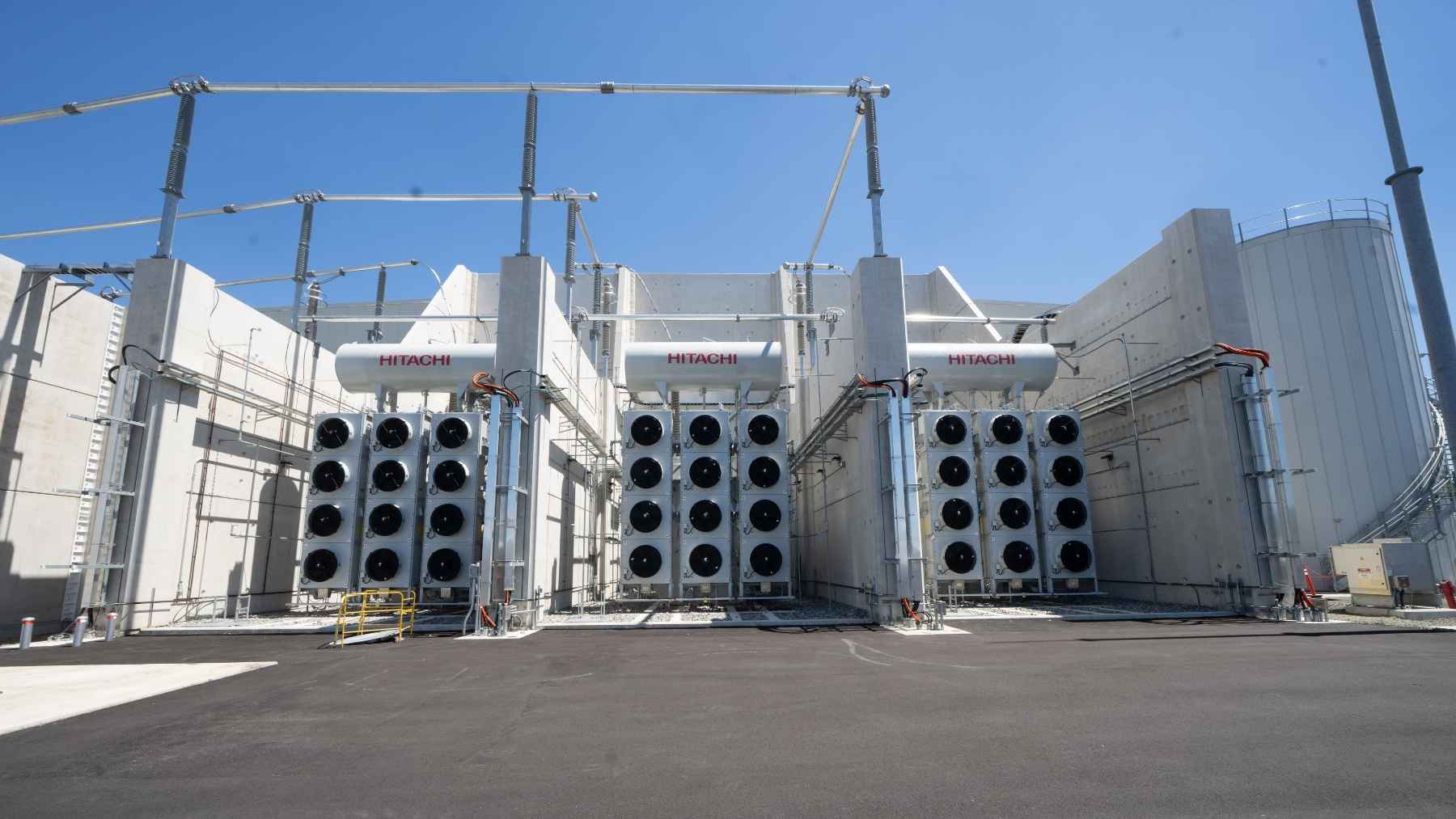
Running it as high-voltage direct current was not optional, either. Direct current is the only practical way to push power through hundreds of miles of buried cable, because long alternating-current cables burn too much of their own capacity just keeping the line charged. Danish cable maker NKT engineered and installed the 400 kV HVDC system on a turnkey contract, Hitachi Energy supplied the converter station, and Kiewit handled the heavy civil work.
Burying it was not an aesthetic whim. The state says the design was chosen to boost long-term reliability and keep community impact low, and buried lines shrug off the storms, ice and visual-impact battles that kill overhead projects. In New York transmission politics, that is half the fight won before it starts.
It switched on early, and New York stress-tested it immediately
CHPE reached commercial operation shortly after midnight on May 13, weeks ahead of its early-June target, per trade outlet HVDC World. Hydro-Québec’s 25-year supply contract with New York State then kicked in on June 1, and the ribbon-cutting followed on June 16.
The grid did not wait for the ceremony. NYSERDA President Doreen Harris said the line was already delivering power to New York City during a June heatwave that pushed temperatures across the state past 90 degrees. Hydro-Québec’s Peter Rose had flagged exactly that scenario back in May: finishing early meant CHPE could pitch in if a heatwave hit. New York obliged almost immediately.
Hochul put the scale in kitchen-table terms at the launch event. “That’s a million homes — a million homes powered by this clean energy,” she said of the demand slice the line can cover. TDI CEO Justin Sauber credited the supplier, saying a project like this does not happen “without world-class cable.”
One asterisk on the paperwork: TDI says temporary market restrictions had Hydro-Québec selling over the line based mainly on New York City price signals through late June, with those restrictions set to clear this month.
So who paid for this thing?
TDI, a Blackstone portfolio company, developed the project and won the contract through NYSERDA’s Tier 4 clean-energy solicitation in September 2021. That program exists for one blunt reason: New York City still leans on aging fossil generation parked largely in underserved neighborhoods, and the state needed a way to pipe renewable power straight into the five boroughs.
Crews broke ground in Whitehall in November 2022, and construction ran about three years, generating 1,400 union jobs and more than 7.5 million hours worked, per TDI. The bill lands at roughly $6 billion.
Against that, TDI projects around $17.3 billion in ratepayer savings over the first 30 years of operation, plus $1.4 billion in added tax revenue for communities along the route over the first 25. The state pegs the climate math at 37 million metric tons of carbon avoided through 2040, mostly by displacing the gas plants that still burn inside city limits.
One detail from the far end of the wire: the roughly 36-mile Hertel–New York interconnection feeding CHPE from Hydro-Québec’s substation outside Montreal is jointly owned by Hydro-Québec and the Mohawk Council of Kahnawà:ke, which describes the arrangement as a historic milestone in First Nation co-ownership of transmission infrastructure.
It landed on a grid that’s scrounging for every megawatt
Context makes the timing pointed. While CHPE was ramping up this spring, seven state attorneys general were in federal court over Washington’s deal paying TotalEnergies nearly $1 billion to abandon offshore wind leases off New York and North Carolina. One arm of government paid to keep generation off the New York coast in the same season another celebrated wiring new generation into it.
Zoom out and the squeeze is everywhere. Pennsylvania is clearing the path to restart an 835-megawatt reactor at Three Mile Island largely to feed Microsoft’s data centers, and crews in Tasmania are rebuilding 287 towers on a live 110,000-volt line because there is no spare corridor to lean on while they work. Firm, deliverable power is what everyone is short of right now, and New York just plumbed in 1,250 megawatts of it.
The caveats are structural. CHPE is a single point-to-point link into a single converter station, so a serious fault on the cable or the converter drops the full 1,250 megawatts at once, in the most congested corner of the state’s grid. And 10.4 terawatt-hours a year is a contract expectation rather than a law of physics, because Québec’s reservoirs have their own dry years and their own customers to serve first.
None of that shrinks what got built. New York spent half a century mostly not building transmission at this scale, then buried one of the biggest lines on the continent where nobody can object to the view, and it was carrying the city’s air-conditioning load before anyone cut a ribbon. If the country wants a repeatable template for adding serious clean capacity without a ten-year tower fight, it is currently sitting seven feet under the Hudson.