
Anyone who has ever had a car stuck at the shop waiting on a back-ordered part knows how this goes. The repair takes an afternoon. The waiting takes forever.
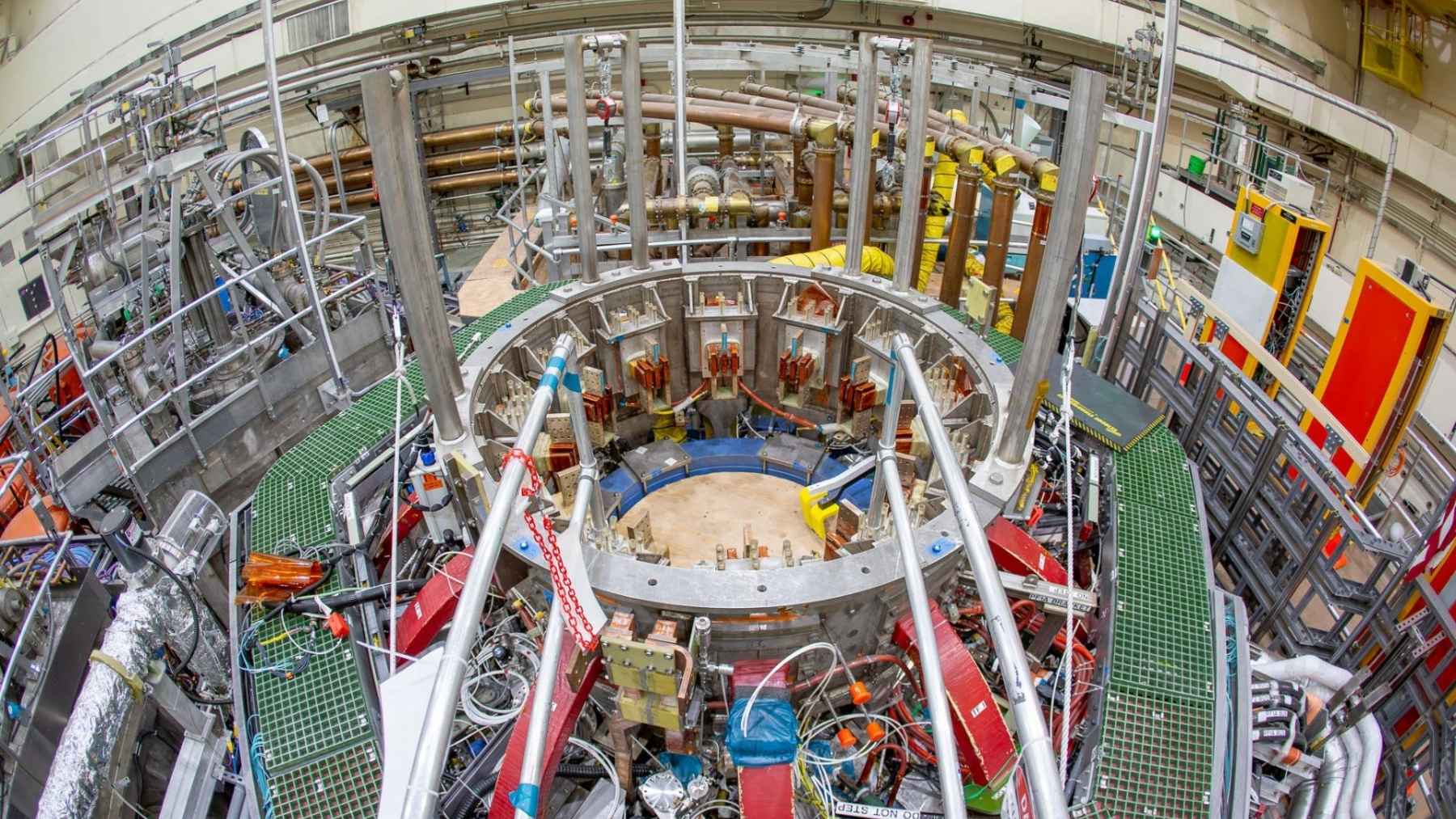
The Princeton Plasma Physics Laboratory (PPPL) has been living the industrial-scale version of that story since 2016. Its flagship machine, a compact fusion device called NSTX-U, is designed to be the most powerful spherical tokamak in the world. It has spent nearly a decade torn apart.
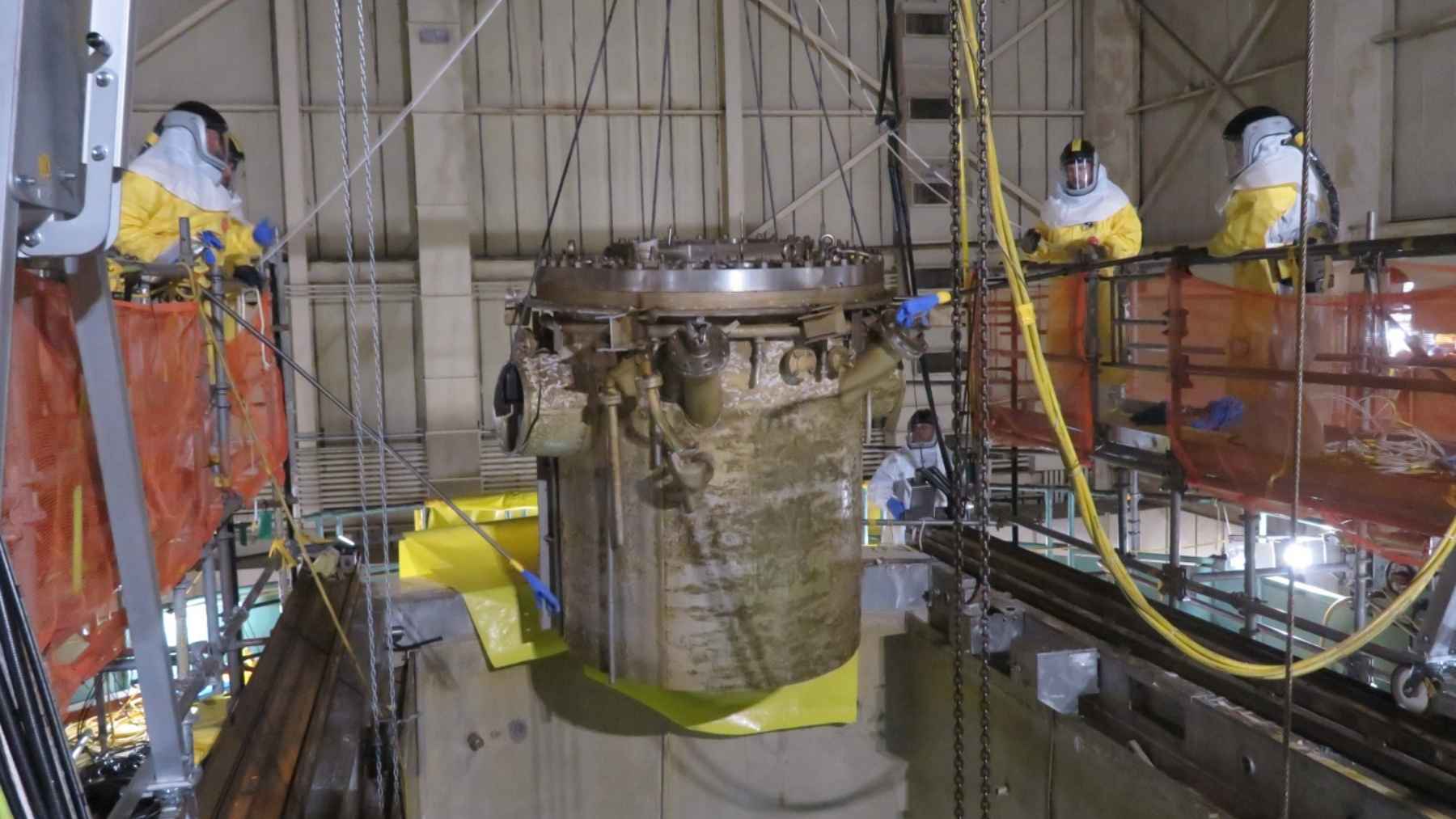
On June 3, the missing part finally showed up. Around 8:30 a.m., a flatbed truck rolled through the lab’s front gates in Princeton, New Jersey, carrying the machine’s central magnet bundle: 23,000 pounds (about 10.4 metric tons) of copper and fiberglass, roughly 20 feet long, fresh off a cargo flight from Bilbao, Spain.
Dave Micheletti, PPPL’s associate laboratory director for engineering and the project director for NSTX-U, called the delivery “truly a momentous occasion.” He also framed it in plain shop terms: with the bundle on site, the lab’s full attention now turns to reassembling the machine and switching it on.
A school bus made of copper and fiberglass
The bundle is really two magnet systems fused into a single column, and PPPL compares its size to a school bus. The inner piece is the toroidal field magnet, which generates most of the magnetic cage that keeps the superheated plasma from ever touching anything solid.
Building it was closer to weaving than welding. Technicians combined 36 copper conductors, each 19 feet long, into one unit using fiberglass tape, resin and a process called vacuum-pressure impregnation, which pulls resin into every last gap so the finished magnet behaves like a single solid object.
The second system wraps around the first. Crews wound more copper conductor around the outside of that column to form the ohmic heating coil, which does what the name suggests: it drives an electric current straight through the plasma, heating it with the same basic physics that makes a toaster glow. A final coat of resin sealed the whole assembly together.
The work happened at Elytt Energy, a Bilbao company that builds high-powered magnets for large scientific facilities. From there the bundle crossed the Atlantic in a cargo plane, landed at Newark Liberty International Airport, and covered the last stretch by road.
At the lab, an overhead crane rated for 15 tons plucked it off the truck. For a magnet built to sit at the heart of a fusion reactor, its first stop was almost humble: a prep hall next door called the Fusion Research and Technology Hub, the same space that once housed the lab’s record-setting Tokamak Fusion Test Reactor.
The part that failed in 2016 was even smaller
To understand why a delivery gets this kind of celebration, you need the backstory. NSTX-U is a $94 million upgrade of a spherical tokamak PPPL originally built in 1999, and when it fired up in 2016, it ran for all of 10 weeks.
Then one of its magnets, a smaller plasma-shaping coil known as an inner poloidal field coil, shorted out. Operations stopped in late July 2016 and never restarted. The lab’s director stepped down that fall, and the teardown that followed turned up more bad news, including a damaged copper cooling tube.
“We know that copper was an unwise choice,” Mike Zarnstorff, then PPPL’s deputy director for research, told Physics Today at the time, adding that the tube should have been stainless steel. When engineers say things like that on the record, a quick fix is off the table.
What followed was the NSTX-U Recovery Project: a review of the machine’s design, hundreds of components re-examined, all six inner poloidal field coils scrapped and rebuilt to a new specification, and the core of the device reworked around lessons from the failure. Ten weeks of run time bought nearly ten years of rebuilding.
Getting 23,000 pounds through a hole in the roof
Right now the bundle is lying on its side on a piece of tooling the lab calls the tilt fixture. Engineers will spend about two months on checks and adjustments before slowly rotating it upright.
Standing vertical, PPPL says, it will resemble a scaled-down version of NASA’s Space Launch System, the Moon rocket that rode the heaviest self-powered vehicle on Earth out to the pad for Artemis II this spring. The comparison fits in another way too: nothing in this phase moves quickly, and nothing is allowed to.
Once upright, the bundle gets dressed for the job. A tall metal casing studded with heat-resistant carbon tiles will be lowered around it, borrowing the same general idea that protected the underside of the Space Shuttle. Its job is shielding the magnet from the plasma’s heat once the machine is running.
After that comes the main event. The building’s big overhead crane will lift the shielded bundle up and over a barrier wall, then lower it through a circular opening in the top of NSTX-U and down into the core of the machine. The lifts will stretch across several days and involve more than a dozen PPPL engineers and technicians.
The rest is hookup work, though “hookup” undersells it. The magnet connects to its power supplies through 72 horseshoe-shaped connectors called flexbuses, plus cooling lines, interior tiles and a bakeout system that heats the machine’s internals to purge any contaminants before the first plasma.
The last gate is commissioning, the full-system shakedown where every subsystem has to prove it plays nicely with the rest. Experiments are expected to begin in 2027.
So why shape a fusion machine like a cored apple?
Most tokamaks are doughnuts. The largest one operating anywhere, Japan’s JT-60SA, is a building-sized ring of magnets holding its plasma in a fat torus. NSTX-U belongs to a different school: squash the doughnut until the hole nearly closes and the plasma hugs a central column, a shape PPPL describes as a cored apple.
The payoff, at least on paper, is efficiency. A spherical tokamak can confine fusion-grade plasma with smaller, cheaper magnetic fields than a conventional machine of similar performance, which is why the concept keeps coming up whenever anyone sketches an affordable fusion power plant.
That makes NSTX-U the public counterweight to the private compact bet. Commonwealth Fusion Systems is chasing smallness through brute-force magnets on its SPARC reactor outside Boston, now roughly 75% assembled. Princeton is testing whether the geometry itself is the shortcut.
NSTX-U is also a Department of Energy national user facility, meaning researchers from around the country can apply for time on it the way they would book a supercomputer. PPPL says the data will feed the DOE’s fusion roadmap and help train the AI systems expected to control future reactors.
“NSTX-U has capabilities found in no other plasma device anywhere in the world,” PPPL Director Steven Cowley said in remarks carried by the American Nuclear Society’s Nuclear Newswire.
There are honest caveats here. This project has blown through restart dates before; earlier coverage penciled in a return for 2021, then for the fall of 2025, and here we are reading about deliveries in the summer of 2026. Commissioning is exactly the phase where fusion schedules go to get humbled.
The difference now is physical. Every major piece of the rebuilt machine is finally on site, and what remains is assembly and testing rather than waiting on a factory an ocean away.
Anyone who has waited months for a back-ordered part knows the feeling when the box finally lands on the doorstep. Princeton’s box weighed 23,000 pounds, flew in from Bilbao, and needed a 15-ton crane just to get off the truck. The install starts now.
 @stephenskender ROOKIE3 months ago