
China gets accused of copying American technology roughly once per news cycle. The AP1000 reactor is the strange case where the copying was written into the contract. Westinghouse sold Beijing four of its flagship reactors back in 2007, blueprints included, and China has spent the years since turning that design into a domestic product line called the CAP1000.
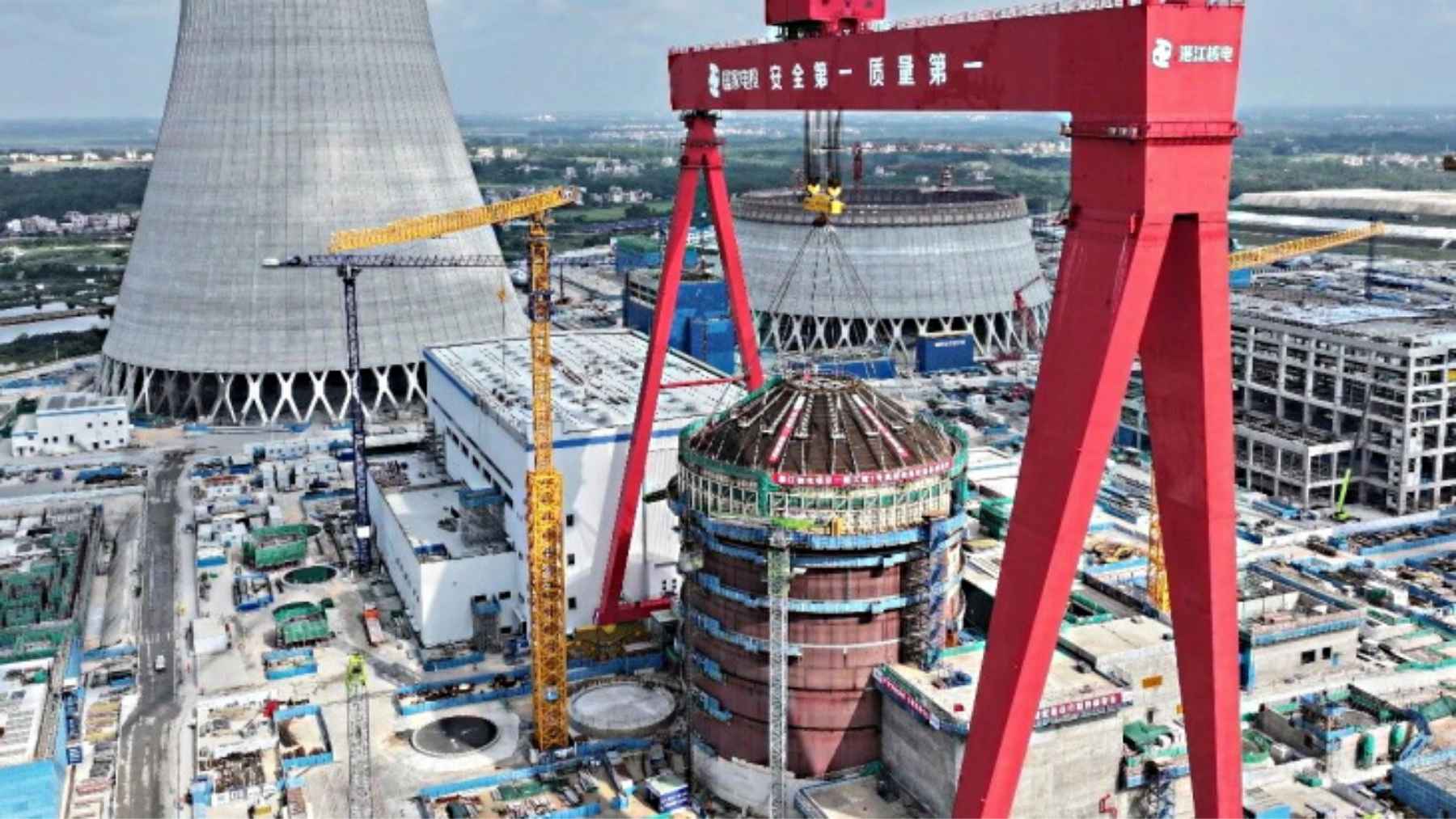
Last month, one of those copies hit the kind of milestone that reads like a routine construction update and looks like a small mountain being assembled. World Nuclear News reported on June 1 that crews at the Lianjiang plant in Guangdong province had lifted the outer steel dome onto the containment building of Unit 1. The lid weighs nearly 1,000 metric tons, about 1,100 US tons.
That one lift closed out the civil construction phase of the reactor. Everything from here on is fitting out the inside, and the target for first power is 2028.
A 1,000-ton lid with a water tank on top
The dome itself is a machine more than a roof. It’s conical, about 41 meters across (roughly 134 feet) and 11 meters tall (36 feet), built from 32 radial main beams, three ring beams, 96 steel cladding panels and three steel platforms hanging underneath.
It caps the shield building, the outer layer of the CAP1000’s double containment. And it has a job beyond keeping rain out: the dome supports the passive containment cooling water storage tank, the elevated reservoir that lets this reactor family cool itself with gravity instead of pumps if things go wrong. So the fancy way to describe it is a critical safety structure. The honest way is a very heavy water tower disguised as a roof.
China National Nuclear Corporation, which is building the plant for its owner, State Power Investment Corporation, called the dome “a key symbol of the main plant’s structural closure.” The reactor pressure vessel was already sitting inside, installed back in February 2025 according to Nuclear Engineering International, waiting for its ceiling. Heavy-lift theater is standard practice in this business. Turkey just finished building its first reactor by lowering the vessel through an open roof with the most powerful crawler crane on Earth.
Westinghouse sold the recipe in 2007
The AP1000 was supposed to be America’s comeback reactor. Modular construction, factory-built chunks, passive safety, shorter schedules. In 2007, Westinghouse won a bid to build four of them in China, two at Sanmen and two at Haiyang, and the deal put the technology itself in Chinese hands.
The first one to run anywhere on the planet was not in the United States. Sanmen 1 connected to the grid on June 30, 2018, which Westinghouse announced as the world’s first AP1000 generating electricity.
The American chapter went differently. The two AP1000s at Vogtle, Georgia, were approved in 2009 at an estimated $14 billion with power expected by 2016 and 2017. They arrived seven years late at a cost north of $30 billion, one of the most expensive energy projects in US history. A sister project in South Carolina burned through about $9 billion before being abandoned entirely. The losses pushed Westinghouse into Chapter 11 bankruptcy in March 2017.
China, meanwhile, digested the design. Its engineers localized the supply chain, reworked the details on their own factory floors, and rebadged the result as the CAP1000, rated at 1,250 megawatts. As Nuclear Engineering International put it this week, they then upscaled it into an even bigger domestic version, the CAP1400, now being built with no Westinghouse oversight at all. Westinghouse still sells the original abroad, and Poland is about to assemble three AP1000s from prefab steel chunks on the Baltic coast.
China is building nine more of these right now
Lianjiang 1 is not a one-off. According to NucNet, China currently has 37 large reactors under construction, once you count the two newest starts the IAEA database hasn’t caught up with. About half are domestic Hualong One units. Nine are CAP1000s.
The pace at Lianjiang is the part worth staring at. China’s State Council approved the first two units in September 2022, excavators started the same month, first concrete went in during September 2023, the reactor vessel landed in February 2025, and the dome closed the structure this June. If the 2028 date holds, that’s about five years from first concrete to a running power plant.
Vogtle Unit 3 needed roughly a decade to cover the same distance. But the honest comparison cuts both ways, because China’s first batch of AP1000s wasn’t quick either. Sanmen 1 broke ground in April 2009 and took nine years to reach the grid. An Idaho National Laboratory analysis of the program notes that the real schedule gains are showing up in the second series of Chinese builds, the CAP1000s. Lianjiang is the test of that learning curve, not yet the proof of it.
The cooling tower is its own world first
There’s a second machine on this site that deserves its own headline. SPIC says Lianjiang will be the first nuclear plant in China cooled by seawater secondary circulation, and the first built around a super-large cooling tower. World Nuclear News described that tower as the world’s first ultra-large seawater cooling tower for nuclear power when its structure topped out last September.
The numbers are absurd in the usual nuclear way. The tower stands 218.7 meters, about 717 feet, on a base 574 feet across, and swallowed 137,400 cubic meters of concrete, roughly 180,000 cubic yards. The natural-draft towers at Vogtle, for scale, stop just under 600 feet.
The point of it is water management. Coastal nuclear plants traditionally pump seawater straight through their condensers and dump it back warmer, a once-through setup. Lianjiang instead recycles its cooling water and uses the atmosphere as the heat sink. SPIC says that cuts water discharge to “one-fortieth of that of traditional nuclear power plants,” keeps the outflow near natural sea temperature, and shrinks the intake that marine life loves to clog. Run all six planned units and the site is expected to generate about 70.2 TWh a year, displacing more than 20 million metric tons of coal.
Washington just bet $17.5 billion on the same blueprint
Here’s the part that turns a Chinese construction update into an American story. On June 23, three weeks after Lianjiang’s dome went on, the Department of Energy announced a conditional commitment of $17.5 billion in loans to kick-start ten new AP1000s in the United States, five sites with two reactors each, feeding a goal of having all ten under construction by 2030.
The money buys long-lead components at fixed prices before shovels move, and Westinghouse plus each utility partner must put up $500 million apiece per project before touching a federal dollar. Seven utilities have signed letters of intent for the five slots, which is the polite corporate version of musical chairs. It stacks on top of last fall’s separate deal committing at least $80 billion of Westinghouse reactor construction, with the government taking 20 percent of future profits.
Still, loans are not concrete. As Edwin Lyman of the Union of Concerned Scientists pointed out to Utility Dive, none of the ten reactors has an actual construction contract behind it yet. The most physical nuclear progress in the West this spring was a 953-ton basemat lowered into a shaft in Ontario, for a reactor a quarter the size of one AP1000.
Two decades ago, Westinghouse pitched a reactor that snaps together from factory modules, cools itself with gravity, and gets cheaper every time you repeat it. At Lianjiang, that pitch finally resembles the brochure. The American version of the story now rests on seven letters of intent, five loan slots and a 2030 deadline — and on whether the next ten can do on home soil what the copies keep doing in China: go up, close the roof, and get boring.