
If you live somewhere with a homeowners association or a house old enough to sit inside a historic district, you already know the drill with solar. The state gives you the right to install panels, and then the local architectural review board gives you a very long list of reasons your particular roof is the exception. Panels have to face away from the street. They have to sit flush.
They have to be black-on-black so nobody driving past has to look at a silver grid on a 1910 slate roof. The whole thing works, right up until someone decides the panels look too industrial for the neighborhood and buries your project in a 90-day review.
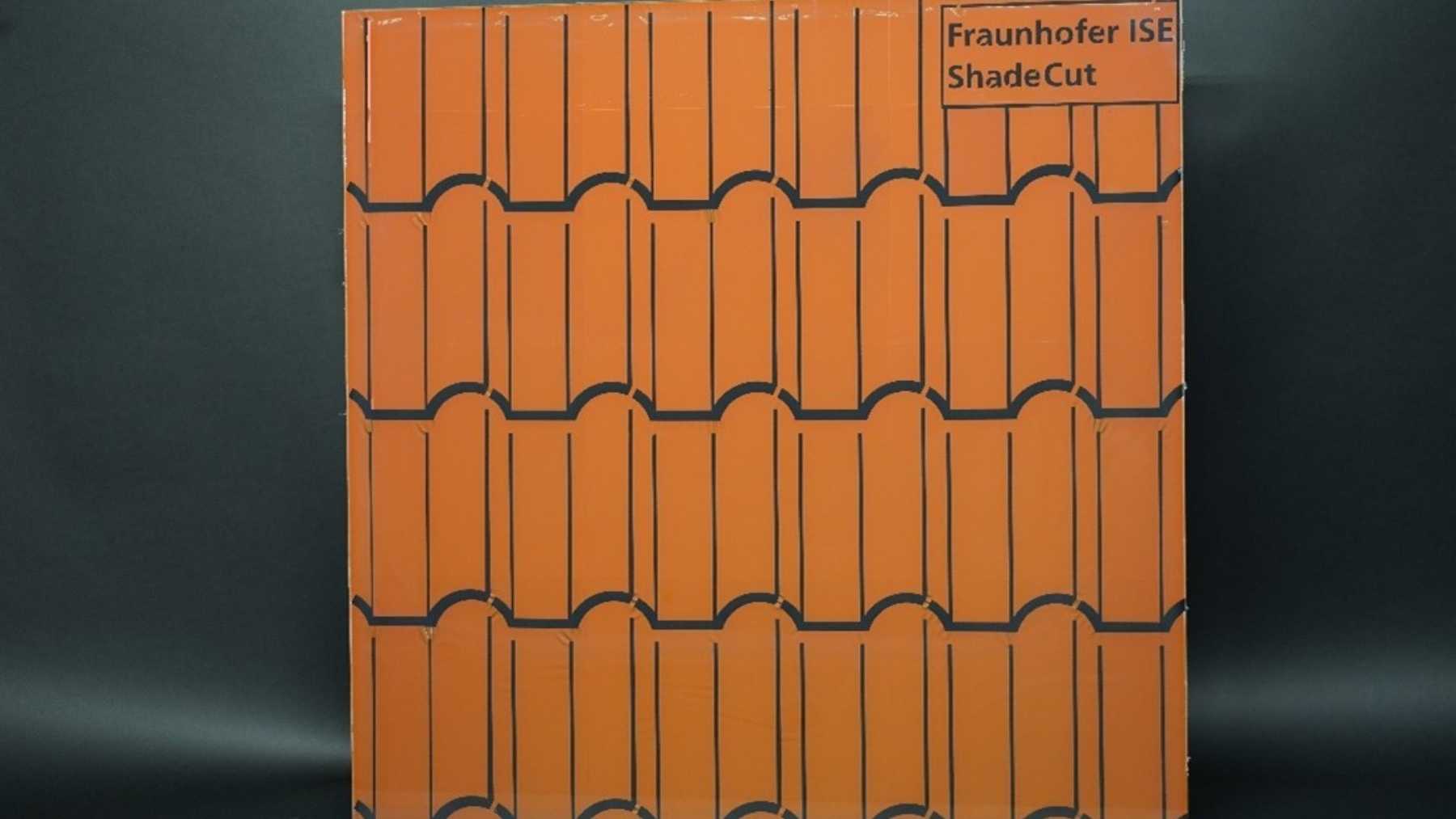
A research team in Germany just built the workaround, and it is stranger than it sounds. They made a solar module that doesn’t look like a solar module at all. It looks like clay roof tiles. Or brick. Or stone. And it does that while still generating about 95 percent of the power a normal panel would.
The tech is called ShadeCut, and it comes out of the Fraunhofer Institute for Solar Energy Systems ISE in Freiburg, one of the biggest solar research outfits on the planet. The institute announced it back in April, and it’s putting working modules on display this week at Intersolar in Munich, the largest solar trade show in the world, running June 23 to 25 at Messe München.
The panel is faking terracotta with a butterfly trick
Here’s the part that makes an engineer stop and reread it. The color on these modules doesn’t come from paint. There’s no pigment involved at all.
Instead, ShadeCut is built on an earlier Fraunhofer invention called MorphoColor, and MorphoColor gets its color the same way a Morpho butterfly’s wings do. If you’ve ever seen one of those electric-blue tropical butterflies, that blue isn’t dye. The wings are covered in microscopic 3D structures that bounce back one narrow band of light and let everything else through. It’s called structural color, and it’s produced by optical interference rather than a chemical that absorbs light.
Fraunhofer copied that idea onto glass. They apply a similar microstructure to the back of a solar module’s cover glass using a vacuum process, and the result is a color impression that stays stable from different viewing angles while barely touching efficiency. The reason it barely touches efficiency is the whole point: pigment would sit on the panel and eat sunlight the cells need, but the butterfly-style structure reflects only the sliver of light that makes the color you see and passes the rest straight down to the cells.
ShadeCut is the step that turns that color into a convincing fake roof. Researchers take a film carrying the MorphoColor coating and cut patterns into it, using either a laser or a CAD-controlled cutting process, leaving transparent gaps in specific places. Line those colored shapes and clear gaps up correctly and a flat glass module reads as a field of individual clay tiles from the street. The film can go on as a flexible encapsulation layer inside the module or as a backsheet, and it works on standard PV and solar thermal modules, so it isn’t locked to one exotic panel type.
What the 95 percent figure actually means
The headline number is that a ShadeCut module keeps roughly 95 percent of the power output of a comparable uncoated one. So you’re paying about a 5 percent efficiency hit to make your panels disappear into the roofline.
That number matters because it’s independently measured, not a company estimate. Fraunhofer says the roughly 95 percent power retention was confirmed by independent measurements, which is a different thing from a manufacturer’s own spec sheet.
Whether 5 percent is a fair trade depends entirely on your situation. If you’ve got a plain roof in a state with no HOA drama, you’d never take the hit. You’d bolt on the cheapest efficient black panels you can find and pocket the extra output. But if the alternative is no solar at all, because the preservation board keeps rejecting anything visible from the sidewalk, then a 5 percent haircut to get an approval is not a hard call.
This is aimed straight at the roofs solar can’t touch
Fraunhofer is pretty direct about who this is for. Dr. Martin Heinrich, the group leader for encapsulation and integration at the institute, says the technology is particularly interesting for modules going into facades, roof-integrated PV, and even railings, especially on historic buildings.
His line on the look is the one that gets quoted, and for good reason. Modules with ShadeCut can look like masonry or roof tiles and, in his words, “blend in perfectly in terms of color,” according to the writeup in pv magazine.
Facades are the sneaky big prize here. Everyone thinks about the roof, but the vertical walls of a tall building are a huge surface that almost never gets solar, partly because a wall covered in obvious blue panels looks like a science project. A wall that reads as brick or stone but quietly generates power is a much easier sell to a planning committee. Marco Ernst, the Fraunhofer researcher who developed ShadeCut, notes the team can add extra film layers with their own cutouts to build up more complex structures or additional colors, so it isn’t limited to one flat tile pattern.
And because the same process can cut any shape, it isn’t only for camouflage. The film can spell out lettering or reproduce a logo, which turns a corporate facade into a branded solar wall. That’s a commercial pitch as much as a preservation one.
Solar tiles already exist, so why does this matter
Fair pushback: you can already buy solar roof tiles. This is not a new idea in the abstract.
The catch is that most of the tiles on the market solve a different problem than the one ShadeCut is aiming at. Take Germany’s Paxos Solar, which makes a glass-glass photovoltaic tile rated at 44 watts each using back-contact cells. It’s a genuinely clever product, and it even ties into a heat pump. But it’s completely black on the front. It’s designed to look like a clean, modern, all-black roof, not to disappear into a row of orange clay tiles on a protected building from 1890.
The most famous version of the black-tile approach is Tesla’s Solar Roof, and that one is a cautionary tale of its own. The company has quietly wound the product down, service has become a real headache for existing owners, and a class action settled in 2023 after one customer was quoted $72,000 and handed a final invoice of $146,000. We dug into what happened to Tesla’s Solar Roof and the owners left holding it if you want the full picture.
So the tile market splits into two camps. There’s the make-my-roof-look-sleek-and-black camp, which is crowded. And there’s the make-my-panels-look-like-something-they’re-not camp, which is where the hard preservation cases live, and where a butterfly-inspired film that mimics terracotta actually has a job to do. ShadeCut is squarely in the second camp.
Where this sits with the road solar people keep hearing about
ShadeCut is a lab-to-trade-show technology right now, not something on a price list. Fraunhofer is showing modules at Intersolar; it isn’t quoting a cost per square foot or naming a launch date. Structural color made by cutting films with lasers is not going to be the cheapest way to cover a barn.
It’s worth being clear-eyed about that, because solar has a long history of demo-stage ideas that photograph beautifully and then stall. The solar-panel roads are the classic example, endlessly recycled online despite tiny real-world output. We went through why paving roads with solar keeps failing while roadside solar quietly works, and the lesson lands here too: putting panels in the wrong place for the sake of a headline is a great way to make solar look worse than it is.
ShadeCut is a more grounded proposition than a drive-over lane, mostly because it targets a real, specific bottleneck instead of a photo op. Historic districts and design-strict HOAs are exactly the places where good solar projects die on aesthetics, and a module that satisfies a preservation board without gutting output is a legitimate answer to that. Whether it survives the jump from Fraunhofer’s booth to a roof you can actually order is the open question, and that’s the one worth watching between now and the next Intersolar.