
Almost every spacecraft in orbit right now runs on sunlight. Panels charge a battery, the battery covers the stretch of each orbit where Earth blocks the Sun, and the panels top it back up on the other side.
That arrangement is fine in low Earth orbit. It stops working at the bottom of a crater near the lunar south pole, which never sees the Sun at all, and it thins out in deep space, where a panel eventually costs you more mass than the power it hands back.
On Tuesday morning, a Falcon 9 lifted 81 payloads out of Vandenberg Space Force Base in California. One of them was a CubeSat from a Miami company called City Labs, carrying a demonstration payload that runs on the radioactive decay of tritium.
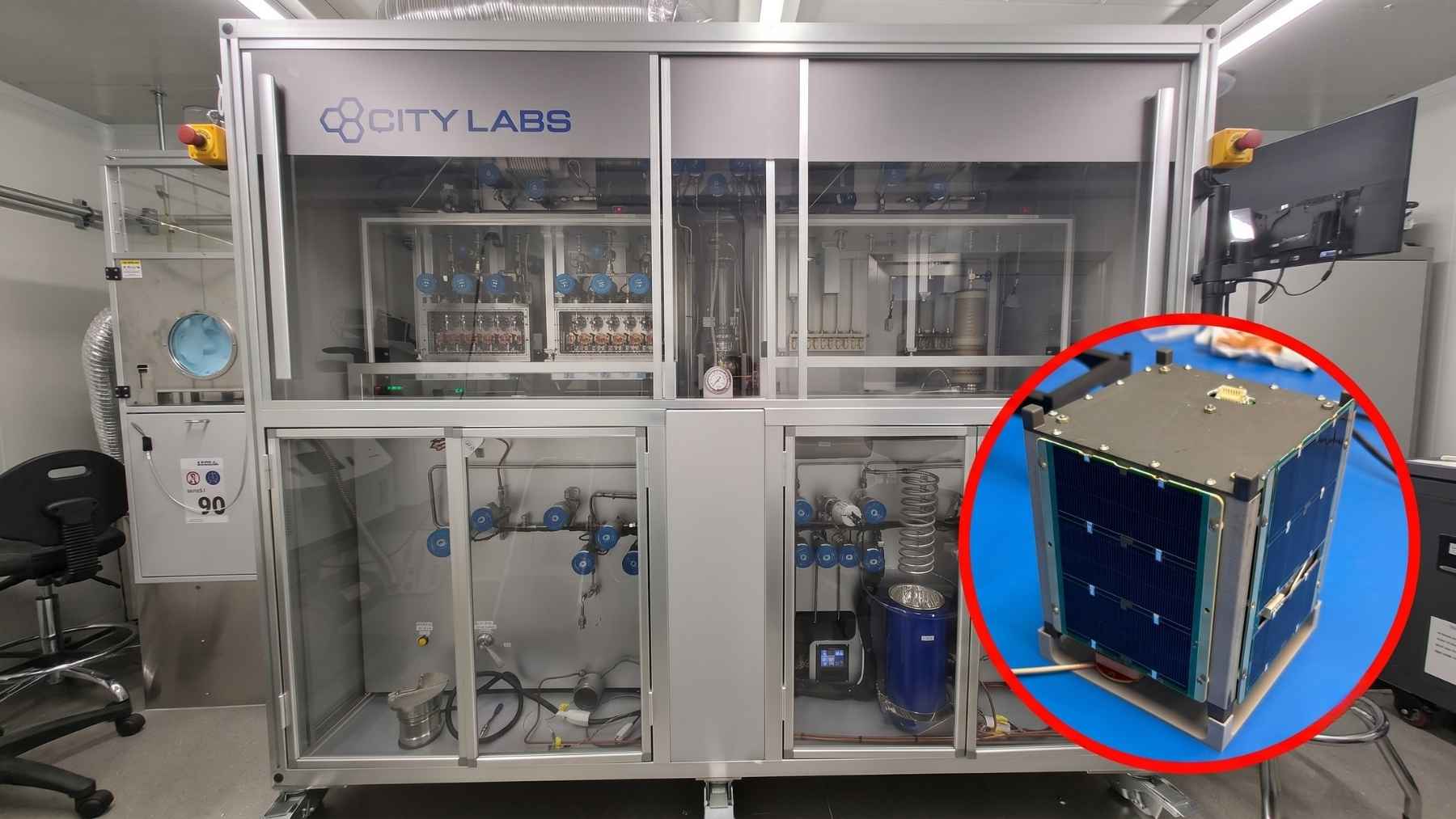
City Labs calls the satellite BOHR, short for Betavoltaic Orbital High-Reliability, and its July 7 announcement describes it as the world’s first commercial nuclear-powered satellite and the first nuclear CubeSat. Aviation Week reported the spacecraft deployed successfully from the Falcon 9 and put it at 1U, meaning a 10-centimeter cube.
The claim is real. It is also narrower than it reads, and the company is the one telling you so. BOHR’s satellite bus, the radio and computer and everything that keeps it pointed correctly, runs on conventional solar panels. The tritium powers one payload, and the whole point of the mission is to prove that payload keeps working when the panels are in shadow.
A nuclear battery is not a reactor
Nuclear power in orbit is not new. Per New Atlas, the U.S. Navy was already flying it on Transit navigation satellites in 1961, and both Cold War superpowers used it for missions that needed more power than solar panels of the era could deliver.
What has always split that history in two is whether you are splitting atoms or just waiting for them to fall apart. A reactor sustains a fission chain reaction and produces real heat, which is the whole reason the U.S. is trying to land a 100-kilowatt fission reactor on the Moon by 2030.
A radioisotope source does none of that. The plutonium generators on the Voyager probes take the heat thrown off by decay and push it through thermocouples. A betavoltaic never bothers with heat in the first place.
Tritium is a heavy isotope of hydrogen. As it decays, a neutron in the nucleus turns into a proton and fires off a fast electron, which physicists call a beta particle. City Labs binds the tritium inside a metal hydride matrix and parks a semiconductor next to it, so those electrons land in the junction and knock loose charge carriers, the way light does inside a solar cell. The American Nuclear Society lays out the same mechanism in its writeup.
The end product is helium-3, which is stable and not radioactive. There is no core, no chain reaction and no coolant loop anywhere in the device. We have covered the same trick running on nickel-63 in a coin-sized cell, and tritium is the other isotope the field keeps coming back to.
The power output is the part everybody skips
City Labs describes its NanoTritium line, in its own words, as operating in the “nanowatt to microwatt range.” That phrase is doing an enormous amount of work.
The company’s product page publishes a two-row table. The P100 series, marked available, puts out 50 to 350 nanoamps at 0.8, 1.6 or 2.4 volts. The P200 series, marked in development, moves up to 52 to 156 microamps.
Run the multiplication on the shipping product and you get hundreds of nanowatts at the top end. City Labs also lists a 100-microwatt unit among its supported configurations, with the word “projected” next to it.
The company has not published which series flew on BOHR, and it has not published the payload’s output. What it has published is a price. Base pricing starts at $5,250 per battery.
So the useful mental model is not a battery that runs a satellite. It is a battery that runs a chip. City Labs sells these things for encryption key retention, embedded circuit board sensors and leadless cardiac pacemakers, and its aerospace page lists CubeSat electronic payloads and long-duration scientific missions. Low power, forever, with nobody coming to service it.
Source: City Labs product and press materials. The company has not disclosed which series flies on BOHR.
The paperwork is the actual product
Tritium itself is thoroughly domesticated. It glows in emergency exit signs and watch dials, a point Payload makes in its own coverage of the launch.
What nobody had done was walk a privately owned nuclear payload through the American launch approval process and come out the far side holding the license.
The framework dates to 2019, when National Security Presidential Memorandum-20 rewrote how the U.S. clears spacecraft carrying nuclear material. The American Nuclear Society explains that the Department of Transportation, and the FAA within it, now coordinates the interagency review of the safety analysis, with the launch regulations updated in 2020.
City Labs prepared that analysis with technical leadership from Kevin Makinson. Sandia National Laboratories independently reviewed and validated it. The FAA issued its affirmative payload authorization on September 30, 2025, which is nine months before the rocket left the pad.
Peter Cabauy, the company’s CEO, told Payload where he thinks the milestone sits. “The innovation here is not just in the technology. It’s in the regulatory part,” he said. Governments have been flying nuclear hardware since the Kennedy administration. Nobody had gotten a commercial company through the same door.
Tritium is why the FAA could say yes
The reason that door existed at all comes down to what is inside the box. When a nuclear satellite fails, the isotope on board decides how bad the day gets.
New Atlas reaches for the reference point everyone in this field knows. On January 24, 1978, the Soviet radar satellite Kosmos 954 came down uncontrolled over Canada with a BES-5 fission reactor and its load of highly enriched uranium-235, scattering radioactive debris across the north. Published estimates of how much uranium was aboard, and how far the debris spread, still vary by a factor of two.
BOHR is a four-inch cube whose nuclear material is an isotope of hydrogen. Its beta particles are low-energy, and City Labs says they cannot pass through skin. The fuel sits in a solid metal hydride rather than a pressurized gas bottle.
Add the 12.3-year half-life, which City Labs pairs with a rated life past 20 years, and you get a device the company says can be handled, shipped and integrated inside a standard commercial launch environment. That is the whole safety case, and it is why the FAA had something it could sign.
The market is everywhere the Sun does not reach
City Labs names three targets in its announcement: deep space, permanently shadowed lunar regions, and long-duration autonomous sensor networks.
The lunar case is the one with money behind it. NASA’s Artemis campaign is aiming at the south pole for its water ice, the lunar night runs roughly two Earth weeks, and the hunt for power that ignores sunlight is why Blue Origin is working on making solar cells out of lunar dust to cut the mass it has to launch.
Payload reports that City Labs wants to scale toward tritium-powered radioisotope heating units for future Commercial Lunar Payload Services missions, so a lander can survive the lunar night and operate in permanently shadowed craters.
These are not competing answers to the same question. A 100-kilowatt reactor keeps a habitat warm and a drill turning. A nanowatt betavoltaic keeps a sensor logging data for two decades in a place where no crew and no cable will ever arrive.
The next contract asks for watts
City Labs has already booked its follow-up. In a release published in June, the company announced a $1.5 million DARPA contract under a program called Rads to Watts, working with Microlink Devices to build watt-class radiovoltaic unit cells targeting system-level performance of 10 watts per kilogram.
Go back and look at the P100 numbers. Getting from 350 nanoamps to watts per kilogram is not a spec bump, and City Labs says outright that the program is what finally lets it chase a new class of tritium metal hydride materials it has wanted for years. The contract funds the attempt, not the outcome.
The same release lists the rest of the pipeline: radioisotope heat units that produce warmth rather than current, and tritium-based propulsion concepts. None of that flew this week.
What actually went to orbit
A 10-centimeter cube, running on solar panels, carrying a nuclear payload that produces less power than the indicator light on your router, on a mission whose stated job is to prove the thing survives launch and keeps working in the dark.
It is also funded in whole or in part by the Department of War under contract FA9453-25-C-X003, with support from the Air Force Research Laboratory, AFWERX, NASA and SpaceWERX. So the word “commercial” is carrying some weight here too.
What City Labs owns outright is the hardware, the FAA authorization, and flight heritage no other private company has. Everyone else chasing tritium power for lunar landers and deep-space sensors now has a route through the regulator that somebody has already walked. On this mission, that is worth considerably more than the nanowatts.