
Floating solar farms sound like a tidy fix for a country that has run out of dry land to build on. Stick the panels on a lake, generate power, and save the fields for tulips and cows.
The obvious worry is what happens underneath. Clamping a raft of glass over a body of water isn’t exactly a natural setup for whatever’s swimming down there.
In the Netherlands, one project stopped guessing and built habitat directly into the design. The results are close to the opposite of what critics of floating solar usually predict.
At the Bomhofsplas floating-PV park in Zwolle, developer BayWa r.e. and its Dutch arm GroenLeven bolted 20 underwater cages, called Biohuts, to the anchoring system beneath the panels.
From 2020 to 2023, researchers from Hanze University of Applied Sciences in Groningen and the consultancy Buro Bakker/ATKB tracked what showed up. The short version: a lot showed up.
By the time the monitoring wrapped, the shelters had drawn more than 400 fish and close to 2,000 invertebrates, including mussels and sponges.
What a Biohut actually is, and why it works in fresh water
A Biohut isn’t complicated. It’s a metal cage, one section left empty for shelter and another packed with shell substrate, built by French firm Ecocean to give juvenile fish somewhere to hide and something to eat.
The shells give larvae, mussels, and microorganisms a rough surface to grab onto. That matters because a lot of freshwater life struggles to settle on smooth artificial materials.
Once things are stuck to the shells, you get grazers. Then small fish eating the grazers. Then bigger fish eating the small fish. The whole food chain bootstraps itself off a cage full of empty seashells.
Ecocean’s system works in both marine and freshwater environments, which is relevant here because most of the published Biohut science comes out of the Mediterranean. Across French ports and marinas like Marseille, La Ciotat, and Monaco, the cages have logged 105 different fish species and more than 170 invertebrate species, according to the EU-funded MERCES project.
Bomhofsplas is one of the more visible freshwater deployments, and it’s the one paired with a working power plant.
The lake itself matters — this isn’t a pristine ecosystem
Bomhofsplas isn’t a wild lake. It’s an old sandpit, the kind of leftover industrial hole that dots the Dutch countryside because the sand for all those dikes had to come from somewhere.
“The Netherlands has thousands of unused sand mining lakes, inland waters and dredging depots,” GroenLeven floating-solar project manager Willem Biesheuvel has said, calling them close to ideal for panels on water. That’s the pitch: use dead industrial water instead of farmland.
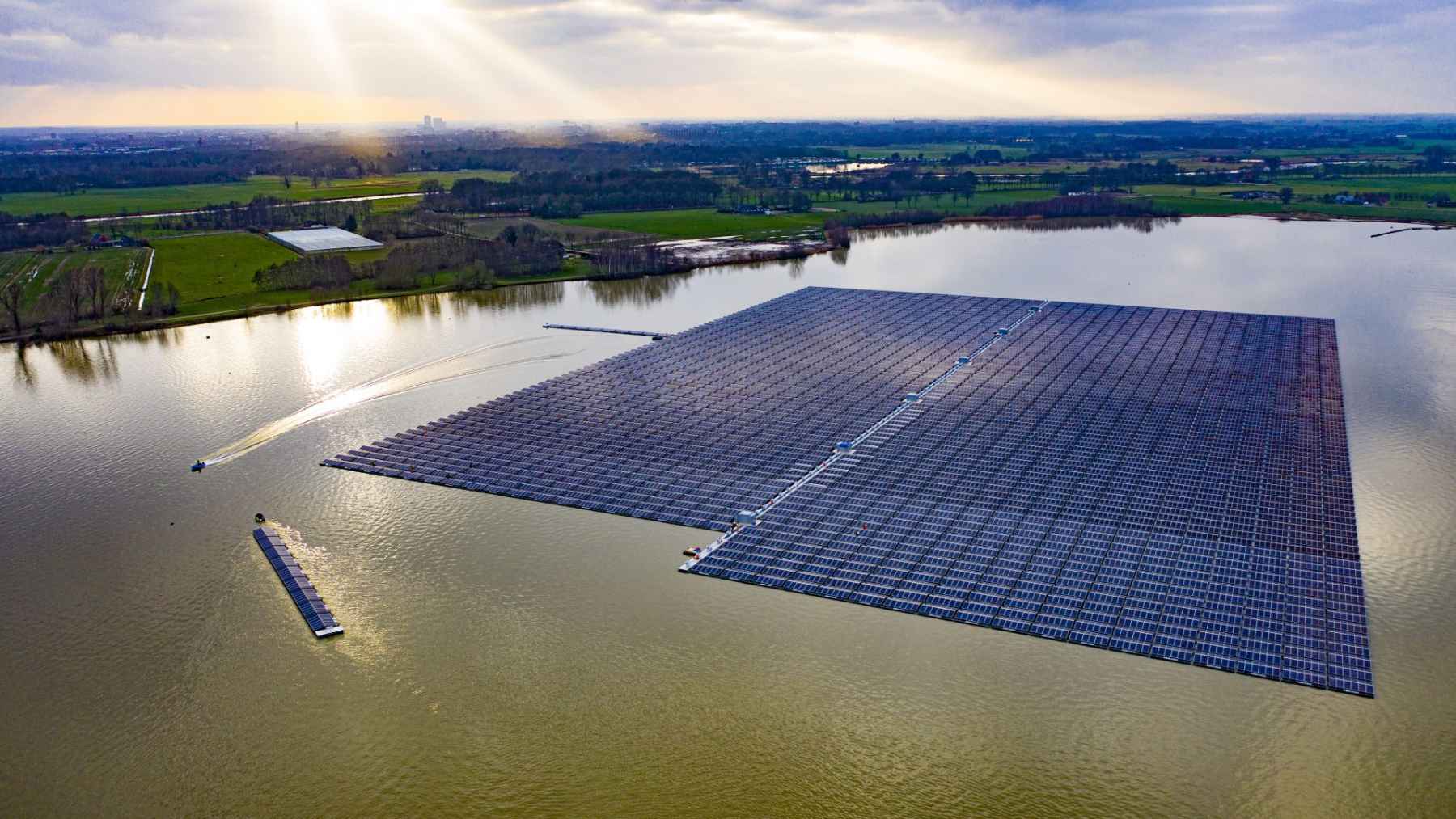
The plant itself is serious hardware. Bomhofsplas is a 27.4 MW array of roughly 73,000 modules on an 18-hectare quarry lake in Overijssel, installed in about seven weeks, and good for around 7,200 homes by BayWa r.e.’s numbers.
It’s also anchored to the lake bed rather than the shore, which is the whole point. Ecologically, the banks are where most of the life lives, so the idea is to leave them alone, put the panels over the deep, boring middle, and drop shelters under them for the fish that would otherwise find that middle useless.
Bomhofsplas is far from the only outfit putting solar over water. China just switched on a gigawatt-scale array bolted to the open seabed, complete with fish farming underneath, so the “power plus habitat” combination is scaling fast.
Panels on top, habitat underneath
What makes the Bomhofsplas result interesting isn’t just the fish count. It’s what it says about the design.
The panels shade the water, which cuts evaporation and, helpfully for the panels themselves, keeps the modules cooler than a land array and nudges up their yield. The elevation lets air circulate, and glass-glass modules let some light bleed through.
Underneath all that, the Biohuts create dark, sheltered pockets where small animals can hide. One observed perk: birds hunting from above can’t see through the panels, so the open water below becomes a safe zone instead of a buffet.
The early signs were flagged years ago. Back in 2021, the first round of environmental studies at Bomhofsplas found no meaningful harm to the lake’s plants or wildlife, per BayWa r.e.’s Toni Weigl. The 2020–2023 Biohut monitoring is the follow-up that turned “no harm” into “actually, quite a lot of extra life.”
Birds nesting under the panels is the real surprise
Here’s the strangest finding. A 2021 paper in the journal Sustainability noted that researchers could hear bird sounds beneath the panels, meaning birds were likely nesting under there.
That matters because renewable energy and birds have a rough history. Solar farms in particular can confuse migrating birds that mistake glossy panel arrays for open water.
A floating array flips that on its head. The panels look like water because they’re on water, and the birds get functional shelter underneath instead of a fatal optical illusion.
None of this means every solar project should suddenly be built on a lake. Bomhofsplas works because it’s a specific kind of lake: deep, artificial, and ecologically limited to begin with. The Biohuts aren’t restoring some ancient wetland. They’re seeding life into a hole industry dug 50 years ago and forgot about.
What the Biohut result actually proves
The real takeaway isn’t “floating solar is good for fish.” It’s that bolting ecological infrastructure onto an energy project, cages, shelters, texture, food substrate, costs almost nothing next to the panels and produces measurable biodiversity gains.
Twenty cages. Three years. Four hundred fish. Two thousand invertebrates. That’s a solid return on a piece of hardware that’s basically a shell-filled basket.
Water is quietly turning into prime energy real estate, from Dutch quarry lakes to wave-powered buoys out in the open Pacific. If you’re going to drop a giant raft of glass on a lake anyway, you may as well bolt something useful to the bottom of it.
BayWa r.e. sold the Bomhofsplas asset years ago, so the ecological angle isn’t a marketing pitch anymore. It’s just part of the technical record. If the next wave of floating-PV projects wants to shrug off habitat-loss objections, this is the template: bolt a cage on, fill it with shells, and come back in three years to count what moved in.