
Every road you drive on runs on the same basic recipe: a pile of crushed rock and sand glued together with a petroleum product called bitumen. Since 2020, most of Hawaii’s roads have stiffened that glue with a synthetic rubber so the surface holds up to heat and heavy trucks without cracking. A team on Oahu has spent the last few years quietly swapping out some of that rubber for something a lot stranger: derelict fishing nets dragged out of the Pacific Ocean.
The project is called Nets-to-Roads, and it runs out of the Center for Marine Debris Research (CMDR) at Hawaii Pacific University. The pitch is half environmental and half logistical. Hawaii is an island chain with a serious plastic problem and no cheap way to get rid of it, so the researchers want to take some of the worst plastic in the state, the nets that wash up on its reefs, and lock it into the one place it can’t blow back into the water. Results from the first long-term test stretch were presented at the American Chemical Society’s spring meeting in Atlanta in March, and the headline finding is the one drivers should care about most.
Hawaii Can’t Just Throw Its Plastic Away
The reason any of this makes sense starts with geography. Shipping waste off the islands is expensive, local landfills are filling up, and the Pacific currents keep depositing other people’s garbage on Hawaiian beaches. The CMDR pulls roughly 200 tons of plastic out of the ocean in a busy year, according to R&D World, which interviewed center director Jennifer Lynch in May.
A lot of that haul is derelict fishing gear, which Resource Recycling reports Lynch’s team considers the single biggest contributor to Hawaii’s marine debris problem. The state already had one way to deal with it: an incinerator that burns the plastic for electricity. The trouble is that burning plastic is a one-shot deal that turns the material straight into greenhouse gases, which is exactly the outcome the team wanted to avoid.
How much washes ashore depends on where the North Pacific Garbage Patch is sitting. Lynch says the patch runs on a four-to-six-year cycle, drifting close enough to bury Hawaii for two or three years and then sliding back toward California for another two or three. Nikolai Maximenko, a physical oceanographer at the University of Hawaii Manoa, has been modeling its location for more than 30 years, and his drift forecasts now tell cleanup crews roughly how much debris is headed for the islands a month out. To pay for the collection, the project landed a $3 million grant from the National Oceanic and Atmospheric Administration in 2023, and a separate bounty program that pays licensed commercial fishers to haul in derelict gear had recovered more than 90 metric tons as of April 8, 2026.
What Actually Ends Up in the Asphalt
The plastic the team cares about is high-density polyethylene, or HDPE. It’s the durable stuff in milk jugs, yogurt tubs, and yes, fishing nets, and it behaves enough like the synthetic rubber in regular road mix to stand in for it.
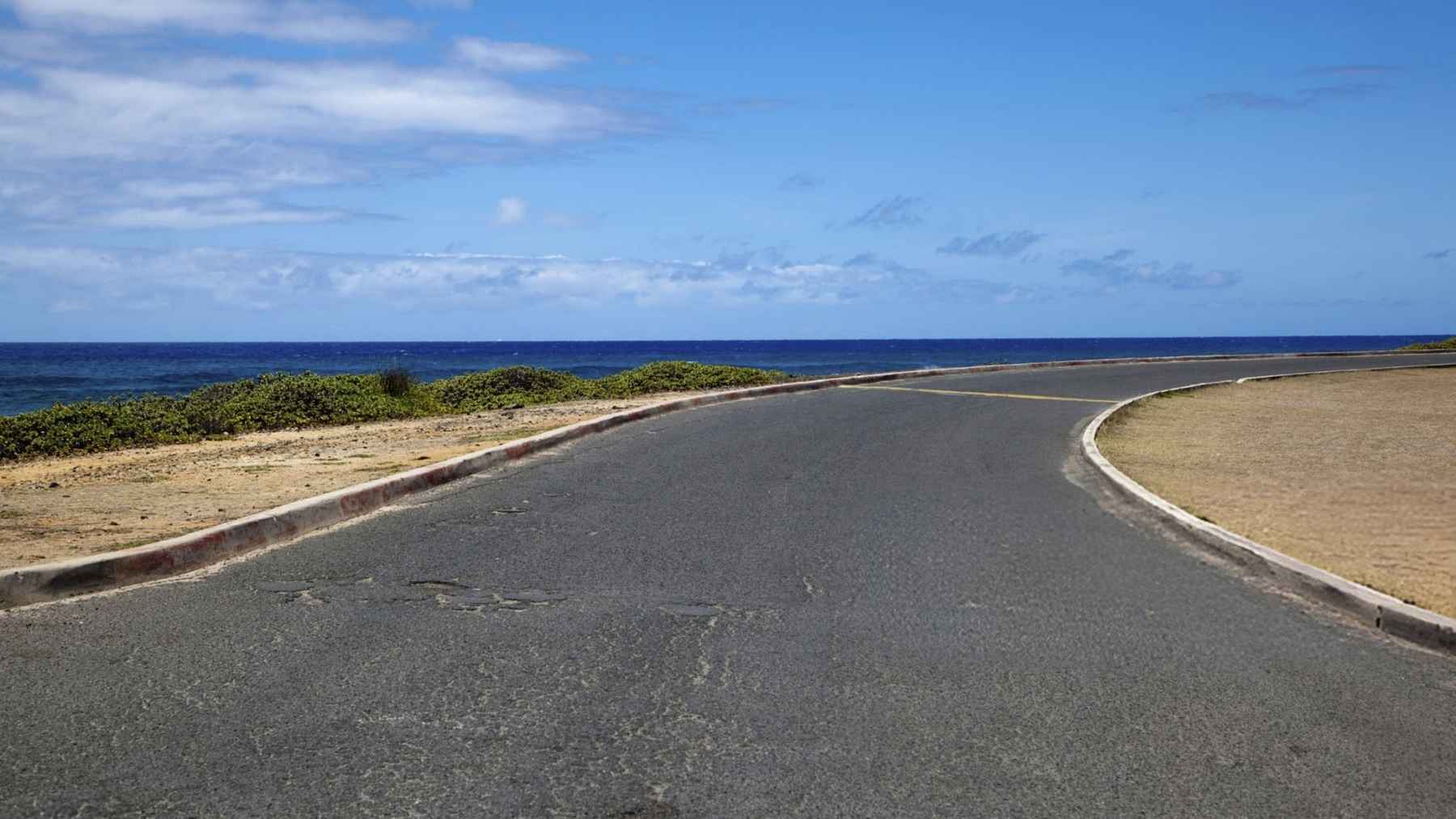
Getting it road-ready is where the process gets a little absurd. Under the pilot, plastic collected off Hawaii’s coast gets shipped to the U.S. mainland, where it’s cleaned, shredded, and ground into pellets or a fine powder. Then it gets shipped back to Oahu, where a local plant melts it into the asphalt binder so it coats the rock and sand the same way the virgin polymer would. In 2025, a stretch of residential road on Oahu got paved with the result, laid down in three side-by-side sections: one with standard polymer-modified asphalt as the control, one using recycled HDPE from household trash, and one using HDPE pulled from fishing nets.
The Microplastics Came From the Tires, Not the Road
Here’s the question that decides whether any of this is a good idea. Plastic roads sound great until you remember that roads shed. Tires grind the surface, weather breaks it down, and stormwater carries whatever comes loose into the soil and the ocean, which is the last place you want to be sending more plastic. If a road built out of recycled nets sheds more microplastics than a normal one, you’ve just invented a slower way to pollute the same water you cleaned up.
So the team monitored the three sections for 11 months, swept up the road dust from each, and ran it through pyrolysis gas chromatography-mass spectrometry, a lab technique that can fingerprint exactly which polymers are in a sample. The recycled-plastic sections did not release any more polymer than the standard asphalt did. The researchers figure that’s because the HDPE gets melted into the binder rather than just mixed in, so it stays locked in place instead of flaking off.
The detail that should get a driver’s attention is where the microplastics in that road dust actually came from. According to Phys.org, most of what showed up didn’t trace back to the recycled plastic at all. It came from tire wear, the same rubber-and-filler dust that every car on every road leaves behind. Jeremy Axworthy, the CMDR researcher who presented the work, framed the whole study around one question: whether it’s “responsible to use recycled plastics in Hawaii’s roads.” On the microplastic side, at least, the early answer is that the nets aren’t the problem your tires are.
It Holds Up Better Than You’d Expect
Shedding was the big worry, but the team also got a look at how the recycled mix performs as an actual road, and the early read is encouraging. R&D World reports that the plastic binder lets the surface flex a little under the weight of heavy vehicles instead of cracking, and that it has a higher melting point than traditional asphalt, which keeps tires from pressing grooves into it on a hot day. Rutting and cracking are the two things that turn a fresh road into a pothole farm, so a mix that resists both is not a small deal in a climate that bakes pavement year-round.
None of this is happening in a vacuum. Drivers on the mainland are in the middle of an argument over who should pay to fix American roads, with the federal government leaning on EV owners while British and Italian trials show graphene additives making asphalt last far longer. Hawaii’s experiment lands in the same lane: the cheapest way to deal with crumbling roads might be changing what you pave them with, not just who you bill for the damage. It also sidesteps the trap that’s swallowed flashier road-surface ideas, from France’s solar road that got ripped up after eight years to the Swiss panels now being tested between live train tracks. Melting plastic into ordinary asphalt is a much smaller bet, which is probably why it has a better shot at sticking.
The Catch Is the Shipping
There’s one honest problem the team doesn’t hide, and it’s the round trip. Shipping nets thousands of miles to the mainland and back to get processed burns a lot of fuel, and Lynch is blunt about the math. Done locally, she says, turning nets into roads would cut emissions roughly in half compared to burning them for power. But the pilot’s mainland detour flips that: hauling the plastic out and back produces, in her words, “two times more greenhouse gases than just burning it here.” So the version of Nets-to-Roads running right now is dirtier than the incinerator it’s meant to replace, and it only becomes the greener option once the recycling happens on the islands.
That’s the next piece the team is chasing. Several groups are working to bring mechanical plastic recycling to Hawaii so the nets never have to leave. Meanwhile, Lynch and Ricardo Arcilla, a researcher at the University of Hawaii Manoa, are writing up a final report on how the test road performed, and that report is what the Hawaii Department of Transportation will use to decide whether to pave any more of the state with recycled ocean plastic.
Right now, Hawaii has exactly one residential road on Oahu carrying the experiment, a stack of microplastic data that came back cleaner than expected, and a report still being written. Whether any more of the state gets paved with fishing nets comes down to two things: whether the durability numbers hold up past 11 months, and whether anyone can stop shipping the plastic 5,000 miles round trip first. The nets are already out of the ocean either way. The only real question is whether they end up under your tires or back in the air.