
The rule of thumb with record-breaking machinery is that the bigger it gets, the more fuel it drinks. Mining trucks, bulldozers, the cranes that stand up power plants: they mostly run on diesel by the drum, and the largest of them sound like a small earthquake when they fire up.
The strongest land-based crane ever built ignores that rule. It can do its whole job plugged into a wall.
It’s called the SK6000, it’s made by the Dutch heavy-lift company Mammoet, and it can hoist 6,000 metric tons, roughly 6,600 US tons. That’s a thousand metric tons more than Big Carl, the crane that lowered the reactors into Britain’s Hinkley Point C and held the strongest-on-land title until this thing rolled out of the factory.
One more thing sets it apart. Big Carl and most of its rivals burn diesel. The SK6000 can run straight off the grid, or off batteries, and put out zero emissions while it does the heaviest lifting on the site.
The machine that bumped Big Carl to second place
Big Carl is formally the Sarens SGC-250, rated to lift around 5,000 metric tons (about 5,500 US tons) and standing over 250 meters tall in its biggest setup. It’s the machine that made “world’s largest land crane” a phrase people outside construction actually recognized.
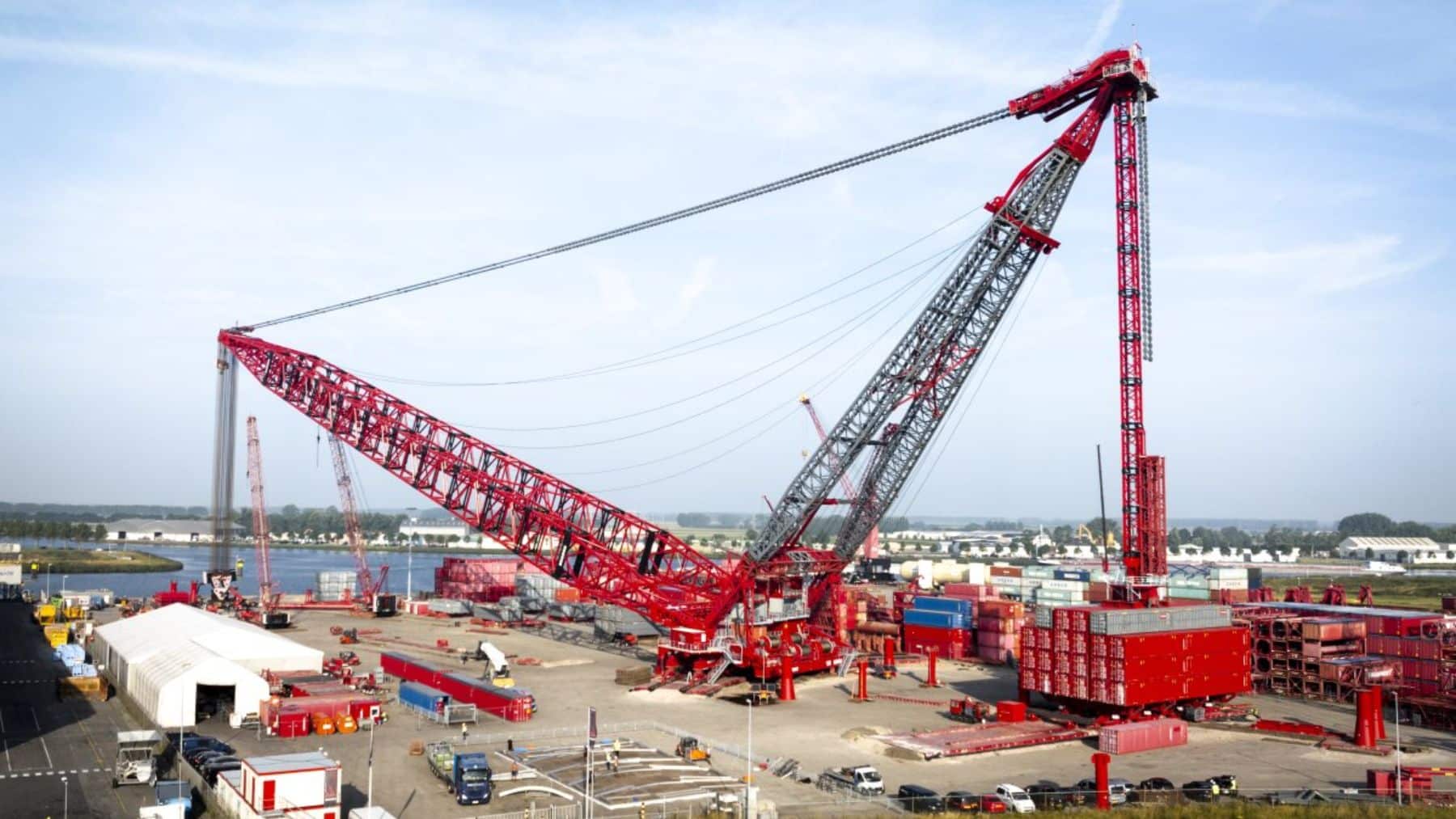
The SK6000 out-rates it by a clean 1,000 metric tons. It’s a ring crane, which means it doesn’t sit on treads or outriggers like a normal crawler. It rotates around a central stack of ballast, 4,200 metric tons of it, packed into shipping containers filled with sand and gravel so the whole rig can be broken down and shipped anywhere in the world.
That’s the same basic idea behind the Mammoet ring crane that hauled eight 100-ton steam generators through the roof of an Ontario reactor earlier this year, just scaled up to a size that’s hard to picture. Fully rigged, the SK6000 is visible from more than 10 kilometers (6 miles) away.
Its main mast runs from 127 meters at its shortest to 171 meters at its tallest. Bolt on the fixed jib and it can put 3,000 metric tons, about 3,300 US tons, up at 220 meters, which is 722 feet, or roughly a 70-story building.
The electric part is the real trick
Plenty of machines claim to be green. Most of them are forklifts. Doing it at 6,000 tons is a different problem, because a crane this size draws serious power the moment it starts moving weight.
Mammoet’s answer is to let it feed off whatever’s available. On an industrial site, it plugs into a medium-voltage grid connection. At a port, it can pull from the same shore-power hookups that keep docked ships from idling. Where there’s no grid at all, it runs on batteries or hydrogen generators.
To prove the battery option, Mammoet ran the crane on two 600 kWh battery packs from the Dutch supplier Bredenoord, wired in series for 1,200 kWh total. That’s about the same energy you’d get out of 20 electric cars. Hooking them up took a single shift, and the long gaps between heavy lifts give the packs time to recharge.
“The SK6000 operates fully zero-emissions on-site,” said Niek Bezuijen, Mammoet’s global sustainability advisor, after the tests. The project was part-funded by a Dutch government scheme that pays for cleaner construction gear. The crane can still run on a conventional diesel setup if a customer wants, so electric is the option that makes it unusual, not a limitation.
Offshore wind is the reason it exists
Cranes don’t get designed this big on a hunch. The SK6000 exists mostly because offshore wind turbines have gotten monstrous.
The industry is pushing toward 20-megawatt turbines, with towers well over 150 meters and foundations to match. The steel monopiles and jackets that anchor them now weigh in the thousands of tons, past what older cranes can safely handle at the heights involved.
So the SK6000 is built to assemble those pieces on land, in bigger chunks, before they ever go to sea. With the fixed jib it can load out a floating foundation with its main boom, then turn around and stack the turbine tower without reconfiguring. Fewer lifts, shorter schedules.
Nuclear is the other target. World Nuclear News reported that Mammoet pitched the crane for new-build reactor projects, where whole sections can be pre-assembled and dropped in as modules instead of built piece by piece on site. Oil and gas rounds out the list, mainly the giant topside modules that sit on offshore platforms.
For a sense of the ceiling here, even a 6,000-ton crane isn’t the heaviest lifter in the business. The heavy-lift ship Pioneering Spirit pulls oil platforms six times that weight off their legs, floating. It just can’t do it on dry land, which is where the SK6000 has no real rival.
The catch: it still hasn’t lifted a thing for a paying customer
For all the records, there’s an honest asterisk on this machine.
Mammoet launched it in the summer of 2024 and finished a full test program a few months later, with the classification society Lloyd’s Register signing off after the crane held 125% of its rated load without complaint. Then it got broken down into containers, ready to ship to its first job, which Mammoet said was planned in Asia.
That’s roughly where the public trail goes cold. As of the most recent trade coverage, the strongest land-based crane ever built still hadn’t landed on its first commercial project. It’s certified, it’s proven, and it’s sitting in pieces waiting for a contract big enough to need it.
That gap tells you something about the top of this market. Sometimes a job is so specialized the crane skips a step entirely, like the time Austria swapped a 1,400-ton railway bridge with no crane at all, rolling it in on computer-steered wheels. The SK6000 is the opposite bet: build the single most capable lifter on the planet and wait for the world to grow into it.
Right now it’s a champion on paper. It out-lifts Big Carl by a thousand tons, it runs clean, and it’s ready to go the day someone’s building something heavy enough to justify it. Big Carl still has the one thing the SK6000 doesn’t: a finished reactor and a highlight reel. Records get you the title. A job site is what makes you famous.