
If you’ve ever wondered why every modern submarine looks roughly the same (long tube, fat fin sticking out the top), you can blame the 1950s. In 1953 the U.S. Navy launched the USS Albacore, an experimental boat with a fat, teardrop-shaped hull that plenty of veteran officers thought looked ridiculous. It worked so well underwater that almost every submarine built since has copied the homework.
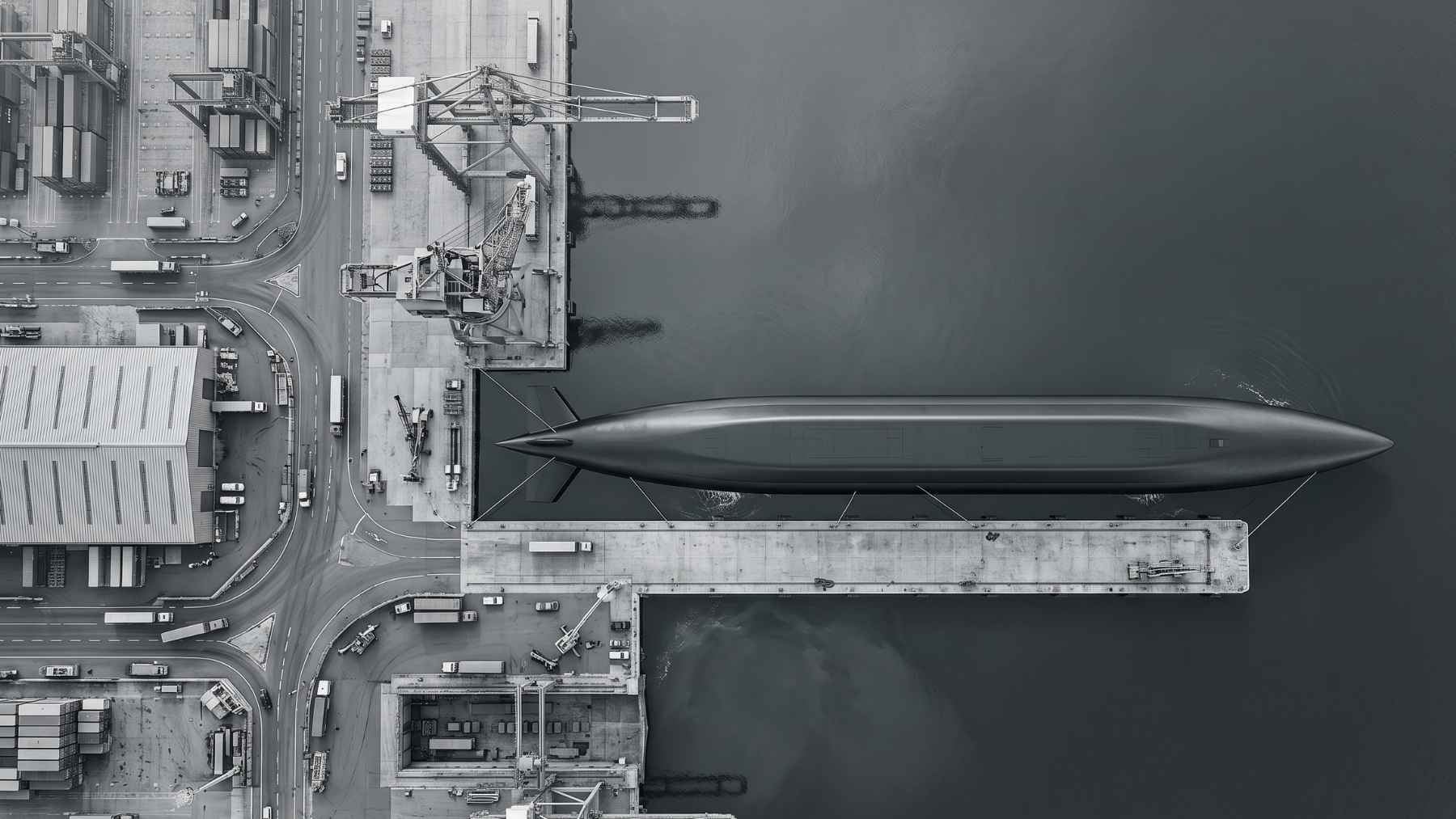
Seventy-three years later, satellite images out of Shanghai suggest China just pulled a similar move, except this time the strange part isn’t the hull, it’s what’s missing on top. A new submarine with no recognizable sail has shown up at the same shipyard that floated a smaller ‘sailless’ test boat eight years ago. This one isn’t a scale demonstrator. It’s full-sized, it’s widely assumed to be nuclear-powered given its dimensions, and it’s parked next to a jetty barge looking like nothing currently in the U.S. fleet.
What the satellites actually saw at Jiangnan
The imagery was first reported by Naval News and then picked up more widely, with The War Zone running shots from commercial provider Vantor, the outfit that used to be called Maxar. Naval News, which broke the story, says the boat first turned up at Jiangnan (JN) Shipyard in Shanghai around the end of May; the imagery TWZ published was captured on June 1. Nobody outside China knows its name or designation yet.
So what’s in the pictures. A streamlined bow, an X-shaped stern, and a hull that sits almost flat against the waterline. No tower, no fin, none of the conning structure that’s been standard on basically every operational submarine for more than a century. The closest thing to a sail, according to undersea-warfare analyst H.I. Sutton, is barely a bump in the casing. Sutton, writing for Naval News, put the boat at roughly 394 feet (120 meters) long and somewhere around 33 to 36 feet (10 to 11 meters) across.
For scale, that’s bigger than a Virginia-class. The U.S. Navy’s Virginia-class attack boats run about 115 meters. The Chinese one is longer, narrower, and has no obvious place to stick a periscope, which is a polite way of saying nobody outside Beijing is sure what it’s for yet.
Why ditching the sail is a bigger deal than it sounds
The sail — that tower you picture when you picture a submarine — isn’t decoration. It’s where the periscopes, communication masts, snorkels and antennas live, plus countermeasure launchers and a bit of storage, and it’s where the crew stands when the boat surfaces in port. Take it off and the hull gets a lot cleaner, which is the whole point.
A submarine that isn’t dragging a big fin through the water is faster, more maneuverable, and quieter, which in submarine terms means harder to find. That matters most when a boat wants to sprint toward a threat without announcing itself on every sonar array between here and there. Exactly how much drag the sail costs is the kind of figure that gets tossed around loosely; the credible analysts who’ve studied the imagery will only say the savings are meaningful, not put a clean percentage on it.
The trade-offs nobody’s pretending don’t exist
You don’t delete a fundamental piece of submarine architecture for free. Where do the periscopes and antennas go. How does the boat ventilate. The working assumption is that the Chinese designers buried all of it in the hull behind flush or retractable hardware, because that’s the only setup that makes sense, but nobody’s confirmed it.
The other obvious cost is ice. U.S. and Russian boats use their sails to punch up through Arctic ice when they need to surface, and a sailless hull can’t do that. Analysts note the Chinese fleet barely operates in the Arctic anyway, so it’s a problem China can afford to ignore. Which is a very Chinese answer: we don’t go there, so why design for it.
The stern is its own tell. That X-form arrangement is more agile than the usual cruciform tail, and there’s what looks like a shrouded propulsor back there too. Analysts think it could be a pumpjet, the kind of setup that keeps a boat quiet at higher speeds, where an open propeller would start to cavitate and sing.
This didn’t appear out of nowhere
The thing that’s easy to miss is how long Jiangnan has been circling this idea. A smaller sailless boat showed up at the same yard back in 2018; Sutton pegged that one at around 150 feet (45 meters) long and maybe 15 feet across. It mostly dropped out of sight afterward, which in hindsight looks less like a cancelled project and more like a quiet one. That older boat, by the way, is reportedly still sitting on the quayside at Jiangnan.
Then came 2024. At that year’s Zhuhai Airshow, state shipbuilder CSSC (Jiangnan’s parent company) put a model on display of an unusually large uncrewed underwater vehicle running on diesel-electric power, and its shape looked an awful lot like that original 2018 boat. CSSC pitched the drone as something you could reconfigure to hunt enemy ships, lay mines, ferry special-operations teams, or act as a mothership launching its own smaller robots.
Line up the three dots, the 2018 test boat, the 2024 drone concept and the 2026 full-size hull, and it stops looking like a one-off bet and starts looking like a program.
What it probably isn’t, and what it probably is
One thing the analysts feel fairly good about: this isn’t a boomer. At close to 400 feet but with that narrow beam, the hull looks too skinny to house China’s JL-3 submarine-launched ballistic missiles, which need much fatter launch tubes. Ballistic-missile boats are wide. This one is long and lean.
Propulsion is murkier. Most experts lean nuclear simply because of the size, but there’s a second candidate that’s been circulating around Chinese yards: a “nuclear-AIP” setup that pairs a small, low-power reactor with air-independent propulsion to stretch endurance without the cost and complexity of a full-size nuclear attack boat. China has already built one boat in that mold, the Type 041 Zhou class, which turned up at Wuhan’s Wuchang shipyard in 2024 and then, awkwardly, sank at its fitting-out pier before it could prove much of anything.
As for what the thing is actually for, Asia Times, building on TWZ’s analysis, floats the idea that the design may be optimized for the seabed rather than the surface. Strip out the sail and the masts that go with it, and you free up room for other gear while optimizing for quiet, fast transits, or for work down on the ocean floor, where raising a periscope matters a lot less.
The industrial story is the loud part
The boat is interesting. The rate at which China is turning out boats is the part keeping Pentagon planners awake. While the U.S. and its allies strain to launch even one or two submarines a year, China has put somewhere between 15 and 20 into the water over the past five years, across roughly eight distinct classes. That’s not a typo.
And Jiangnan producing a nuclear-powered hull is a milestone on its own. By most readings this is the second brand-new class of Chinese nuclear-powered submarine to surface in 2026, after satellite imagery earlier in the year caught the first Type 095 (Type 09V) attack boat fitting out at Bohai. If Jiangnan keeps building, China would have three separate yards capable of turning out nuclear submarines, and its production capacity had already pulled ahead of both the United States and Russia before any of this.
That last fact is the one that doesn’t unwind on a five-year timeline. It rhymes with the broader problem U.S. planners keep running into, the one where China controls the industrial back-end of a startling share of Western defense hardware, from rare-earth magnets on up. With no official word from Beijing (Chinese authorities rarely announce a first-in-class launch), outside assessments rest entirely on satellite imagery and the analysts reading it.
So how worried should anyone actually be
The honest answer is that nobody outside a small circle in Shanghai knows what this boat does, how quiet it really is, or when it’ll be operational. The hull shape implies stealth, the dimensions imply nuclear, the lineage implies a long-running program, and the timing implies parallel production. None of that adds up to a confirmed capability, and it’s best treated as informed guesswork until more imagery shows up.
What’s clear enough is that an idea Western navies kept parked on the drawing board for decades just got built at full scale by someone else. Sailless concepts go back a long way, from Cold War Soviet experiments to a Spanish naval architect’s patent in the 1990s, and Sutton reckons this Chinese boat is probably the first full-sized sailless submarine anyone has actually put in the water. The same competition that has the Pentagon scrambling to onshore the materials inside its own weapons is now playing out on the hull of a submarine. Jiangnan, it seems, got tired of paper.