
Solar panels have been screwed onto roofs, floated on reservoirs and, in California, strung over irrigation canals. The one place they keep dying is anywhere vehicles actually touch them. France found that out with Wattway, the €5 million solar road in Normandy that cracked, peeled and got partially demolished within three years. We ran the full autopsy on that one.
So when a Swiss startup said in 2025 that it would lock photovoltaic panels between the rails of a working train line and let regional trains hammer over them all day, the reasonable move was to bookmark the story and wait for the failure photos.
Fourteen months in, those photos don’t exist. Sun-Ways founder Joseph Scuderi told Swissinfo in late June that more than 11,000 trains have now rolled over the panels in Buttes, Switzerland, and that the installation stayed “perfectly stable and safe during their passage.”
The operator running the line agrees. And the phone keeps ringing: France’s SNCF signed a collaboration contract in February, Italy’s rail infrastructure manager is discussing a pilot before the year is out, and South Korea has already approved one of its own.
48 panels, 11,000 trains, and no excuses yet
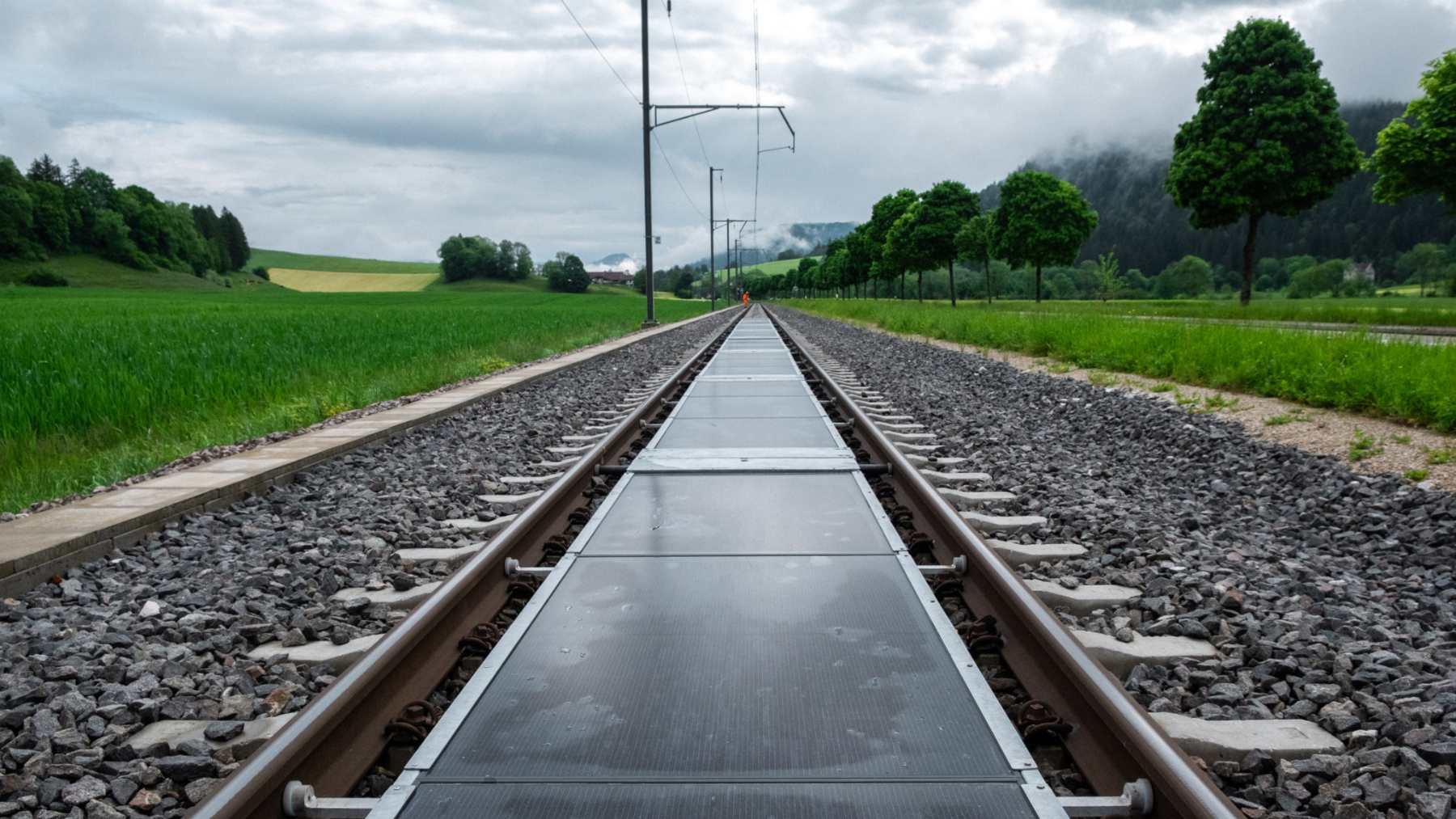
The test site is a 100-meter stretch (about 330 feet) of regional track in Buttes, a village in canton Neuchâtel in western Switzerland, operated by TransN. Sun-Ways installed the plant in April 2025: 48 panels rated at 380 watts each, sitting on the sleepers between the rails, for a total of 18 kW.
It is the world’s first removable solar power plant on a line open to rail traffic, a system we broke down in detail when the trains started rolling.
The silicon was never the hard part. The hard part is a patented locking connection that has to hold every panel still while trains pass inches above them at up to 90 km/h (56 mph), dozens of times a day. If a clamp backs out or a module shifts, you don’t have an underperforming solar plant. You have a derailment hazard.
Eleven thousand passes later, nothing has moved. And the plant has been producing the whole time: more than 16,000 kWh fed into the local grid since May 20, 2025, despite roughly a month offline for snow and some planned work to integrate a technical component.
That’s the annual draw of three to four households, which sounds like nothing until you remember the wattage was never the point of this pilot. The mounting hardware was.
The operator’s one-year verdict is that nothing happened
Startups grade their own homework generously. Rail operators don’t. TransN, the public transport company of canton Neuchâtel, told Swissinfo by email that the system hasn’t clashed with anything in a year of service: not the infrastructure, not maintenance work, not train traffic.
The assessment came from company spokesperson Aline Odot, and in railway language that counts as a rave review.
Glare was supposed to be the deal-breaker. The International Union of Railways flagged it early on, along with micro-cracks and fire risk, and Sun-Ways responded with a tougher panel build and an anti-reflective coating. One year in, TransN says not a single driver has reported being dazzled.
Swiss Federal Railways, which runs most of the national network, is monitoring the project without joining it. The state operator prefers to put its own solar on things that don’t get run over: station roofs, noise barriers, maintenance centers. Which is exactly the posture you’d expect from a giant public railway. Watch closely, sign nothing, let the startup carry the risk.
Ten minutes to pull a module, and the cleaning system fired itself
Maintenance access is what killed most previous solar-on-track concepts. Rails need grinding, sleepers need swapping, welds need redoing, and no operator will accept panels that turn a two-hour repair into a two-day argument with an installer.
Sun-Ways’ answer is that everything comes apart fast. With dedicated tools, a crew can unhook a module of three panels, about six meters (20 feet) of hardware, from both the track and the power grid in roughly ten minutes.
Laying the things down is even quicker. Scheuchzer, the Swiss track-maintenance firm, built a dedicated machine called PUMA that Sun-Ways says can install up to 150 panels an hour, unrolling them along the track like carpet.
Cleaning turned out to be a problem that solved itself. The original plan was a cylindrical brush bolted to the back of trains to sweep dust off the cells. Scuderi told Swissinfo they scrapped it after noticing that the slipstream from every passing train blows the panels clean on its own. The cleaning crew is the timetable.
SNCF signed in February. Italy wants a pilot running by December
France moved first. In February, SNCF announced a technical cooperation contract with Sun-Ways, and the company’s own announcement spells out what it gets: pilot data, experimental feedback and the startup’s technology assessments, all the way to the end of the test in April 2028. SNCF Réseau and the group’s innovation directorate are specifically studying what removable panels do to maintenance operations.
The motivation isn’t subtle. SNCF describes itself as France’s biggest electricity consumer and its second-biggest landowner, it operates roughly 28,000 km (17,400 miles) of lines, and per Swissinfo it wants photovoltaics covering 20% of its energy consumption by 2030.
Scuderi calls the French operator a key partner, both for the size of the prize and for the credibility it lends the Swiss test.
Italy is the newer name on the list. Scuderi says he’s in contact with Rete Ferroviaria Italiana, the public company that manages the country’s rail infrastructure, with the idea of getting a pilot organized before the end of the year.
RFI wants large amounts of solar feeding its railway traction grid, and building plants on land next to the tracks means slow, expensive expropriation procedures. Panels between the rails skip the land fight entirely, because nobody has ever sued to protect the view between two rails.
Korea already has government approval. Indonesia flew in to look
Asia is further along than most people assume. In September 2025, the Korea Railway Solar Power Generation Project received government approval to install solar panels near Osong station in Chungcheongbuk-do province. That pilot runs two years, with the option of expanding nationwide if it holds up.
Indonesia’s interest has a name attached too: Mutitron Automa, a solar engineering company whose director, Dieter Napitupulu, traveled to Buttes for the 2025 inauguration. His verdict, given to Swissinfo, is caution. The technology still needs more field testing before his market can commit.
Japan’s transport ministry (MLIT) has been tracking the project since launch, as Swissinfo reported at the time, with open questions about operating safety and track maintenance that Tokyo wants answered before anything moves.
The math everyone is chasing, and the one problem left to solve
Nobody is signing agreements over 16,000 kWh. They’re signing over the extrapolation. Sun-Ways estimates that Switzerland’s roughly 5,320 km (3,300 miles) of railway, minus tunnels and poorly lit sections, could generate up to one billion kWh of solar power a year.
That’s the consumption of 300,000 households, or about 2% of the electricity Switzerland uses.
Rail corridors come with advantages no greenfield solar site can match. They’re already fenced, already engineered, already next to grid connections, and already politically settled. In a country where big Alpine solar farms keep running into local resistance, that last part is worth more than the silicon.
There is one genuine engineering wall left. Julien Pouget, an associate professor at the University of Applied Sciences of Valais (HES-SO) who studies solar on linear infrastructure, told the Swiss daily 24heures that current technology can’t properly collect and move the power once a stretch runs past about 500 meters. The fix requires a specific electrical architecture that steps the current up to high voltage for transport.
A proposed solution, co-authored by Pouget, other HES-SO professors and the Sun-Ways founder, gets presented in Paris in August at a meeting of the International Council on Large Electric Systems.
The pilot officially runs until April 2028, a duration the Federal Office of Transport insisted on. Scuderi is now openly lobbying to shorten it, arguing the safety case is already made and that final approval is what’s holding his foreign partners back. He may or may not get his way with the Swiss regulator. But consider where the bar was: the last time somebody put solar under vehicles, the story ended with a demolition crew. This one is ending, so far, with governments asking to go next.
 @paultobiason ROOKIE3 months ago