
Russia is about as walled off from the world economy as a large country can get. Its oil trades at a discount, its biggest banks are locked out of Western finance, and a lot of its trade now moves through back channels.
Its nuclear business didn’t get the memo.
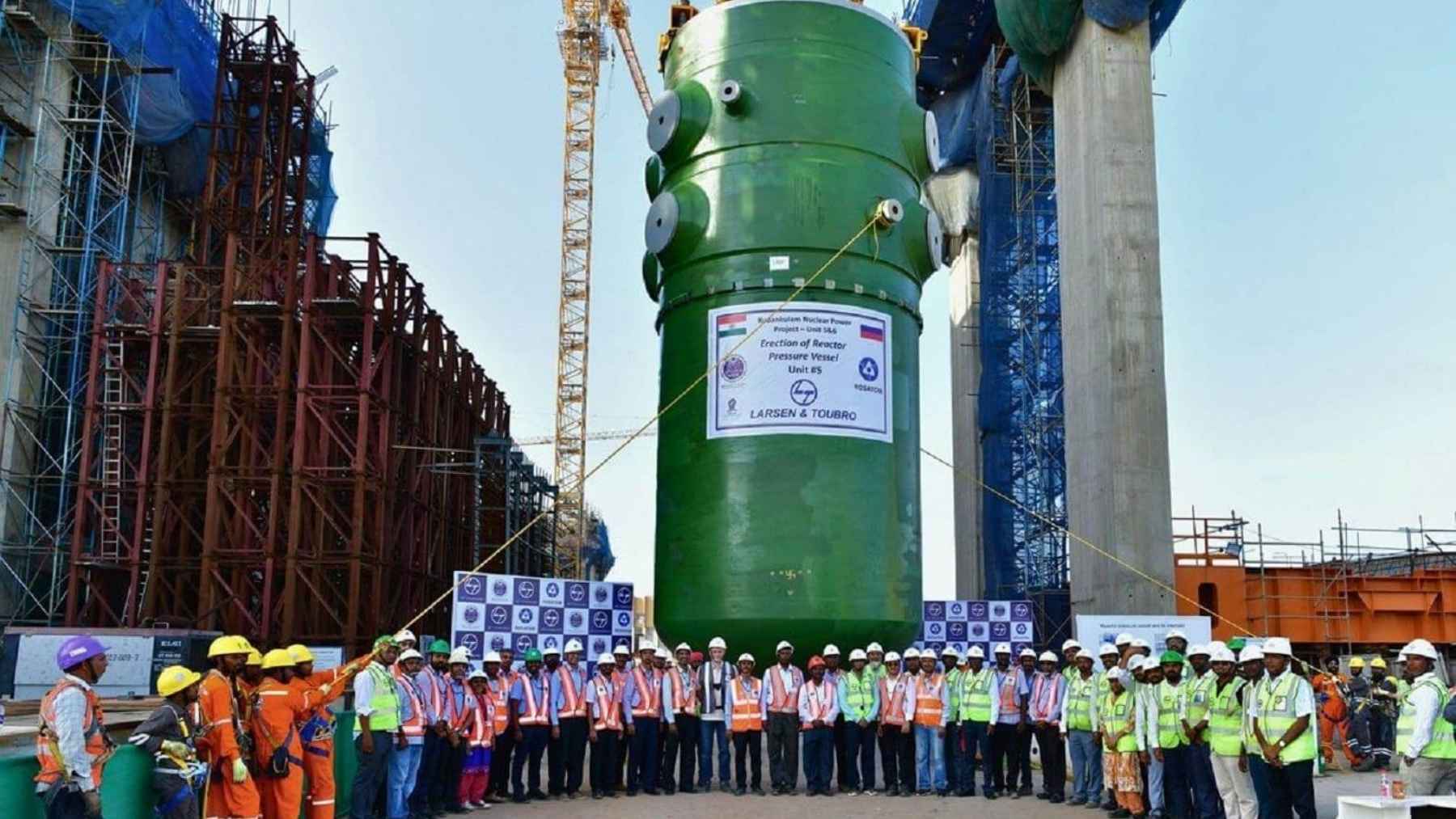
The clearest proof landed this month in southern India, where crews at the Kudankulam plant lowered a 320-ton steel reactor vessel through the open roof of Unit 5 and sealed the building over it. The part was forged thousands of miles away, at a single factory in southern Russia that keeps turning out the one component almost nobody else can make and shipping it around the planet.
A 320-ton can, lowered through the roof
Kudankulam Unit 5 is one of six reactors going up on the coast of Tamil Nadu, a state of 72 million people. Units 1 and 2 have been running for years. Units 3 through 6 are still under construction, and Unit 5 just hit the milestone that turns a building site into an actual reactor: the vessel is in.
Getting a 320-ton object (about 350 US tons) into a reactor building is not subtle work. Instead of threading it through a doorway once the walls are up, the Russian-Indian team used what the industry calls the “open top” method reported by World Nuclear News: leave the roof open, lower the vessel straight down from above with a heavy-lift crane, then build the containment dome over it. The same approach was used earlier on Kudankulam’s Units 3 and 4. Turkey pulled off a louder version of the trick at its Akkuyu plant, dropping its vessels in from above with one of the most powerful cranes on Earth.
With the vessel seated, the rest of the primary circuit can finally go in around it: the steam generators, the main circulation pumps, the pressurizer, the coolant piping, the emergency cooling tanks. India’s nuclear regulator, the Atomic Energy Regulatory Board, had to clear major equipment erection before any of that could start. NPCIL, the state operator, described the lift as a major construction milestone for the site.
The factory on the Don that runs vessels like a production line
That vessel came from a place called Atommash, in the city of Volgodonsk in southern Russia, on the Don River. It started life in 1976 as a Soviet mega-project built to mass-produce reactor parts, fell on hard times after the Cold War, and is now the reactor-equipment arm of Rosatom, the Russian state nuclear corporation.
The difference is volume. Forging a single seamless reactor vessel is one of the hardest jobs in heavy industry, and most plants that can do it turn out only a handful a year, squeezed in around everything else. The West effectively lines up behind one Japanese forge in the port of Muroran for its biggest vessels. Atommash runs it the other way. By Rosatom’s own account, the plant is set up to build up to four complete sets of reactor equipment a year, on a line, feeding its own pipeline of projects.
Shipping the output is its own saga. The pieces are too big for a normal road, so crews temporarily take down trolleybus wires along the route to move them to a port terminal on a reservoir near the plant. From there the equipment goes by sea. Rosatom has clocked those voyages before: roughly 3,000 kilometers to Turkey, about 14,000 kilometers to Bangladesh. India’s vessel made a similar trip in 2025 and sat on site until the building was ready for it.
The same line that feeds Turkey, Egypt and Bangladesh
The Kudankulam vessel is a VVER-1000, the workhorse Russian reactor. The same factory is turning out the bigger VVER-1200 vessels for other customers at the same time.
In Turkey, Atommash has been building the vessels for Akkuyu, a four-reactor plant on the Mediterranean aiming to switch on its first unit by the end of 2026. In Egypt, it’s producing reactor equipment for El Dabaa, another four-unit Russian build on the coast. Bangladesh’s first-ever nuclear plant, Rooppur, got its steam generators from the same line. China is on the customer list too.
Add it up and it’s less a factory than a supplier to an empire. Rosatom is building dozens of reactors outside Russia right now, with four more due to switch on in 2026, and by most counts the largest foreign order book in the business. Atommash is one of two Russian plants doing the heavy forging that makes all of it physical. The other, the Izhora works near St. Petersburg, forged the vessel for Hungary’s new reactors, the first Russian-designed plant going up inside the European Union.
The Russian export sanctions never really stopped
None of this is supposed to be easy in 2026. Russia sits under the heaviest Western sanctions of any major economy, and the reactor projects haven’t been immune. Turkey’s Akkuyu lost about two billion dollars in frozen funds and watched Siemens walk away from equipment it had already paid for, forcing Rosatom to find replacements on the fly.
But Rosatom the company has mostly dodged the sweeping measures that hit Russian oil and gas. The Centre for Eastern Studies, a Polish government think tank, notes that unlike much of Russia’s energy sector, the nuclear corporation has not faced significant Western sanctions, which is precisely why it can keep signing contracts and shipping steel. Hungary’s reactor project was even pulled off the sanctions lists in 2025.
There’s a logic to that most customers understand going in. Once a country builds a Russian reactor, it also buys Russian fuel, Russian servicing and Russian financing, often for decades. The vessel going into the ground in India is the front end of a 60-year relationship.
Kudankulam still has four reactors to finish
Back in India, the vessel is in but the reactor is nowhere near done. Unit 5 still needs its steam generators, pumps, piping and cooling systems installed and tested before it can ever see fuel. Unit 6 is behind it, Units 3 and 4 are ahead, and Unit 3 is the next one lined up to start.
When all six are running, Kudankulam is designed to put out 6,000 megawatts, one of the largest nuclear stations in India, feeding a southern grid that badly needs the power.
The engineering headline is a crane and a 320-ton lift. The real story is the address on the shipping label. India didn’t just install a reactor vessel this month. It took delivery from a factory on the Don that has turned the world’s hardest steel casting into something close to routine, with a waiting list running from Turkey to China to prove it.












Imagine if Krsna got a Nuclear plant built, its Spent fuel, Reactor Vessels and Nuclear Waste would still be Lethal for another 95,000+ years. This is the REAL LEGACY of Nuclear Power... mortgaging the future of mankind for a few decades of Electricity... I sympathies with THE PEOPLE of Chennai abd Tamil Nadu...😢😢😭😭