
This week, the president of a small helium company stood up at a quantum technology conference in Boston and made an unusual pitch. Before anyone spends billions flying rockets to the Moon to scrape helium-3 off the lunar surface, he said, maybe check Minnesota first.
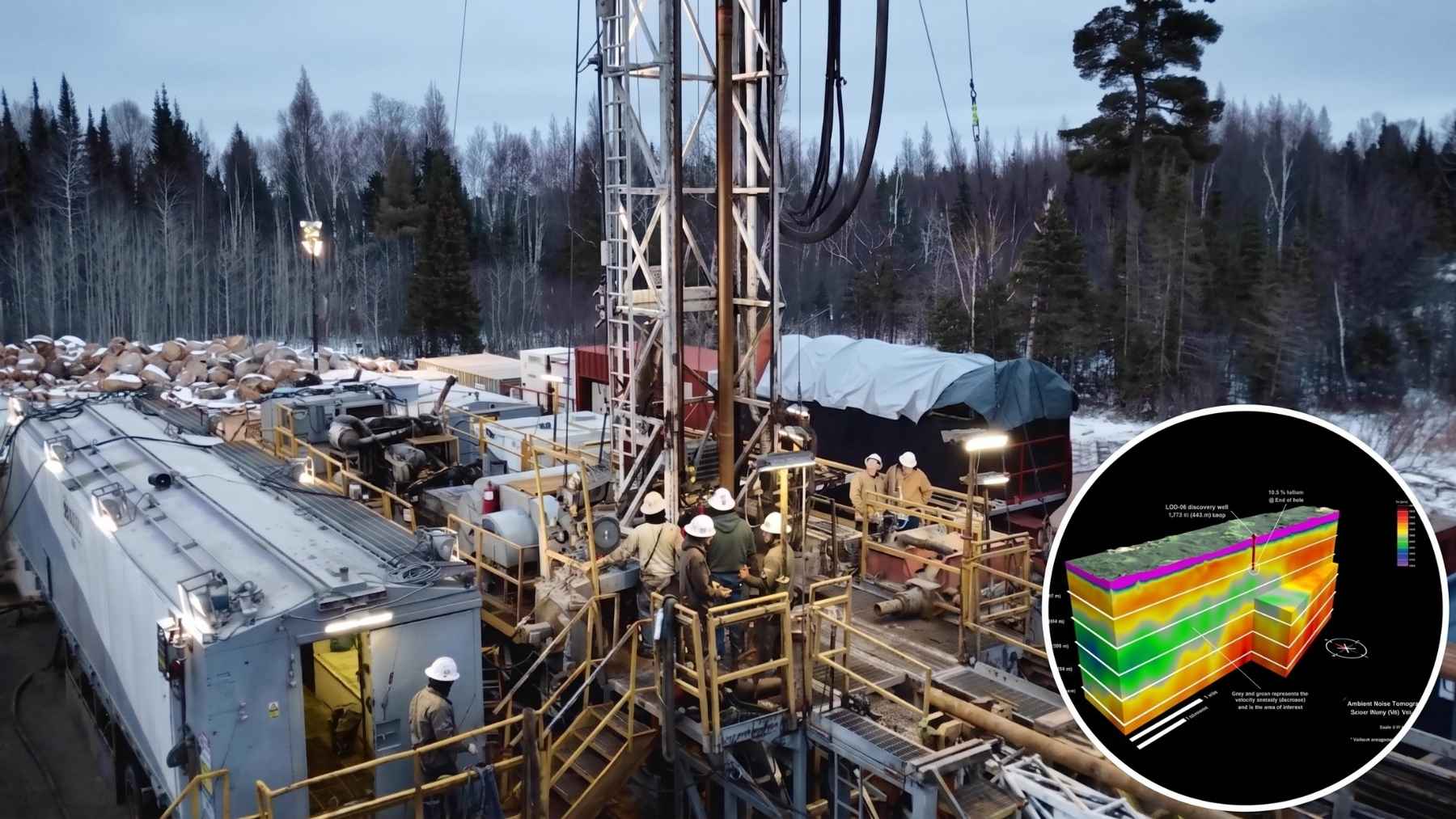
That sounds like a stretch until you look at what two U.S. federal laboratories signed off on. A gas well at Pulsar Helium’s Topaz project, in northeastern Minnesota about 60 miles north of Duluth, holds some of the richest natural helium-3 ever measured in a reservoir on Earth. Not a model, not a press-release adjective. Government labs ran the raw gas and landed on the same numbers the company did.
Helium-3 is the reason that pitch is not as silly as it sounds. It is one of the rarest things you can legally buy, it sells for around $2,500 a liter, and the machines cooling the world’s quantum computers cannot run without it. The usual way to get it runs through nuclear weapons, which is exactly as constrained as it sounds.
Two federal labs ran the gas and landed in the same place
Back in January, the USGS Noble Gas Laboratory in Denver and Lawrence Livermore National Laboratory in California each analyzed a raw gas sample from the Jetstream #1 well. Both put the helium-3 at 11.2 to 11.9 parts per billion. A third lab, the Woods Hole Oceanographic Institution, had measured roughly the same thing earlier.
Eleven parts per billion sounds like a rounding error, and for almost anything it would be. For helium-3 it is enormous. An earlier reading from the same well ran as high as 14.5 ppb, a level the company says falls inside the range estimated for lunar soil (about 1.4 to 15 ppb). On Earth, numbers like that almost never turn up.
The sample was collected by Dr. Peter Barry of Woods Hole, the company’s helium-3 advisor, using sealed copper tubes, which is the standard method for this kind of work. Portions went to all three labs blind, and they agreed. That agreement is the whole story, because helium-3 claims are easy to make and hard to trust until someone independent checks them.
The helium carrying the isotope is unusually rich too. Flow tests put Jetstream #1 at about 8.1% helium and a second well at 5.6%. The industry generally treats anything above 0.3% as potentially worth producing, so Topaz is running more than 20 times the usual cutoff.
Why a liter of it costs more than a car
Helium-3’s price, around $2,500 a liter or north of $18 million a kilogram, is not about marketing. It is about where the gas comes from, which is almost nowhere.
Nearly all the helium-3 the world uses is a leftover from nuclear weapons. Tritium, the radioactive hydrogen isotope packed into thermonuclear warheads, decays into helium-3 with a half-life of about 12.3 years. Governments capture what bleeds off the stockpile and sell it. That is the supply chain. There is no mine.
The shortage is not new. It bit hard in the late 2000s, when the U.S. started buying neutron detectors by the thousand after 9/11, since helium-3 is the material of choice for spotting smuggled nuclear material, and demand blew past what the warheads were shedding. Russian supply, the other big source, has been off the table for Western buyers since 2022.
Despite the headlines, America did not technically run out. A 2021 Department of Energy document put the national stockpile at roughly 90,000 liters, up from about 50,000 during the 2010 crunch, according to Science. But it is rationed through a federal allocation program, and the warheads are not shedding it any faster. The decay rate is fixed. You cannot drill a bomb.
Quantum computers can’t get cold without it
The demand is all heading one place. Every leading superconducting quantum computer, IBM’s and Google’s included, has to be chilled to within a hair of absolute zero, somewhere around 10 to 20 thousandths of a degree above it. The only practical machine that gets there is a dilution refrigerator, and a dilution refrigerator runs on a mix of helium-3 and helium-4.
Take the helium-3 out and the fridge stops being a fridge. There is no substitute. The cheap helium-4 handles the upper stages of the cooling chain, and helium-3 does the final, coldest job, and that job has no backup material.
These coolers are not cheap, and the gas is the reason. A single unit can run past $600,000, and up to a quarter of that price can be the little droplet of helium-3 inside. Physicist Silke Paschen put the value plainly to Science: “You cannot buy a perfume that’s so expensive,” she said.
Demand is climbing while the warhead supply shrinks. The exact figures vary by source, but the rough shape is global production in the tens of thousands of liters a year against demand that several analyses put higher, with quantum computing, neutron detection and fusion research all drawing from the same small pool.
Minnesota or the Moon
This is the backdrop for the pitch in Boston. With the warhead stream finite and getting tighter, governments and private companies have started looking up. The Moon’s soil has been soaking up helium-3 from the solar wind for billions of years, and several outfits are spending real money on plans to go dig it out.
The U.S. already has an agreement with a startup, Interlune, under the Department of Energy’s isotope program to eventually mine the stuff up there, a War on the Rocks analysis noted. When a billion-year-old gas pocket in Minnesota counts as the down-to-Earth option, that tells you how short the list of sources really is.
So at the Quantum Tech World conference in Boston, held June 25 to 27, Pulsar’s president, Cliff Cain, pitched Topaz as the terrestrial alternative. “Minnesota offers a practical opportunity here on Earth,” he said, arguing a domestic, already-accessible source beats launching rockets at the problem.
The case is not nothing. A gas well does not depend on the size of a nuclear arsenal, and it sits next to roads, grid power and an experienced mining workforce rather than on the far side of a 240,000-mile supply line. That is a real argument, and it is why Pulsar wants U.S. agencies at the table.
The wider helium market is not getting easier, either. The U.S. Geological Survey projects that global helium production capacity will stay roughly flat through 2029, and that is ordinary helium-4, the easy kind. The rare isotope is a harder problem sitting on top of an already tight one. It is the same supply paradox that has Gulf states importing sand while sitting on a desert the size of France: the thing looks abundant right up until you need a specific, hard-to-make version of it.
The measurement was the easy part
Earlier this month the company said it had finished drilling all seven of its Topaz exploration wells, every one of which hit pressurized gas, and was shifting from asking whether the gas is there to whether it can produce it. Minnesota only finalized the rules for producing helium as a commodity in June. Production-ready drilling is set to start in September.
The honest caveats are large. No reserves have been assigned to the project yet. The economics have not been published, with a resource update and the first economic study due around the middle of this year. And by the company’s own admission, no commercial technology running anywhere yet separates helium-3 from helium-4 in a gas stream at scale.
The helium-3 under Topaz has been sitting there for a very long time, trapped in some of the oldest rock in North America. Finding it was almost an accident. A driller looking for nickel hit the gas back in 2011, long before anyone was thinking about quantum fridges.
The hard part was never the geology. It is pulling one isotope cleanly out of the other, at a price someone will pay, in volumes that matter to a quantum lab. Three labs agree the gas is real and rich. Nobody has yet shown they can do the rest at scale. Whether the answer ends up being Minnesota or the Moon, that gap, between a remarkable measurement and a working supply, is still the whole game.
 @stevenbosse ROOKIE2 months ago