
Every few months a new fight breaks out over a cobalt mine somewhere on land. A coup in the Congo, a permit dispute in Indonesia, a price spike that sends battery makers scrambling. The whole supply chain for the metals that go into an EV battery runs through a handful of unstable places, and most of the refining runs through exactly one country. So the obvious move is to find more of these metals somewhere nobody is fighting over yet.
It turns out the largest untapped pile of them is sitting four kilometers under the Pacific, in the dark, in the shape of rocks roughly the size of an apple. Nobody planted them there. They grew, one atomic layer at a time, over a span that makes human history look like a rounding error. And after decades of being a science-paper curiosity, the race to vacuum them off the seabed just officially opened in the United States.
What is actually down there
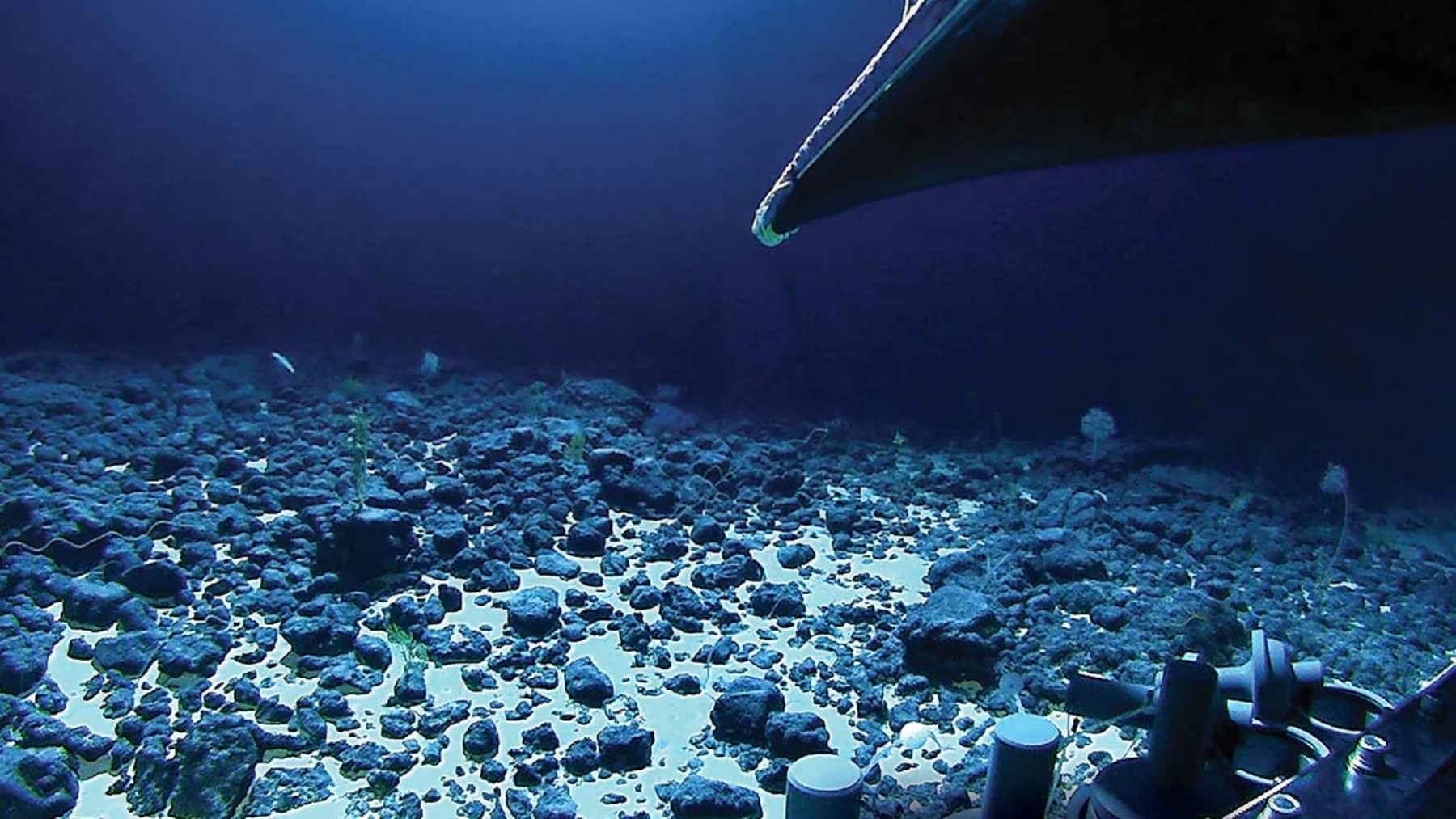
The place everyone is circling is the Clarion-Clipperton Zone, a stretch of seafloor running roughly 1.7 million square miles across the Pacific southeast of Hawaii, sitting around 4,000 meters down. Scattered across the muddy bottom of that zone are polymetallic nodules, dark lumpy formations that the people who study them tend to compare to potatoes. Inside each one is a concentric layer cake of manganese, nickel, cobalt and rare earth elements, the exact shopping list for a modern battery and a fair chunk of modern electronics.
Here is the claim that gets this story written in the first place, and it deserves to be quoted carefully. Writing in the U.S. Naval Institute’s Proceedings, submarine officer Lieutenant Commander James Halsell notes that the nodules in the CCZ hold cobalt, nickel, manganese and rare earths “often in greater abundance and purity than their terrestrial counterparts.” That is the responsible version. The flashier version you will see floating around, that these rocks contain more cobalt and manganese than every land deposit combined, is plausible by some estimates but should always be read as per-metal and per-estimate, not as gospel. The deep ocean is the least-surveyed place humans try to put a number on.
The part that is not in dispute is how long these things take to make. The metals precipitate out of seawater and settle onto a nucleus, a shard of rock or an old shark tooth, building up at a pace that the Smithsonian’s ocean program measures in millimeters per million years for the slow type. A nodule the size of your fist may have started forming before our species existed. We are about to suck them up at the rate of a vacuum cleaner.
The vacuum cleaner is not a metaphor
That comparison is not me reaching for a punchline. It is the actual engineering. The Metals Company, the firm furthest along in trying to do this commercially, describes its method in plain terms to NPR: a large machine crawls along the seabed, picks the nodules up, and sends them up a pipe to a ship on the surface. The company has filed to bring up more than a million tons of them over a 20-year lease in the CCZ. In a 2022 trial it hauled roughly 3,000 metric tons to the surface, which is one of the few times anyone has done this in deep water at all.
The reason this is hard is the same reason the metals are valuable. Four kilometers of cold saltwater sits between the prize and the ship, and almost nothing built by humans likes operating down there. What changed the math is the same wave of autonomous underwater vehicles and remote platforms that the Navy article credits with overcoming the once-prohibitive cost of working at extreme depth. Japan is leaning on the exact same idea, with a national agency building a deep-sea drone to scout rare-earth deposits 6,000 meters down, a project we covered in our look at Japan’s seabed robot. The robots got good enough first. The mining is following them down.
America just finished the paperwork
For most of the last decade, the rulebook for mining international waters has been written, slowly, in Kingston, Jamaica, by the International Seabed Authority. As of January 31, 2026, the ISA had issued 31 exploration contracts to 21 contractors, according to a Congressional Research Service report, and not one of them has graduated to commercial mining. The body’s mining code has been stalled since 2014 over fights about environmental standards and money. China holds five of those contracts, the most of any single country, and several analysts read that stockpile as exploration permits waiting to be flipped into mining permits the moment the rules are finalized.
The United States decided not to wait in that line. It never ratified the treaty that created the ISA, so it is playing a different game entirely. On January 21, 2026, the National Oceanic and Atmospheric Administration issued its final rule consolidating the application process under a domestic law, the Deep Seabed Hard Mineral Resources Act. Where companies used to apply to explore and then separately apply to mine, with an environmental review at each gate, they can now do both in a single filing. It is the difference between two checkpoints and one.
The companies moved fast. On May 1, 2026, NOAA determined that The Metals Company’s consolidated application was in full compliance with the law, which pushes it into the certification stage. The company says the next steps run through a draft environmental impact statement and a public comment window, and it expects a final decision on whether it gets the license and permit before the end of the first quarter of 2027. It is not alone. A second firm cleared the same compliance bar in early June, and the Associated Press counted at least nine companies in talks with the government, with sections of seafloor from American Samoa to Alaska potentially up for auction over the summer and fall.
Nobody knows what lives down there yet
Here is the catch, and it is a real one. The seabed everyone wants to vacuum is also habitat, and it is some of the least-understood habitat on the planet. NPR points to research finding that around 90 percent of the species in the Clarion-Clipperton Zone are unknown to science. The nodules themselves are part of the problem: on a muddy bottom with nowhere to anchor, they are the only hard real estate around, and somewhere between a fifth and a third of the local life depends on them. There is a translucent octopus down there, nicknamed Casper, that lays its eggs on sponges that grow on the nodules. Pull the nodules and you pull the nursery.
The companies are not pretending the impact is zero, and to their credit they funded the studies that produced the uncomfortable numbers. Scientists working with The Metals Company’s test sites and publishing independently found that two months after a mining test, the abundance of species in the area had dropped by 37 percent and biodiversity by 32 percent, per NPR, and nobody has been able to study the longer-term recovery. The Metals Company’s environmental manager argues those impacts, while real, are nowhere near as severe as what land mining does to places like the Indonesian rainforest, which is a fair point and also not much comfort to the octopus.
There is a second argument that has nothing to do with the seabed and everything to do with who controls the metals once they are out of it. The Naval Institute piece frames the whole thing as a strategic problem: by one set of estimates China controls as much as 80 percent of global rare-earth mine production and up to 90 percent of the refining, and the worry in Washington is less about running out of cobalt than about depending on a single supplier for it. That is the case the U.S. government is making for why these rocks are worth the trouble. It is the same anxiety driving everything from a U.S. company locking up a piece of Greenland’s rare earths to Japan’s seabed drones, and it is why a carpet of stones in the dark suddenly has a permitting fast lane.
So what happens to the rocks
For now, nothing has actually been mined. There is a final rule, a pile of applications, a frontrunner sitting in the certification stage, and a draft environmental review that still has to clear public comment before anyone gets a commercial permit. The earliest the leading company expects to be hauling nodules for sale is sometime in 2027, and that assumes the paperwork and the science both break its way.
What is genuinely new is that the question stopped being theoretical. For fifty years these nodules were a thing scientists photographed and geologists wrote papers about. Now there is a legal path, a fleet of robots capable of reaching them, and a strategic reason to hurry that overrides a lot of the usual caution. The rocks took millions of years to grow and they are not going anywhere on their own. Whether they spend the next decade feeding battery plants or sitting exactly where they are is about to come down to a federal environmental statement and a comment period, which is a remarkably ordinary way to decide the fate of something that old.