
A warship sitting in port runs on roughly the same logic as your phone on the nightstand. It draws power from a cord plugged into the wall, except the cord is a thick shore-power cable running from the pier, and the point is to let the ship’s reactors or engines ease off while the crew handles maintenance. This summer, the US Navy wants to run that cable the other way.
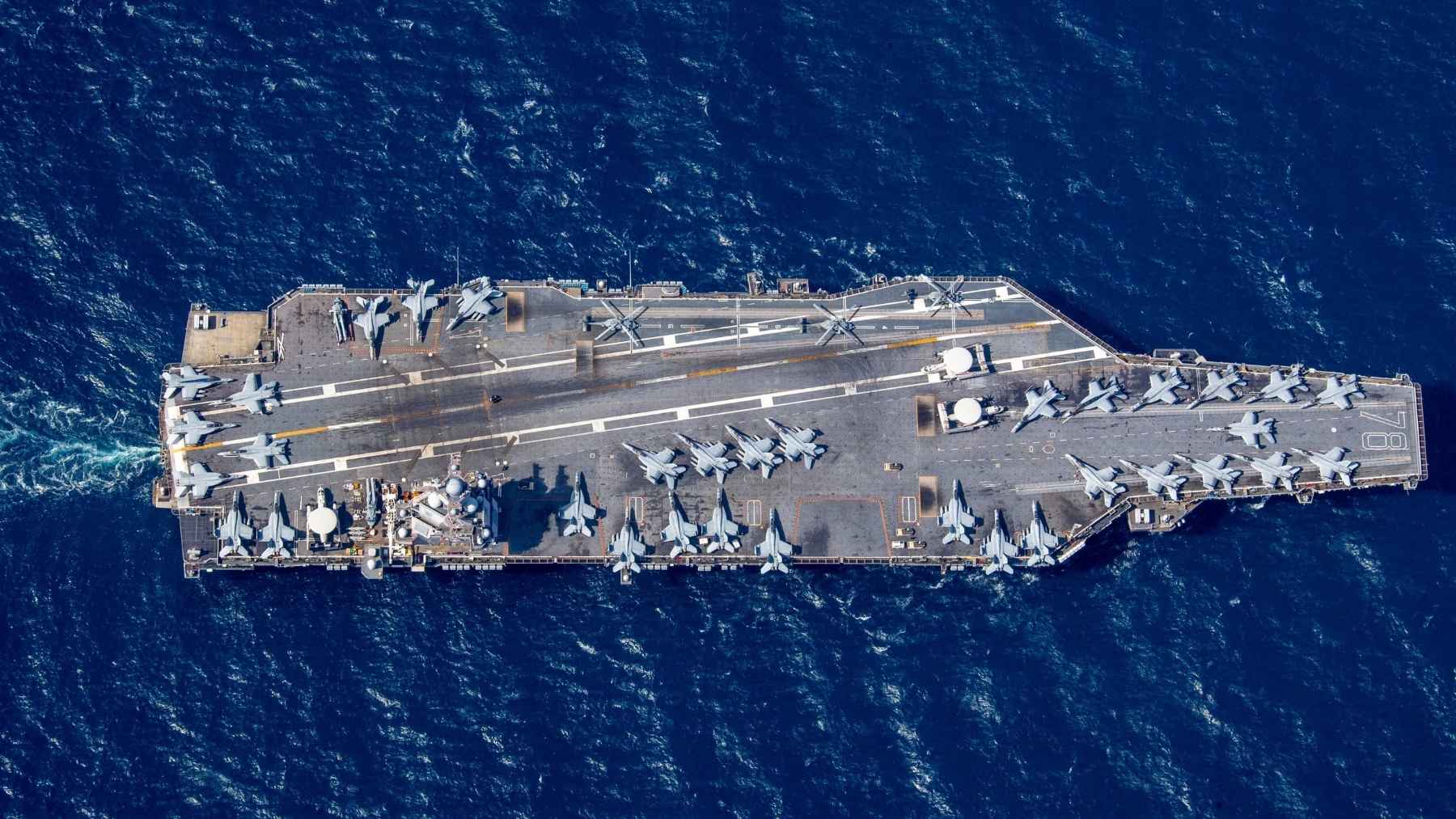
The plan is to plug the USS Gerald R. Ford, the largest warship afloat, into Naval Station Norfolk and power the base off the carrier’s two nuclear reactors. Acting Secretary of the Navy Hung Cao laid it out at a May 14 House Armed Services Committee hearing on the Navy’s 2027 budget.
“This summer, Norfolk Naval Base is going to be powered from an aircraft carrier,” Cao told lawmakers. “We’re going to export the energy from the aircraft carrier to the base.” A Navy spokesperson later confirmed that an initial test of the capability is being planned for Norfolk later this year, using a Ford-class carrier.
Norfolk would run off a carrier, at least for a test
The target is Naval Station Norfolk in Virginia, the largest naval base in the world. Cao stopped short of naming a specific ship, but the Ford is the obvious candidate. It is the only commissioned Ford-class carrier right now, it is homeported at Norfolk, and it just got home. The carrier returned in mid-May from a 326-day deployment, the longest for a US flattop since the Vietnam War, and it is heading into maintenance. So it is the carrier that is actually around to be plugged in.
The reason to bother is energy resilience. If a cyberattack, a drone or missile strike, or a plain old hurricane knocks out the civilian grid that feeds the base, a carrier tied up at the pier could keep the critical stuff running. Cao framed it as exporting power to the base, and went a step further, raising the idea of pushing electricity out to the surrounding area too. It is the same worry now driving civilian projects to keep dispatchable backup power on standby for the moment the grid gets stressed, except the backup here happens to be a 100,000-ton warship.
The reactors put out more than the Navy will tell you
The Ford runs on two A1B pressurized water reactors, and the name is basically a code. The “A” is for aircraft carrier, the “1” is the first generation of that core design, and the “B” is for Bechtel, the company that engineered them, according to the American Nuclear Society. BWX Technologies built the reactor cores and fuel. The exact output is classified, which is its own kind of answer. Public estimates put each A1B at around 700 megawatts of thermal power, so about 1,400 megawatts combined, roughly a quarter more than the A4W reactors on the older Nimitz-class carriers.
Here is where the floating-power-plant headline needs a footnote. That 1,400 figure is thermal output, and most of it goes into spinning the shafts and running what amounts to a small floating city of roughly 4,500 sailors and air wing personnel. The slice you could actually peel off and export as electricity is a fraction of the big number. As The War Zone has noted, a carrier’s reactors are built compact and wrapped in safety margins so they can live inside a warship, which means they put out far less than a full commercial power reactor, and they are sized to back up a base rather than feed a whole region. So picture a serious backup generator, not a replacement for the local utility.
It can also distill drinking water
Power is not the only thing those reactors can hand over. The same heat can run a distiller, and Cao pointed straight at it. “The energy that’s produced from these, we can also use it for a four-stage distiller making fresh, potable water,” he said, tying it to helping drought-stricken or disaster-hit regions. A carrier already makes its own water at sea, so the hardware is proven. Scaling it up to help a city is the new idea.
The honest catch is that none of this is as simple as a carrier pulling up to Puerto Rico after a hurricane and lighting the island back up. Shipboard electrical systems run at voltages and frequencies that have to be carefully synchronized with a land grid, and the Navy has not said what interface hardware it would use to make that connection. That is almost certainly why the first test is happening at Norfolk, where every piece of the puzzle, ship and shore, sits under the Navy’s own control. Prove it works in the controlled case first, then worry about the messy ones.
Floating nuclear plants exist, but not quite like this
The world already has a floating nuclear power plant, and it has had one for years. Russia’s Akademik Lomonosov has been moored off a small Arctic port since 2019, the only purpose-built floating nuclear plant running anywhere on Earth. South Korea’s Samsung Heavy Industries is working on its own floating nuclear station design, and non-nuclear floating power barges are already in service, like the ones Turkey’s Karpowership operates.
The difference is the starting point. Those are vessels built from the keel up to be power plants. The Ford is a $13 billion warship being asked to moonlight. What the Navy is not short on is reactor know-how, though, since it has spent decades using retired nuclear submarines as floating schoolhouses to train the sailors who run these cores. It is part of a broader stretch of navies rethinking what a ship’s power system is supposed to do, from carriers exporting electricity to the new wave of submarines built around novel onboard power generation. The Ford test just takes that thinking and points the cable at the dock.
The Navy doesn’t actually have carriers to spare
The limits are real, and the Navy knows them. Running a carrier as a power plant for days or weeks burns through reactor service life, and these ships are built around a mid-life refueling and complex overhaul that takes them out of action for years when it comes. The Ford was commissioned in 2017 and is not due for that overhaul for a good while yet, so there is little appetite for spending reactor hours parked at a pier playing generator.
And there simply are not enough carriers to go around. The Ford pulled a 326-day deployment in the first place because the fleet is stretched thin across too many hotspots. Tying up the most expensive warship ever built to back up a single base is not something anyone wants to lean on as a routine. This is a break-glass capability, not a business model.
The longer game is on land: Congress has been pushing to fund a nuclear-reactor pilot for military bases in the 2027 defense bill, and the Navy wants its own reactor pilot alongside the ones the Army and Air Force are already running. On the civilian side, Dominion Energy signed an agreement in 2025 to study a small modular reactor at a Navy weapons station in Virginia, though the utility does not expect a plant online there until the mid-2030s.
What the Norfolk test actually proves is narrow. It shows a carrier can push electrons up the same cable it normally drinks from and keep a base running if the grid goes dark, which is genuinely worth knowing for the day a storm or a drone swarm takes Norfolk offline. Nobody is turning the Ford into a permanent power station bolted to the waterfront. It is the kind of insurance you hope you never have to cash, and the moment a small reactor shows up on the base itself, the carrier gets to go back to its day job.
 @aldogrimaldi ROOKIE3 months ago