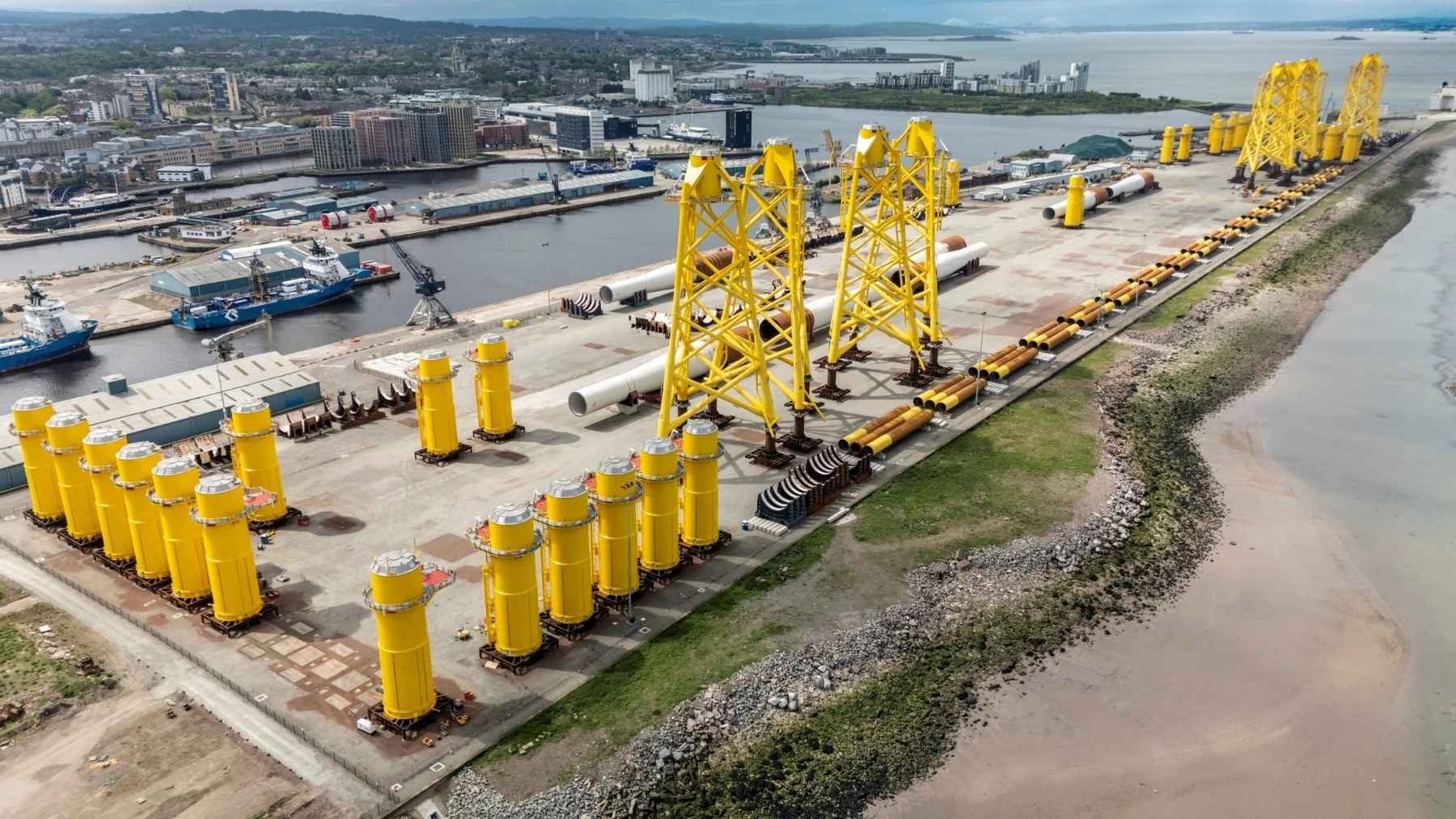

If you’ve spent any time around the Port of Leith in Edinburgh this year, you’ve probably noticed the bright yellow giants sitting on the dockside and wondered who ordered the Despicable Me sequel. Locals have been calling them “Minions,” sharing them on WhatsApp, and arguing about whether they’re friendly or about to vaporize the city. The truth is less science fiction and more heavy industry: they’re the steel guts of Inch Cape Offshore Wind Farm, the 1.1 GW project being built 15 to 22 km off the Angus coast, and each of those yellow stubs is the part that bolts a 15 MW Vestas turbine to the seabed.
The Herald’s Vicky Allan got a tour of the port and broke down what the components actually are, who’s moving them, and why they’re painted that very specific shade of traffic yellow. The short version: two foundation designs sharing one dockyard, a fleet of some of the heaviest lift vessels on the planet shuttling them out to sea, and a 100-strong crew at Leith feeding the whole thing.
The “Minions” are transition pieces, and they’re huge
The stubby yellow cylinders everyone’s photographing are “transition pieces,” or TPs in offshore-wind shorthand. They’re the connector between the monopile (the giant tube hammered into the seabed) and the turbine tower above. Inch Cape’s developer says each transition piece is around 28 metres tall, roughly the height of an eight-storey building, has an outer diameter of 8.3 metres, and weighs approximately 600 tonnes. They’re not 1,500 tonnes, by the way. That figure has been doing the rounds in social posts, but the developer’s own spec sheet puts them at roughly 600 tonnes each.
There are 54 transition pieces in total, each individually designed and engineered by renewables engineering consultancy SLPE for its corresponding monopile foundation. Inside each TP there’s a stack of four working platforms: an air-tight platform at the base, a cable hang-off platform that supports the inter-array cables, an entrance platform with elevator access to the turbine and nacelle, and a bolting platform for the crew when they join the transition piece and turbine tower together. So it isn’t just a glorified collar. It’s the access lobby, the cable junction box and the structural splice rolled into one.
The yellow itself is industry standard. The Herald says Inch Cape uses traffic yellow RAL 1023 for visibility, and the developer adds that the TPs come with sacrificial anodes for cathodic protection, to stop the structural steel corroding in harsh marine conditions. That’s the bit that quietly corrodes instead of the load-bearing steel, like a zinc speed bag for North Sea saltwater.
The monopiles are some of the biggest ever built
Underneath each TP sits a monopile, and these are the parts that genuinely earn the “XXL” tag the industry has slapped on them. Inch Cape Project Director John Hill says these are amongst the largest ever monopiles installed for an offshore wind farm: diameters of 11.5 m, up to 102 m in length, and a weight of around 2,300 tonnes. For scale, that’s a steel tube longer than a football pitch standing on end and heavier than five fully loaded Boeing 747s.
All 54 of them are already in the seabed. Inch Cape confirmed in early June that the last of the project’s 54 giant monopiles was in place, with Jan De Nul’s heavy-lift vessel Les Alizés transiting to and from the purpose-built berth at the Port of Leith collecting five monopiles per voyage. The first one went in on 27 December 2025. The last went in roughly six months later. That’s a brutal pace for components this big.
Those hammered-in steel tubes don’t stay lifeless for long, either. In the same North Sea, scientists have filmed seals hunting along the rows of wind-farm foundations, drawn in by the reef of mussels and fish that colonizes the bare steel within a season or two.
The monopiles themselves came from China. The first eight arrived in October 2025 after manufacturer CWHI shipped them out on 31 August aboard the COSCO vessel XIAN TAI KOU, with a second supplier, Dajin Offshore, picking up the rest of the order.
The jackets are the lattice “Tripods,” built for deeper water
Not every turbine sits on a monopile. The 18 turbines going into the deeper parts of the site sit on three-legged steel lattice “jacket” foundations instead. These are the ones Edinburgh has nicknamed “Tripods.” Each jacket is up to 83 metres tall and weighs around 2,250 tonnes, with three pin piles per jacket driven into the seabed to hold the whole thing down.
The first three jackets showed up at Leith in early March. On 4 March, the Inch Cape joint venture said the first three of its 18 jacket foundations had arrived in the Port of Leith aboard the heavy transport vessel Hua Yang Long. They’re being installed by Seaway7 using the heavy-lift crane vessel Seaway Alfa Lift, the same vessel handling the transition pieces. Two foundation designs, one crane, a lot of coordination.
The vessels doing the lifting are a class of their own
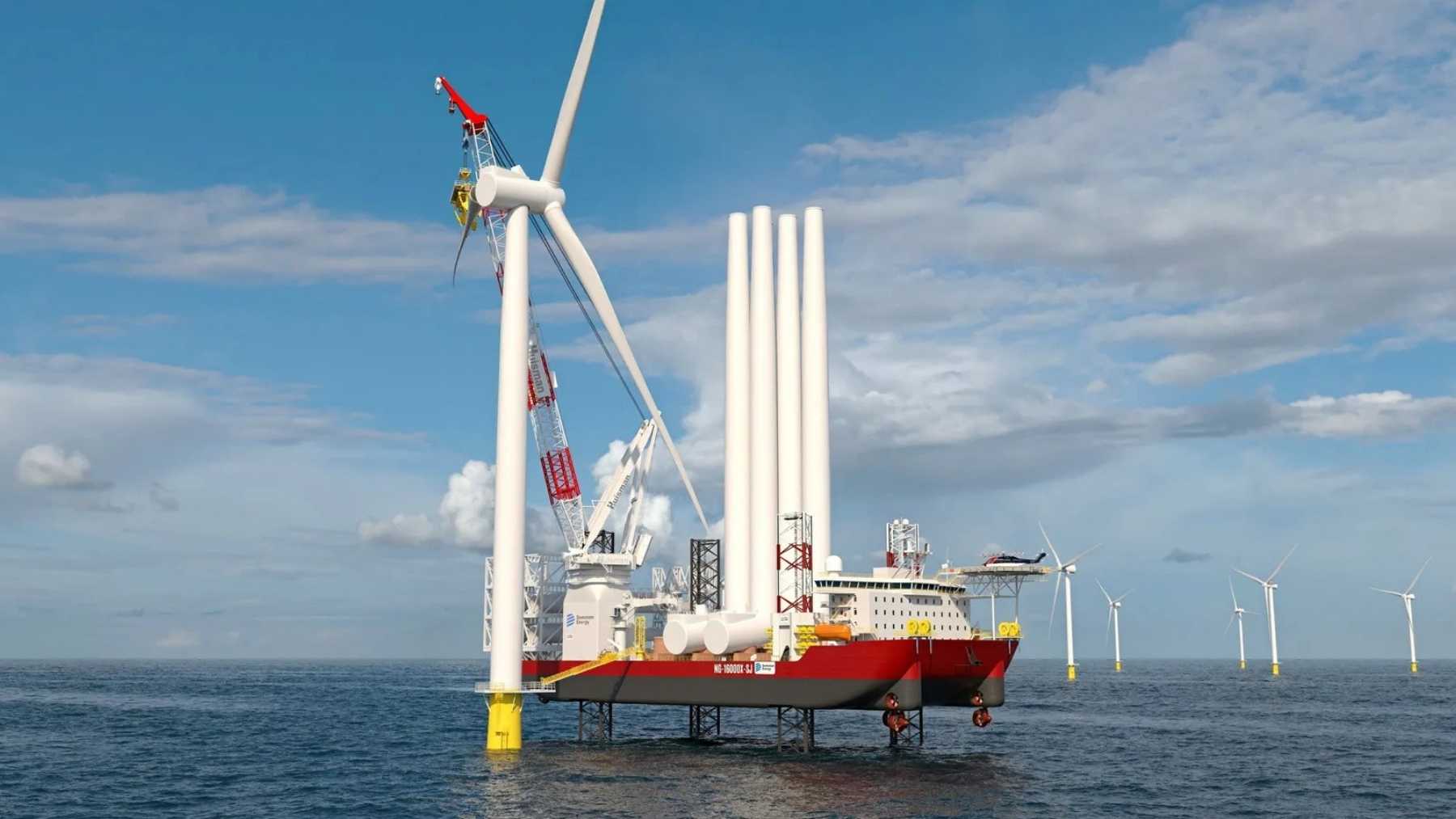
The reason you see only a handful of named ships in any offshore-wind story is that the world’s heavy-lift fleet is tiny. Inch Cape is leaning on two of the biggest. Jan De Nul’s Les Alizés has been handling the monopiles, a 5,000-tonne-capacity heavy-lift crane vessel that can carry five of the XXL monopiles from Leith to the site at once, with each one taking around an hour to load. Les Alizés isn’t even owned by Inch Cape’s contractors directly: it’s on long-term charter to RWE, which leased it to Inch Cape in a gap between its own construction projects.
Jan De Nul is the same outfit floating 22,000-tonne concrete boxes out to build Belgium’s artificial energy island in the same stretch of sea, which tells you the scale this fleet works at. The Seaway Alfa Lift is the other star. During its initial port call in March, it spent around four weeks in port just loading the transition pieces. Four weeks to load. That’s why these things feel like a science-fiction invasion when you live in Leith. They’re not popping in for a coffee.
Leith was rebuilt specifically for this
None of this works without the dock. Forth Ports spent serious money turning Leith into a renewables hub, and Inch Cape is the first tenant. The Charles Hammond Berth was redeveloped as part of a £150 million investment programme at the 175-acre site, which included £50 million committed on the back of the Inch Cape work, Forth Ports’ largest ever offshore wind contract. The berth itself has a heavy-lift capability of up to 100 tonnes per square metre, with 175 acres of adjacent land for renewables logistics, marshalling and manufacturing.
That capacity matters because the components don’t just sit on dollies. They ride on remote-controlled, self-propelled modular transporters, or SPMTs, that slide under each piece and walk it across the dock. The Herald’s tour describes six SPMT trailers per jacket, two under each of the three legs. It’s the same kit used to move space-shuttle stacks and oil-platform modules. Around 100 people work at Leith day-to-day to coordinate all of it, with Forth Projects as principal contractor and Global Energy Solutions handling completion works.
What comes next, and when the lights come on
The remaining work for this year is the bit the public actually associates with offshore wind: the turbines themselves. Inch Cape will use 72 Vestas V236-15.0 MW turbines, each up to 274 metres tall to the blade tip. The developer says turbine installation will begin towards the end of 2026, with first power expected in late 2026 and full commercial operations in 2027.
Inch Cape is far from alone out there. Off the Yorkshire coast, Britain just topped out the first phase of Dogger Bank, the biggest offshore wind farm on the planet, while several nearly finished US projects sit frozen. Once it’s running, Inch Cape is expected to generate more than five terawatt-hours per year, enough to supply more than half the homes in Scotland, and offset up to 2.5 million tonnes of carbon a year. The wind farm is a 50/50 joint venture between Ireland’s ESB and Edinburgh-based Red Rock Renewables, with SSE Energy Markets locked in to take half the output for at least 15 years.
So the next time someone in an Edinburgh pub insists the yellow Minions are about to issue an ultimatum, you can hand them the actual answer: 600-tonne transition pieces, 2,300-tonne monopiles, 2,250-tonne jackets, all painted RAL 1023 so a ship’s bridge can spot them in fog, all built to hold up a Danish turbine almost as tall as the Eiffel Tower above the North Sea. Less invasion, more enormous IKEA flat-pack.
 garrymasters DRIVER1 month ago