
Most of the concrete on a construction site shows up wet in a truck and gets poured into forms right where it’s going to sit forever. Precast works the other way around. The panel gets cast in a factory, cured, trucked in, and dropped into place by a crane, which is faster and a lot more consistent than pouring in the field. It also leaves you with something a poured wall doesn’t have, which is a seam everywhere two panels meet.
In a parking garage, that seam is a caulking job. In a wall whose entire purpose is to stop radiation, it’s the first thing you have to solve, and it’s most of what a crew in Oak Ridge, Tennessee, has been testing inside a building that has no fuel anywhere in it.
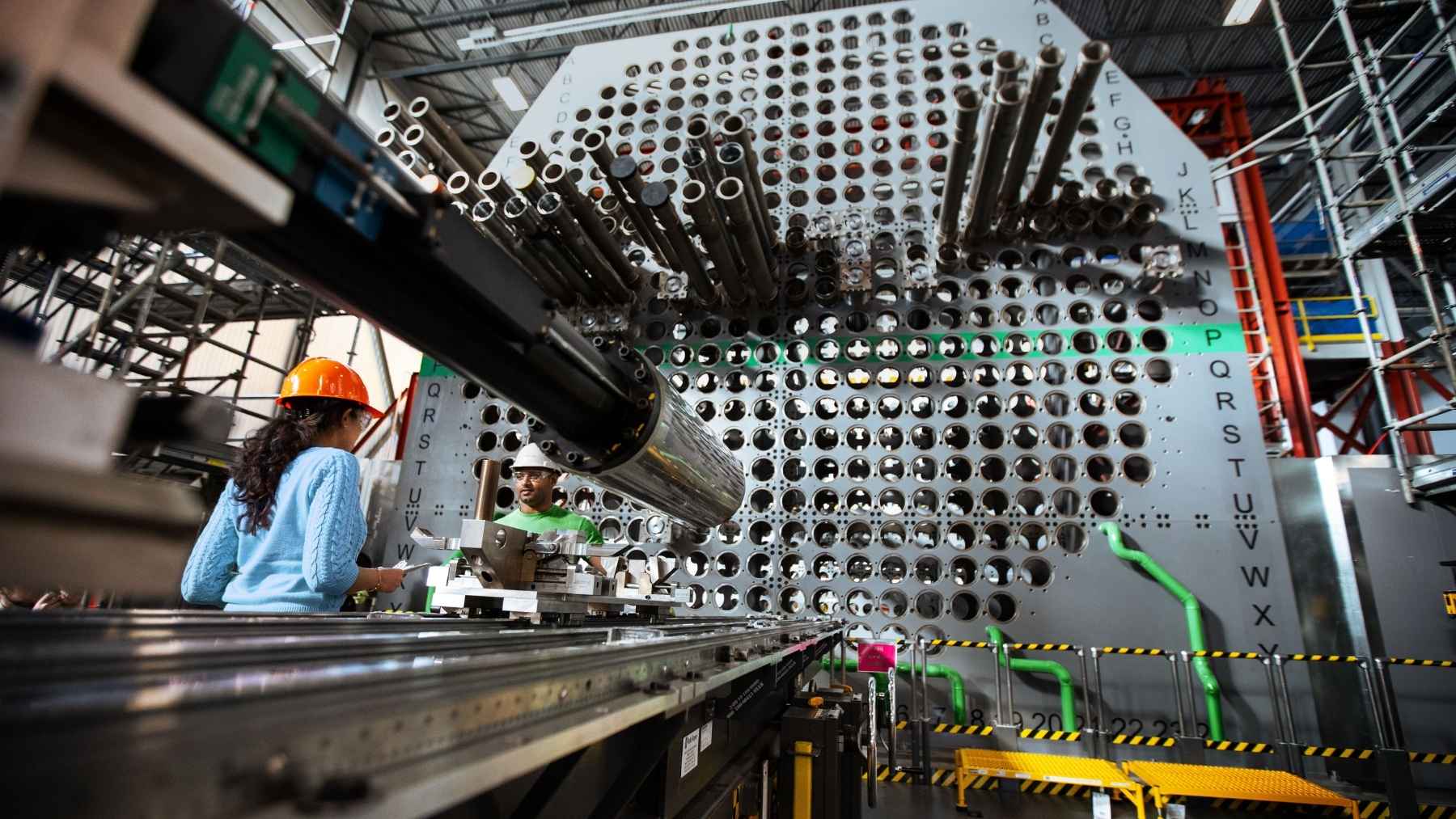
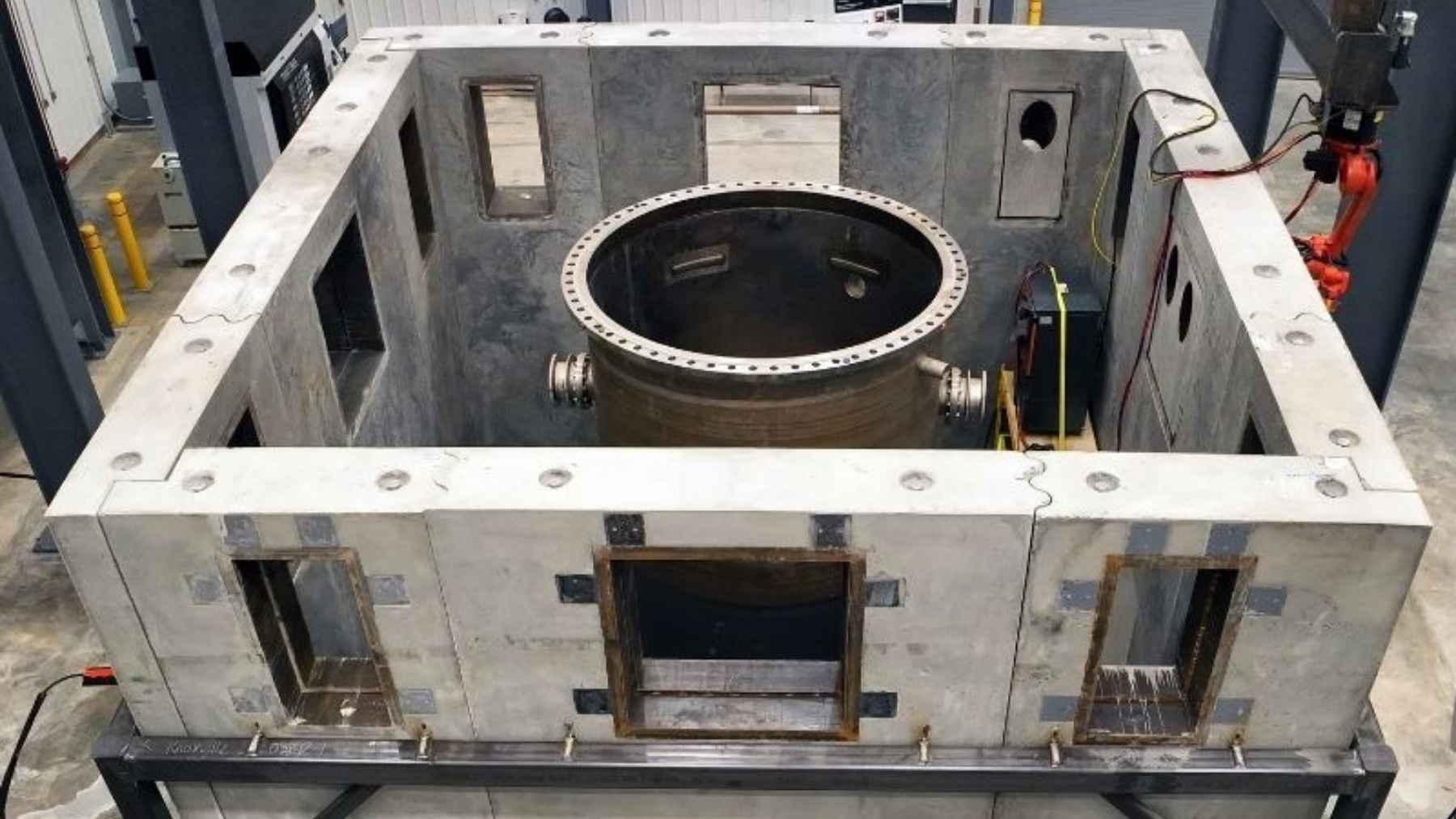
Kairos Power said on September 4 that it had finished the first phase of a hardware demonstration at Engineering Test Unit 3, the non-nuclear platform it’s been putting together on its Oak Ridge campus. Teams from construction, manufacturing and engineering built a reduced-scale mockup of the reactor cavity that will go inside Hermes 2, the molten-salt plant that broke ground on the same campus in April. The mockup is a reactor vessel with a precast concrete shielding structure around it, held up by steel frames.
The crew stood up 12 modular wall elements across four different panel designs, and the joints between them are cut in stepped and sinusoidal geometries meant to keep radiation from leaking at the seams. Sinusoidal is the engineering word for wavy.
So why not pour one big wall and skip the seams?
You could, and plenty of plants have. Kairos doesn’t want to, because a poured wall is a custom job every time, and this company’s whole pitch is building the same reactor over and over until the price stops moving around. Panels cast in a factory come off the same drawings every time, ride in on a truck, and go up in a fraction of the time.
So you accept the seams, and then you have to beat them.
Gamma radiation travels in straight lines. A flat butt joint between two slabs gives it a clear shot through the gap, a stepped joint makes it turn a corner, and a wavy one makes it turn several. The concrete’s doing identical work in all three cases, and the geometry is what takes the straight path away. As far as I can tell that trick is old news in shielding design, and the newer part is casting it into a panel you intend to mass produce.
The forms those panels were cast in are their own experiment. Oak Ridge National Laboratory’s Manufacturing Demonstration Facility worked on the design and printed them in polymer composite, Tindall Corporation cast the panels in South Carolina, and Barnard Construction stood them up in Tennessee. Printing a mold instead of building one out of plywood or steel is, I’d assume, how you end up with four panel designs rather than one.
So what are the robot arms doing up there?
A reactor cavity can’t be a sealed concrete box, because pipes have to get out of it. Process lines run from the reactor through the shielding to the rest of the plant, and every one of them is a hole in your wall. Each panel in the demonstration has steel-framed openings for exactly that, and Kairos is using them to test different concrete plug designs that let the lines through without opening a path for anything else.
Mounted above the cavity are robotic arms that connect and disconnect those lines, and the design goal is that nobody walks into the enclosure to do it. The group building this stuff is called SPEED, short for Salt Process Equipment Execution and Delivery, and its job is servicing the reactor while the reactor’s running.
The reason is time and money rather than anything dramatic. Kairos says handling those connections remotely cuts downtime and overall operating costs, and a plant sitting idle for maintenance isn’t selling anything to anybody. The company’s writeup of the Engineering Test Unit program gives one number for the rig it’s been testing at its Albuquerque campus. It’s a six-axis arm that pushes with up to 50 pounds of force, built to copy what a human arm can do. Fifty pounds isn’t much for a robot. That tells you these are meant for fiddly work at arm’s length rather than for hauling.
I’d argue this is the more interesting half of the demonstration. Plenty of outfits can show you a reactor design. Far fewer have shown you how they plan to change a part inside one without shutting the plant down, and I can’t find many public demonstrations of it at this scale.
There’s nothing nuclear in the building
That’s not a knock on it, but it does change what the result means. There’s no fuel in that vessel and no salt moving through it, ETU 3 doesn’t generate a watt of electricity, and the cavity is a scaled-down copy of the Hermes 2 cavity rather than the real one at full size. Kairos hasn’t published dimensions for the mockup. It did crane a 14-foot reactor vessel into that building back in July 2025, welded with an electron beam instead of an arc, and then built the roof over the top of it.
The salt matters here, because it’s the reason the robots exist. Kairos reactors are cooled by Flibe, a mix of lithium fluoride and beryllium fluoride that’s a solid at room temperature and doesn’t work as a coolant until it’s molten. When the company loaded it into the first Engineering Test Unit in Albuquerque, roughly 15 short tons (14 metric tons) of it went in at about 1,112 degrees Fahrenheit (600 Celsius). That’s the neighborhood the maintenance gear eventually has to work in.
ETU 3 is the third of these, and the series is the reason Oak Ridge keeps turning up in advanced nuclear stories. ETU 1 ran in Albuquerque, logged more than 2,000 hours of pumped salt operations and was decommissioned in 2024. ETU 2 is the modular one, more than 30 skid-mounted equipment modules built to be trucked in and bolted together. ETU 3 is the one about civil construction, maintenance and training the people who will run a real reactor.
What Kairos hasn’t said is how many days the testing ran, or how many times those arms made and broke a connection, which I’d have liked to see attached to a demonstration about maintenance. We also don’t know how far the mockup is scaled down. The company said in the spring that it expected to finish building ETU 3 over the summer, and its own technology page still lists the unit as under construction, so this is a facility that’s working before it’s finished.
Co-founder and chief technology officer Ed Blandford said the tests point at design features that will be “standardized in commercial KP-FHR deployments,” and World Nuclear News picked the story up on September 7. From here the findings feed into the next version of the Hermes 2 cavity design, and the building turns into a training floor for future operators. Hermes 2 broke ground on April 17 on the footprint of the old Oak Ridge Gaseous Diffusion Plant, and it’s contracted to put up to 50 megawatts onto the Tennessee Valley Authority grid.