
Anyone who’s done a long hike with a heavy backpack knows how it goes. The first mile’s fine. By mile six, you’re quietly deciding which of your belongings could live in the woods from now on.
Marines deal with a far worse version of that. The radios, batteries, water and ammunition a unit needs don’t get any lighter as the walk gets longer, and dragging a truck along isn’t always an option. So for the last few years, the Marine Corps has been testing an eight-wheeled electric cart that drives itself and carries the heavy stuff instead. And it’s getting 12 more.
American Rheinmetall, the US subsidiary of Germany’s Rheinmetall, announced on Sept. 10 that it had won a $7.28 million contract for 12 Mission Master SP autonomous ground vehicles and five amphibious “Marine Kits.” The Defense Logistics Agency is running the purchase, with ADS Inc. as the prime contractor, and the deal also covers training, engineering support and acceptance testing. Rheinmetall Canada, the vehicle’s original manufacturer, is backing up the US team on engineering and production.
It’s all going to the Marine Corps Warfighting Laboratory. If you haven’t come across it before, the Warfighting Lab is basically the Corps’ in-house testing outfit, based at Quantico in Virginia. It takes new gear and new ideas out into the field and works out whether they’re worth adopting on a bigger scale. It’s the same lab that’s been keeping tabs on the seaglider drone we covered last month.
The company says these vehicles are for continued evaluation and experimentation. That’s arguably a sensible way to buy a technology the Marines are still figuring out how to use.
So what exactly is a Mission Master SP?
A-UGV, the label on the paperwork, stands for autonomous unmanned ground vehicle, which is a long way of saying a robot that drives itself. The SP stands for Silent Partner. It runs on electric motors and lithium-ion batteries and sits very low to the ground. It was built that way to keep its noise and heat signature down, which matters a lot when you’re trying not to get spotted.
Army Recognition’s spec rundown has it at about 10 feet long and a little over 3 feet tall, with a flat deck on top. That deck is where the useful stuff goes. Mission modules can be swapped in a matter of minutes, according to the manufacturer, so the same chassis can carry cargo, a stretcher, sensors or a remote weapon station.
Empty, the SP weighs about 2,500 pounds, and it can carry up to about 2,200 pounds on land. So one of them can haul close to its own weight in water, ammo or batteries. That’s a lot more than anyone wants on their back.
Here’s where it gets interesting. The autonomy software, called PATH, lets a Marine tell the vehicle to follow them on foot, fall in behind another vehicle in a convoy, or drive itself to a spot on a map. Rheinmetall says it’s tested PATH on more than 40 kinds of vehicles, some on wheels and some on tracks. It also says a person always makes the call on firing a weapon. Frankly, that’s the only answer anyone should want to hear on that front.
Wait, doesn’t it already swim?
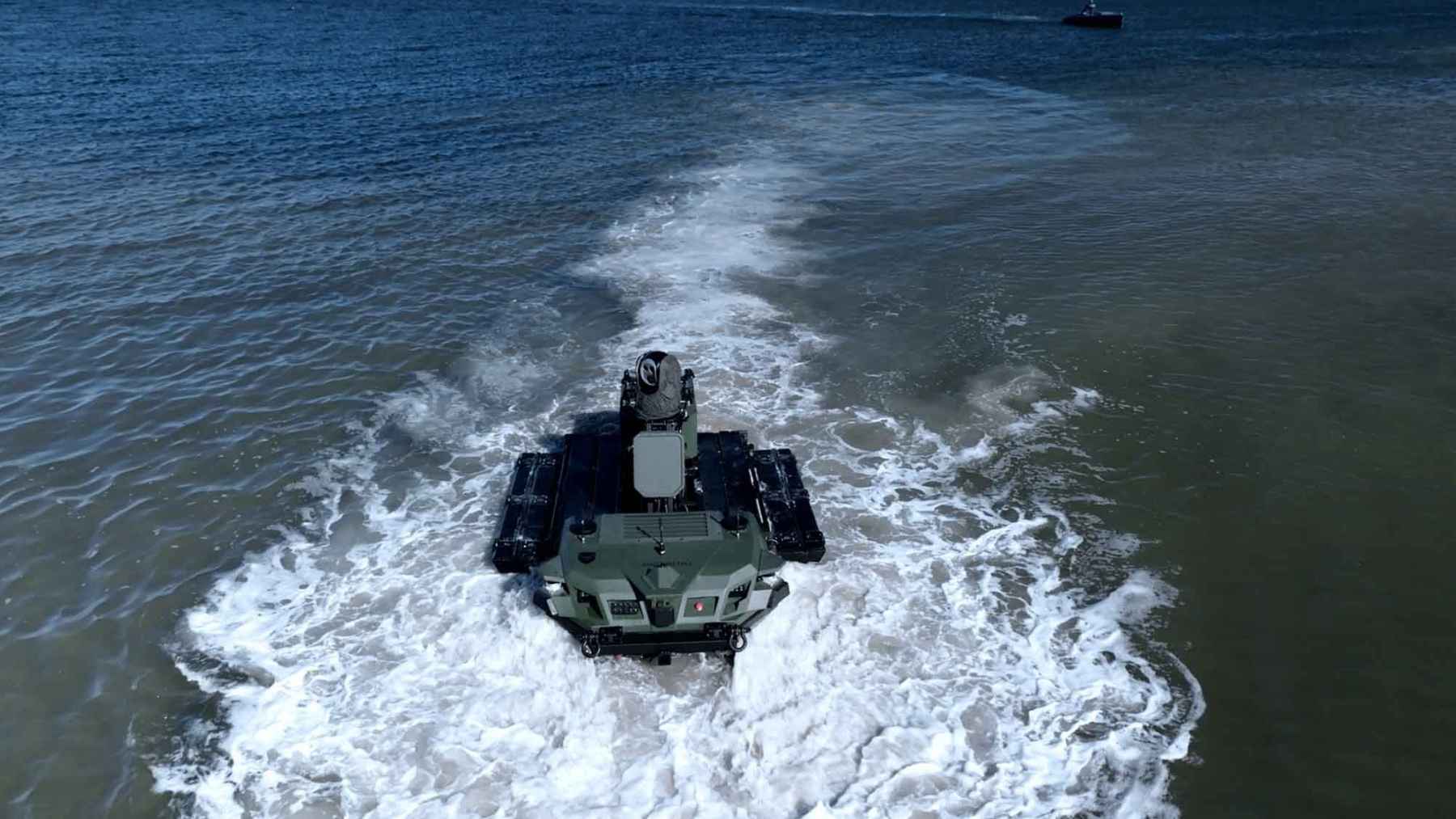
Yes, and it’s an easy thing to get backward. You might assume the five Marine Kits are what let these robots float. According to Army Recognition, though, the Mission Master SP can already swim without one. The manufacturer describes the kit as an upgrade that lets the vehicle work in the water more reliably and for longer near the coast.
That strip where the sea meets the land is what the military calls the littoral. The Marines expect to do a lot of their work there in the Pacific, spreading small units out across islands and shorelines, and those units still need resupply.
What I can’t find anywhere is a breakdown of what’s physically in the kit. The contract announcement skips that detail, and so does every defense outlet I checked. With five kits for 12 vehicles, it’s safe to assume not every robot in this batch will be doing water work.
Swimming comes with a trade-off, too. Afloat, the SP’s maximum load drops from about 2,200 pounds to about 660. Army Recognition lists its water speed at about 2.5 mph, or around 5 mph with assisted propulsion, while an earlier Army Recognition report put it closer to 4 mph. Unassisted, that’s roughly walking pace.
The Marines already have a dozen of these
This isn’t the Corps’ first rodeo with the Mission Master. According to Rheinmetall, the vehicles went through Marine exercises in Australia and at Twentynine Palms in California, doing casualty evacuations, resupply runs and fully autonomous road marches of up to 31 miles. A follow-on order added six vehicles for III Marine Expeditionary Force. Four of those were earmarked for 3rd Battalion, 4th Marines. The company now counts 12 Mission Master systems fielded with Marine Corps operating forces.
My favorite use so far comes from Okinawa. In January, Marines with the 4th Marine Regiment loaded one onto a CH-53E Super Stallion helicopter at Camp Schwab and flew it into a combat readiness evaluation, where it carried the communications and power gear for a regimental command post. According to the Marine Corps, it was the first time the vehicle had been airlifted anywhere in the Department of War.
A command post is basically the brain of a unit in the field. Usually, that means hauling it around in several military vehicles, and each of those needs fuel, someone to drive it and someone to guard it. Putting that job on a quiet robot a helicopter can drop off is a pretty neat trick.
Pricing one of these is tricky
So what does a single Mission Master SP cost?
Honestly, it’s hard to say. The $7.28 million covers 12 vehicles, but it also pays for the five kits, support equipment, engineering, logistics, training and acceptance testing. Dividing the total by 12 gives you a tidy number that doesn’t mean much. There’s no published unit price. I also couldn’t find a delivery date in the announcement.
Matt Warnick, CEO of American Rheinmetall, called the award “a significant milestone” in the company’s statement and said his company has spent more than four years working with Marines on autonomous ground vehicles. That’s pretty standard press release language, although the Marines really have been testing these for years.
So the Warfighting Lab is about to have a dozen new Silent Partners to put through their paces. The $7.28 million award was announced on Sept. 10, and the 12 vehicles and five Marine Kits are headed to the lab for testing on land and in the water.