
If you’ve ever had an MRI, you’ve been inside the strongest magnet most people will ever get near. Those machines run at about 1.5 to 3 tesla, and hospitals respect them enough to screen every paperclip that enters the room. So when a fusion company outside Oxford, England, says its magnet system peaked at 13.7 tesla and held together, that number’s earned a second of your attention.
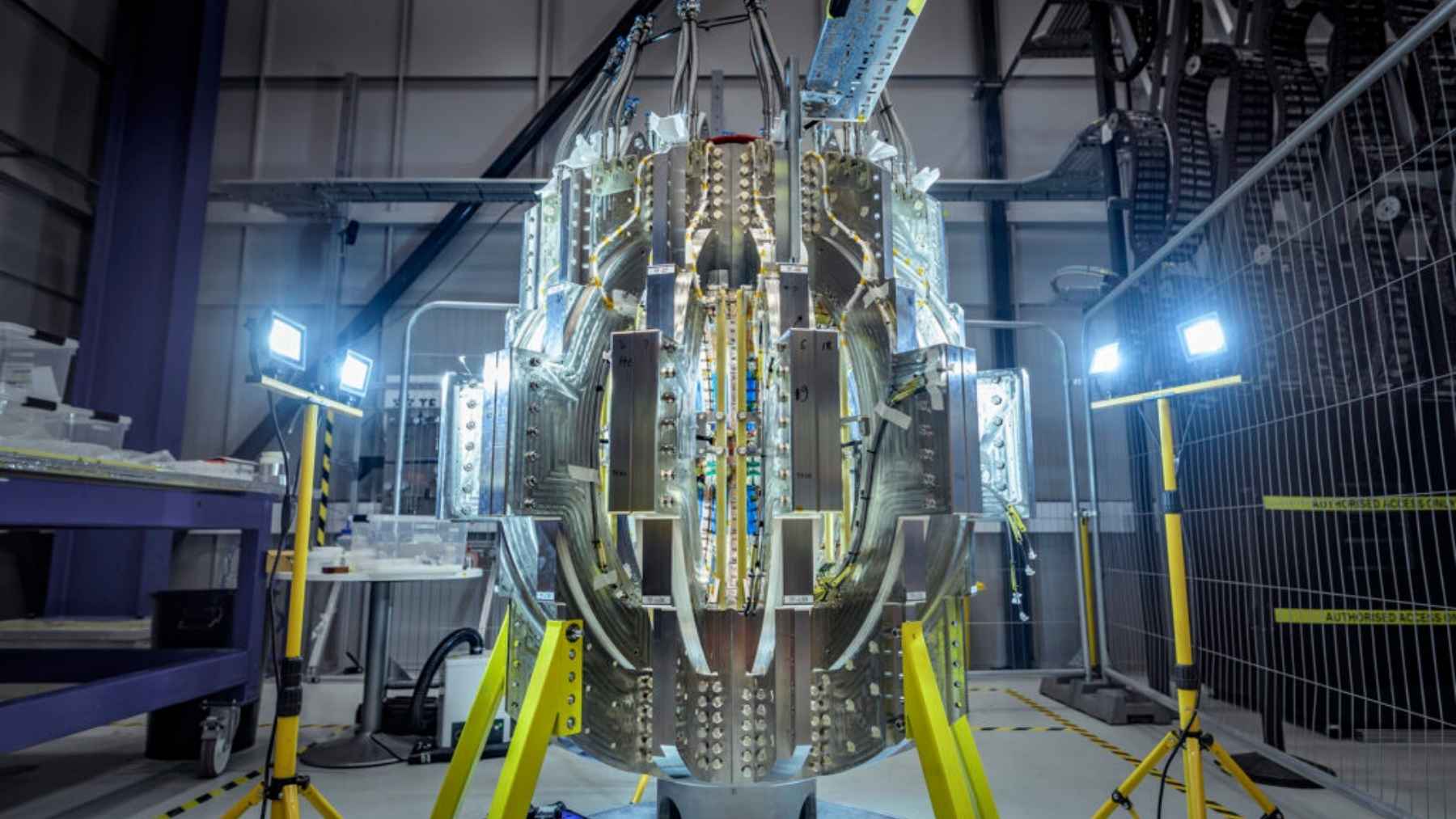
The company is Tokamak Energy, and the system is called Demo4: 44 superconducting coils arranged the way they’d wrap around a spherical tokamak, the squashed version of the classic donut-shaped fusion reactor, plus the cooling, power and control gear needed to run them as one machine. Tokamak Energy announced on September 9 that it had finished a 14-month test campaign on the whole assembly. And honestly, the 13.7 tesla wasn’t the number that got me. Demo4 spent roughly 10,000 hours energized over those 14 months, by the company’s count, including long stretches at high field.
Why do the hours impress me more than the teslas?
Because holding a big field for a moment is a lab trick you can pull off with one heroic coil. Holding field for months on end, across 44 coils that all push and pull on each other, while the cryogenic plant, the power supplies and more than 600 sensors behave themselves, is a lot closer to what a power plant’s going to need from its magnets. Reactors don’t get sick days.
A quick refresher on why fusion needs any of this: the reaction only happens once hydrogen fuel gets heated into a plasma several times hotter than the sun’s core, and nothing solid can touch something that hot. So magnetic fields do the holding, and the stronger the field, the smaller and cheaper the reactor around it can be.
For scale, I ran the arithmetic on 13.7 tesla, and it works out to roughly 270,000 times the magnetic field you’re standing in right now, give or take, depending on where on the planet you do your standing. The forces at that strength are vicious. Tokamak Energy says the coils rode out transverse mechanical stresses of about 21,750 psi (150 MPa), the field trying to shove the conductors sideways out of their own supports, and Nuclear Engineering International puts that load at almost 1,500 times atmospheric pressure.
So what’s a “high-temperature” superconductor doing at 429 below?
Demo4’s coils are wound from high-temperature superconducting tape, HTS if you want the industry shorthand, and the name’s a bit of a bait and switch. A superconductor is a material that carries electric current with zero resistance once you get it cold enough, and that’s what lets a magnet this strong run without cooking itself. Demo4’s “high-temperature” coils still operated between 321 and 429 degrees below zero Fahrenheit (77 down to 17 Kelvin) during the campaign. That only counts as warm because the older superconducting wire in an MRI machine has to sit near 452 below to work at all. Every degree you skip chilling saves real money in a power plant, and that’s basically why the industry keeps betting on HTS.
The cooling ran on pressurized helium at up to 290 psi (20 bar), and the team deliberately cycled the system around that temperature range instead of parking it at one comfortable setting. The toroidal field coils also carried 5,600 amps, against the 200-amp rating of the main panel in a typical American house.
Then there’s the abuse. A superconducting magnet stores a serious amount of energy, and if part of a coil suddenly stops superconducting, all of that energy has to go somewhere in a hurry. So the engineers triggered forced discharges on purpose, several of them, at fields up to 12.5 tesla, essentially pulling the fire alarm to make sure the building actually empties. Frankly, that’s the data I’d want most if I were designing a power plant around these magnets, because a magnet that can’t survive its own faults is just a very expensive liability with a cryostat around it.
“Demo4 proves our integrated magnet system can perform under demanding fusion-relevant configurations,” said Liam Brennan, who runs TE Magnetics, the company’s magnet division.
Not everyone builds fusion magnets the same way
Demo4’s previous public milestone was 11.8 tesla, so the field moved a fair distance over the course of the campaign. And Tokamak Energy isn’t the only outfit treating the magnet, rather than the reactor, as the product. Thea Energy, a Princeton spinout working out of New Jersey, went the opposite direction with stacks of identical flat coils for a stellarator, and its test magnet reached 6 tesla, which we covered earlier this month. Two very different bets on the same physics, and as far as I can tell, nobody in the industry agrees yet on which magnet architecture ends up in the first commercial plant.
There’s a destination for the Demo4 data, too. Tokamak Energy is the magnet systems partner for STEP, the UK government’s prototype fusion power plant, and it’s feeding the results into that design work with UK Fusion Energy, the state-owned body delivering the project. STEP is planned for West Burton, a former coal power station site in Nottinghamshire, and that’s arguably the tidiest piece of site symbolism this industry has managed so far: superconducting magnets moving onto ground where a coal plant spent decades burning through trainloads of the stuff.
What comes after Demo4 isn’t as clear. The announcement mentions better ways of making and joining the coils, upgraded instrumentation and a firmer grip on operating margins, but I couldn’t find a named successor system in it, or a date for building the STEP magnets themselves. I wouldn’t read too much into that silence. ITER, the 35-nation reactor going up in southern France, is still qualifying the tooling that’ll merely assemble it, and fusion hardware generally moves at fusion speed.
Tokamak Energy closed the campaign out with its September 9 announcement, and STEP’s targeting first operations at West Burton in 2040. That gives everyone involved about 14 years, and from the looks of things, the magnet people don’t plan on being the bottleneck.