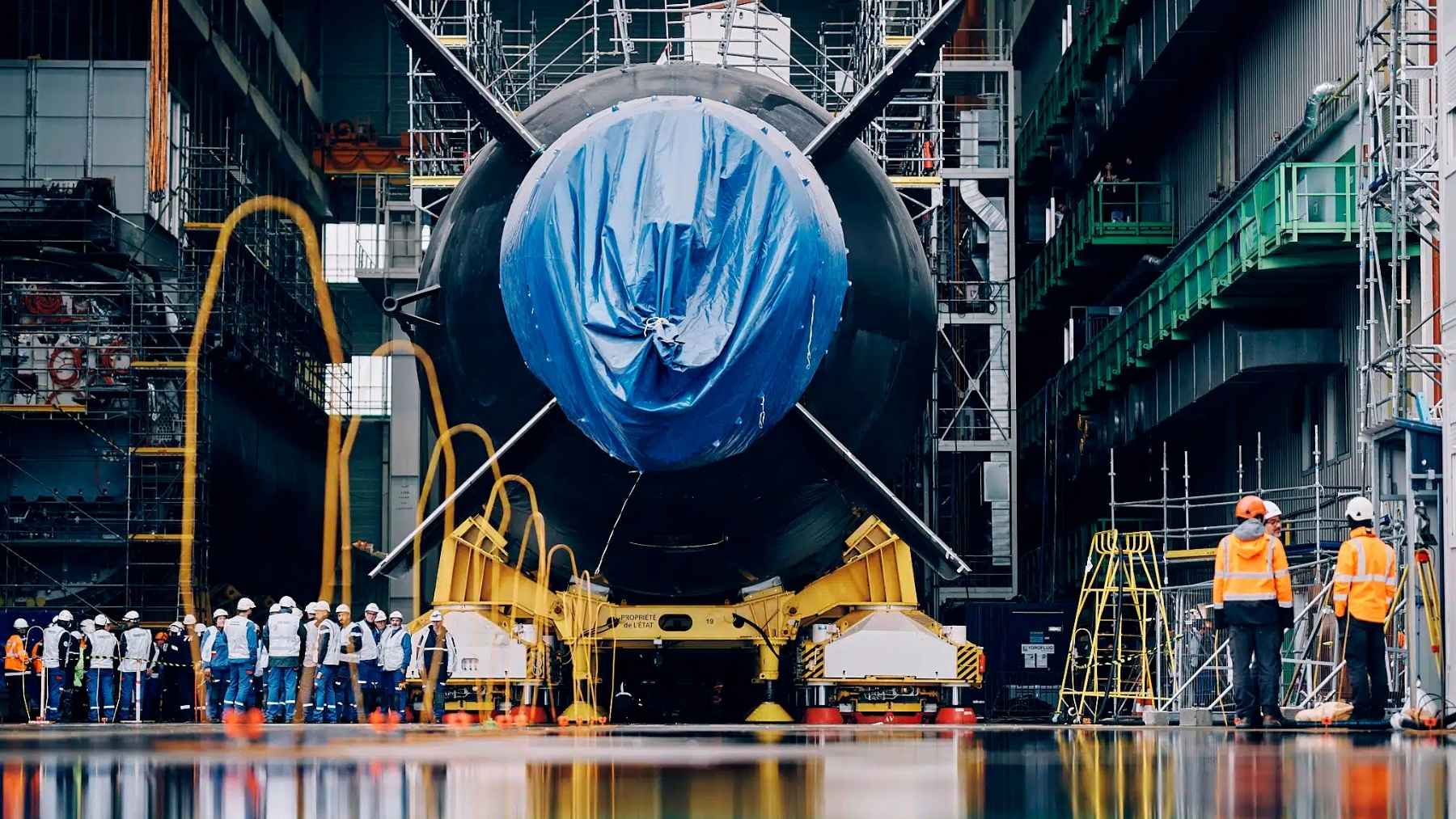

Building a nuclear attack submarine is one of the slowest jobs in heavy industry, and France has spent the better part of two decades proving it. The Barracuda program has been crawling out of Cherbourg one hull at a time since the contract was signed in 2006. Then boat number four turned up ahead of schedule, and the pattern that had defined the whole program quietly broke.
On June 24, Naval Group handed over De Grasse, the fourth Suffren-class boat, to France’s defense procurement agency (the DGA) and the French Navy. That leaves only two hulls to go in a six-boat program.
The part that actually matters here isn’t the handover. It’s the clock: the delivery landed exactly four months after the submarine’s first sea trial, which is quick for a nuclear-powered SSN and a clear sign the shipyard has finally found its rhythm building these things.
De Grasse, S636, and a four-month sprint
The timeline is worth walking through, because it’s basically the entire argument for why the program is suddenly ahead of schedule. The hull rolled out of its construction hall in May 2025. Dockside checks followed. In December 2025 the reactor went critical for the first time, the step the French call divergence. On February 24, 2026, De Grasse set out from Cherbourg for its first sea run. Four months after that, it belonged to the Navy. Naval Group’s own account credits the speed to the obvious thing: they’ve now built three of these boats and know where the surprises hide.
One small housekeeping note for anyone who has been tracking the boat. Earlier reporting, including the coverage of its first sea trial, listed the pennant as S638. The handover paperwork uses S636, and that’s the number now on the hull. If you saw S638 floating around for the past few months, S636 is the one that stuck.
What’s different about boat number four
This isn’t a carbon copy of the first three. In an interview with Naval News, Admiral Xavier Petit, who commands France’s submarine forces (ALFOST), said De Grasse ships with upgrades to two of the most important non-nuclear systems aboard: a new build of the SYCOBS combat management system and a next-generation electronic warfare suite. So the combat brain and the boat’s ears both rolled forward a generation between hulls three and four.
If you’ve followed the class, you know the Barracudas already carry a serious deep-strike kit. The headline weapon is MBDA’s naval cruise missile, the MdCN, fired from the torpedo tubes and built for long-range strikes against land targets. Alongside it sit the F21 heavyweight torpedo from Naval Group and the modernized Exocet SM39 anti-ship missile.
The boats also carry non-penetrating optronic masts from Safran, which feed 4K imagery to every console in the command center instead of routing a periscope through the hull. Aft of that sits a removable dry deck shelter for the PSM3G swimmer delivery vehicle and the combat divers the boats are sized to embark. That special-forces plumbing is the same class hardware a Suffren-class boat used this spring when it launched and recovered a US Navy underwater drone while submerged, the first time an American robot had gone to sea from an ally’s submarine.
For the spec-sheet crowd: the hull runs roughly 99 meters long with an 8.8-meter beam, displacing about 4,700 tons surfaced and 5,200 tons submerged, all of it driven by a pressurized-water reactor derived from the plant on the Triomphant-class missile boats and the carrier Charles de Gaulle. Crew is lean, with the official handover listing 65 sailors plus commandos. Small numbers are the modern standard for these boats. Russia’s newest Yasen-M runs a 13,800-ton hull on just 64 sailors, automation having quietly replaced a lot of bodies.
Two left: Rubis and Casabianca
That puts the program within sight of the finish. The last two boats, Rubis and Casabianca, are both under construction at different stages, with deliveries staggered toward the end of the decade. Rubis reuses the name of the lead boat of the very class the Barracudas are replacing, which is the kind of tidy naval housekeeping the French do well.
And the schedule may keep tightening. Naval News reports that Rubis begins sea trials next year, while Casabianca could reach the Navy as early as 2029, a year ahead of the original contract. The first plan called for all six boats in service by 2030. If the current pace holds, the last one could be operational in 2029 instead.
That’s a real shift in posture. French Navy officials have pointed to two things behind it: smoother production flow at the Cherbourg yard and tighter coordination with the nuclear-propulsion supply chain. Whether the schedule survives contact with reality is another question, since submarines have a long history of slipping, but for once the trend is running the right way.
Why this matters for France’s undersea force
The entire point of the Barracuda program is replacing the Rubis-class SSNs, which entered service in the early 1980s and are well past their prime. The deal that kicked it off was signed on December 22, 2006, when the French government committed €7.9 billion to Naval Group, then known as DCN, and Areva-Technicatome for six boats and their reactors. Twenty years from contract to fourth delivery sounds glacial by commercial standards. By nuclear-submarine standards it’s roughly normal, and it isn’t only a French problem. America’s $15 billion Columbia-class boat, the largest submarine the US has ever built, has spent years fighting to claw its own schedule back on track.
The Barracudas are also a real generational jump. At the Tourville commissioning in Toulon last July, then-Armed Forces Minister Sébastien Lecornu called the boat a leap in both technology and operations and singled out one gain above the rest: its ability to stay deployed, in his words, “twice as long” as the old Rubis boats. Each Suffren-class hull is built to be available more than 270 days a year.
That endurance, plus the MdCN’s reach and a quieter acoustic signature, is what France is actually buying. The Rubis boats were small, noisy by modern standards and limited in what they could take on. The Barracudas are bigger, quieter and carry weapons the older class never could.
One name worth knowing
The boat carries a heavy name. The Comte de Grasse, François Joseph Paul, was the 18th-century French admiral who pinned the Royal Navy off the Virginia coast in September 1781 and made Cornwallis’s surrender at Yorktown possible. Anyone who paid attention in a US history class remembers the Battle of the Chesapeake as the moment a French fleet briefly, and unexpectedly, helped decide the American Revolution. Putting that name on a 2026 attack submarine handed over days before the Fourth of July is exactly the kind of detail Paris is rarely shy about.
Boat five goes to sea trials next. The Barracuda program isn’t breaking new ground anymore; it’s executing. And after the better part of twenty years, executing on schedule is the closest thing this program has to a breakthrough.