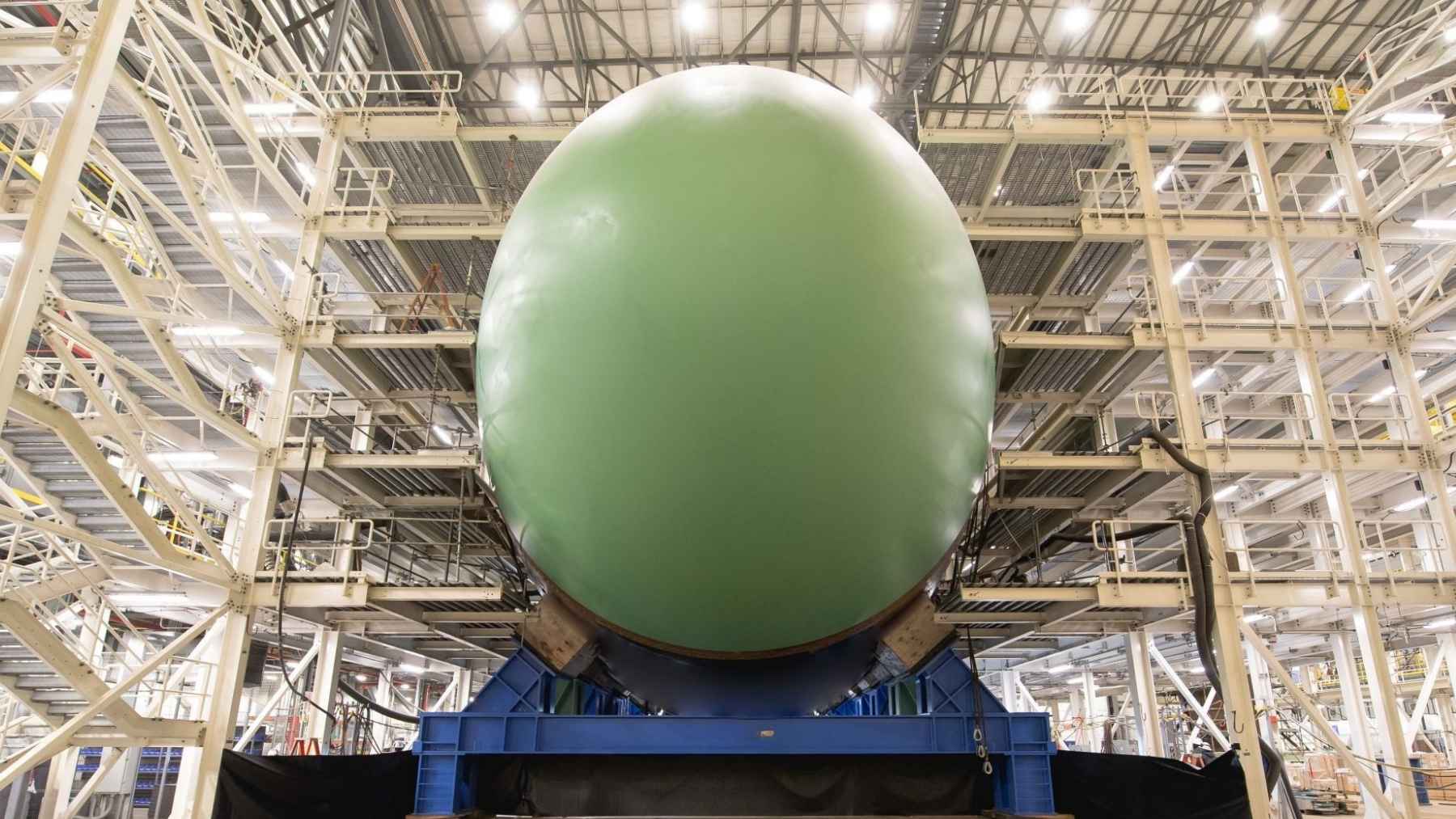

Most submarines are, give or take, about as long as a football field. The future USS District of Columbia is closer to 560 feet, more than half again that, and once it slips beneath the surface it will weigh somewhere near 21,000 tons. That makes it the largest submarine the United States has ever built. Right now it is being bolted together out of 26 separate pieces inside a purpose-built assembly building on the Thames River in Groton, Connecticut, and for the past couple of years the Navy has been doing everything short of prayer to drag the whole project back onto schedule.
It is the lead boat of the Columbia class, the program meant to replace the Ohio-class boats that have carried most of America’s sea-based nuclear deterrent since the early 1980s. The Pentagon calls it its single highest acquisition priority, which is the kind of label that comes with a lot of money attached and very little room to be late. And the genuinely interesting part of this machine is not the missiles. It is almost everything built around them.
Bigger Than Any Sub America Has Built, With Fewer Missiles Than the One It Replaces
Here is the first thing that does not add up. The Columbia is physically larger than the Ohio class it is replacing, yet it carries fewer missiles. The Ohio boats were built with 24 launch tubes each. The Columbia gets 16, arranged in four “quad-packs” of four tubes apiece, inside a section called the Common Missile Compartment that the U.S. designed jointly with the United Kingdom for its own Dreadnought-class boats. Each tube holds a single Trident II D5LE ballistic missile, the same 87-inch-diameter tube and the same missile family already riding in the Ohio fleet today.
Going from 24 tubes to 16 sounds like a downgrade until you run the fleet math. Twelve Columbia boats carrying 16 tubes works out to 192 tubes across the force, where 14 Ohio boats at 24 tubes gave you 336. The Navy’s argument is that it no longer needs the raw tube count it once did, because the missiles themselves are more capable and the warhead planning is more flexible, and because a dozen well-maintained Columbias can keep the required number of boats on patrol at any given moment more reliably than the older fleet managed.
So why build it so much larger if it is hauling fewer missiles? Partly because fitting a 42-year reactor and an entirely new propulsion system into the hull takes room. And partly because, by the Navy’s own framing, the extra internal volume is margin for whatever comes next. As Naval News noted this month after a fresh batch of construction photos surfaced, the jury is still out on exactly what all that extra tonnage ends up doing. For now, a real chunk of the biggest submarine America has ever built is essentially reserved space.
For the record, it is not the biggest submarine ever built by anyone. Russia’s Cold War Typhoon boats were more than twice as heavy. But among everything that has ever rolled out of an American yard, nothing else comes close.
The Real Upgrade Is the Drivetrain, Not the Warheads
If you care about how machines actually work, this is the part worth slowing down for. Most nuclear submarines route their reactor’s steam through turbines that are mechanically geared to a shaft that spins the propeller. The Columbia does it differently. It uses a turbo-electric drive: the steam turbines spin generators, the generators make electricity, and that electricity feeds a large electric motor that turns the propulsor. There is no big reduction gearbox bolting the turbine to the shaft. By the Navy’s own program descriptions, it is the first time turbo-electric propulsion has gone into an American strategic submarine.
The reason that matters is noise. Gears mesh, and meshing gears sing at specific frequencies that a sonar operator on the other side can learn to pick out of the ocean. Take the gears out of the equation and you take out a whole family of those tones. Pair that electric drive with a pump-jet propulsor instead of an exposed propeller, the same approach the Virginia-class attack boats already use, and you get a boat that is harder to hear coming.
General Dynamics, the prime contractor, flatly calls it the quietest and most capable submarine ever built, which is exactly the sort of thing a builder says, but the engineering underneath the claim is real. It is a different route to the same goal that conventional boats now chase with fuel cells, like the Spanish Navy’s S-80, which brews its own hydrogen onboard so it can stay quiet and submerged for weeks.
The stern is getting an X instead of the usual cross-shaped fins. Those four control surfaces sit in an X layout and are moved by electronic input rather than purely mechanical linkage, which buys finer handling at low speed and when holding a depth, exactly the slow, quiet crawling an SSBN spends its entire career doing.
Then there is the reactor, which is the quiet headline of the whole program. The Columbia’s core is built to last the full 42-year service life of the boat without ever being refueled. Each Ohio boat needed a mid-life refueling that pulled it out of service for years at a time. Eliminating that across the class is the single biggest reason the Navy believes 12 Columbias can do the job that took 14 Ohios. If you have ever compared the upkeep on a combustion engine to the relative simplicity of an electric one, the logic will feel familiar, just scaled up to a 21,000-ton boat.
Built in 26 Pieces Across Two Shipyards, Which Is Exactly Where the Delays Came From
The Columbia is not built in one place. It is built in chunks. General Dynamics Electric Boat is the prime contractor and handles final assembly at its yard in Groton, Connecticut, in a building put up specifically for these boats. Huntington Ingalls’ Newport News Shipbuilding in Virginia builds major sections, including the bow and the stern, and barges them north. Those finished modules, 26 of them for the lead boat, get stacked and joined into a complete submarine, fed by more than 3,000 suppliers spread across the country.
Modular construction is supposed to make this faster, and on paper it does. In practice it also means the entire boat can be held hostage by any single late module, which is roughly what happened.
The lead ship slipped its schedule, and the Navy has been candid about why. Testifying to Congress, Navy Secretary Carlos Del Toro pointed to the late arrival of turbine generators from Northrop Grumman as one of the most significant problems, alongside delays finishing the bow section in Virginia. A build contracted to take 84 months has been tracking closer to 96, according to the Congressional Research Service.
The recovery plan got a blunt name: A-26, after the goal of getting all 26 of the lead boat’s modules to the Groton assembly yard. The Navy says it pulled that off, with the final piece, the bow, arriving from Newport News in late 2025, ahead of an internal target that had been slipping toward mid-2026.
The boat now sits somewhere in the 65-to-70 percent complete range, the final propulsor component was delivered last April, and the next major milestone is sealing up the pressure hull, expected by the end of this year, before the boat enters the water in 2027. A new floating dry dock named Atlas, 618 feet long and built in Louisiana, turned up in Groton in January 2026 specifically to launch these boats.
Two follow-on boats are already taking shape behind it. The second, the future USS Wisconsin, is about 35 percent done and, in the Navy’s own words, one of only two of its ships under construction that are actually on schedule. The third, USS Groton, is around 10 percent complete.
Late, Costly, and Still the Pentagon’s Number-One Build
So when does it actually show up? That depends on who you ask, which is itself part of the story. General Dynamics told investors this spring it is on a path to deliver the first boat by the end of 2028. The Navy’s own Fiscal Year 2027 budget submission is less optimistic, listing a March 2029 delivery for District of Columbia and April 2030 for Wisconsin. Government auditors have noted the date could land anywhere across that window depending on whether the planned improvements hold. The one date nearly everyone agrees on is the important one: the boat’s first deterrent patrol, planned for 2030, timed to the retirement of the oldest Ohio boat.
That timing is the whole reason for the urgency. The Ohio fleet is aging out, and the Navy has been studying life extensions for several of those boats just to avoid a stretch where the number of available SSBNs dips below what it needs. In April 2026 a dedicated submarine production office stood up under Vice Adm. Rob Gaucher, who described getting District of Columbia delivered on time as a “life or death imperative.” That is heavy language for a shipbuilding schedule, and it tells you how little slack is left in this one.
None of it is cheap. The Navy’s recent estimates put the full 12-boat program in the neighborhood of $126 billion. The lead boat alone runs around $15 billion, partly because it absorbs most of the one-time design and engineering cost for the entire class; later boats are projected closer to $9 billion each. Interesting Engineering, citing the program plan, reports the next five boats will run roughly $62 billion combined.
There is also a squeeze that does not show up on any single price tag. The same shipyards, the same welders, and the same nuclear-qualified trades that build Columbia also build the Virginia-class attack submarines, and the industrial base has been stretched trying to do both at once. The Navy has said submarine construction capacity needs to nearly double to hit its targets.
It is the expensive, crewed end of a spectrum the Navy is also probing from the cheap end, with uncrewed boats like Boeing’s Orca drone submarine, which the Navy recently committed to buying 16 of for a fraction of the price of a single Columbia. Building the biggest submarine in American history was always going to be hard. Building it while the yard next door is slammed with other work is the part that has actually kept people up at night.
Strip away the budget fights and the schedule slips and you are left with a genuinely strange object: the largest submarine the United States has ever built, hauling fewer missiles than its predecessor, running its propeller off an electric motor, carrying a reactor that will never be refueled, and holding a fair amount of empty volume the Navy has not fully decided what to do with yet. It is designed to stay in service into the 2080s, which means the sailor who will report aboard the last boat in the class has not been born. For a machine that spends its whole career trying not to be noticed, the District of Columbia is turning out to be very hard to ignore.