
Off-grid mining has always run on one simple arrangement: if the nearest power line is hundreds of miles away, you truck in diesel, you burn it around the clock, and the generators never stop humming. The fuel convoys are as much a part of the operation as the ore. Nobody ever loved this setup, but for about a century nobody had a better one, because a remote mine that loses power is a mine losing money by the minute.
In early May, a gold mine in Western Australia walked away from that arrangement for 155 consecutive hours. The Bellevue Gold mine, an off-grid operation near the small mining town of Leinster in the state’s northern Goldfields, powered its entire site (underground workings, processing plant, offices and the workers’ village) on nothing but solar, wind and batteries, with every engine switched off. That is six days and 11 hours without burning fuel for electricity, at a facility that has no grid connection to fall back on. RenewEconomy, which first reported the milestone, says the streak “is believed to be a world first” at a wind-and-solar-driven facility of this scale. Zenith Energy, the company that built and operates the mine’s power station, called it “a significant milestone, not only for the project” in a LinkedIn post, and credited a system designed to do exactly this whenever the weather lines up.
The hardware list is shorter than you would expect
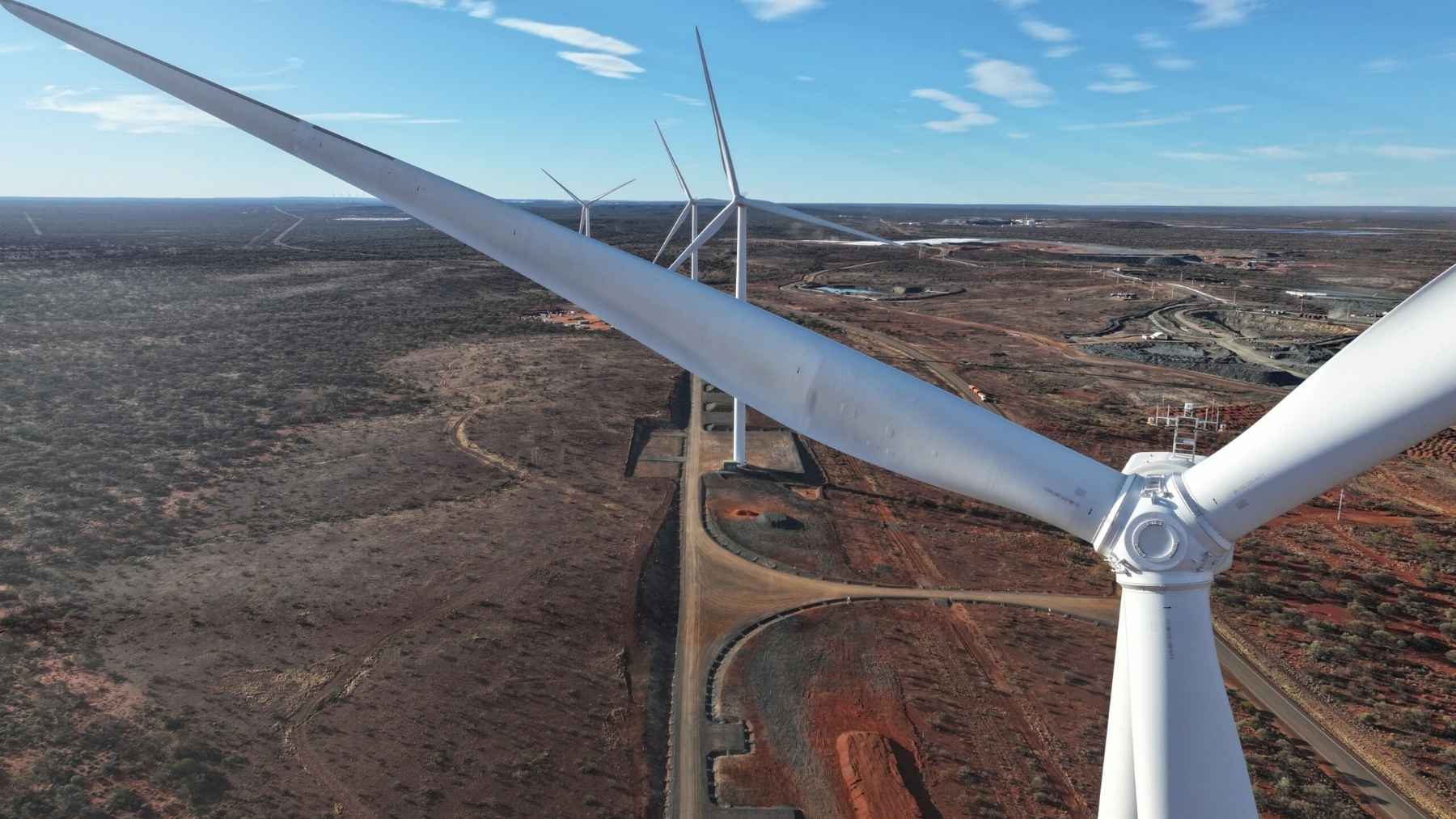
The power station behind all this is a 90 MW hybrid that Zenith Energy financed, built, owns and operates under a long-term power purchase agreement. The renewable side comes down to three items: a 27 MW solar farm, 24 MW of wind across four turbines, and a 15 MW battery holding 33 megawatt-hours. Sitting behind them is 24 MW of thermal generation, the gas and diesel units that give “engines off” its name. No exotic chemistry, no experimental anything. This is catalog equipment arranged by people who did the math properly.
The mine itself draws an average load of about 12.5 MW, and that covers a working underground gold mine, a processing plant chewing through some of the highest-grade ore in the country, and housing for its workforce. Now do the battery math, because it tells you something important. A 33 MWh battery feeding a 12.5 MW load is empty in roughly two hours and 38 minutes. The battery alone cannot carry a single night, let alone six of them. It is a shock absorber, not an engine. What actually carried the streak was wind blowing through the nights while solar owned the days, with the battery smoothing every handoff in between. Which is why Zenith’s framing of the record leaned on conditions: the system can do this whenever the weather allows, and in early May it allowed for almost a week straight.
For a sense of scale in the other direction, California’s grid batteries recently discharged just over 12,000 MW in a single evening, roughly a thousand Bellevues firing at once. Different sport entirely. California’s fleet shifts a few hours of stored sunshine across one of the biggest grids on Earth. Bellevue’s modest 15 MW unit helped keep an entire industrial site alive, alone, in the middle of nowhere, for the better part of a week.
Each new record keeps eating the previous one
What makes Bellevue interesting is not one lucky week. It is the slope. The mine logged 58 engines-off hours in June 2025, before the last of its four wind turbines had even been commissioned. By August the record stood at 84 hours. November stretched it to 101. And in early May the site blew past all of that with 155, beating the old mark by more than two full days. Every time the operators learn something new about running the place on variable power, the ceiling moves.
The closest Australian precedent was King Island, a pioneering wind-and-solar mini-grid on the Tasmanian coast that serves an average load RenewEconomy puts at around 2.5 MW. Bellevue runs five times that, around the clock, with a process plant attached. This is also, for the record, the same country currently replacing all 287 towers on a transmission line energized since 1949 without ever switching off the power. Australians appear to treat impossible grid engineering as a form of recreation.
One good week is not a whole year
Now the honest part, because a streak is a highlight reel and a power bill is twelve months long. Bellevue’s system was designed to cover at least 80% of the site’s energy needs with renewables, and the rest of the time those 24 MW of thermal engines earn their keep. Bellevue Gold says the station is forecasting annualized renewable rates of 80 to 90% for the 2026 financial year, and the company told investors in April it was tracking toward the top of that range. The recent monthlies back it up: an average of 93.8% across February, and 87.8% across the January-to-March quarter. So the realistic picture is a mine running roughly nine-tenths of a full year on sun and wind, with engines plugging the gaps. The 155 hours is what the good stretches look like, not the annual average.
The net zero claim deserves the same treatment. Bellevue says it became the world’s first gold mine to reach net zero for Scope 1 and Scope 2 emissions, hitting in the first half of 2025 a target it had originally set for 2026. True as stated, with two asterisks attached: part of the balance comes from offsets, and the mining fleet itself (the trucks and loaders actually moving rock) still drinks diesel every shift. Electrifying that side of the business is the next mountain, and a much bigger one. Fortescue is chasing it by 2030 at its Pilbara iron ore operations, where RenewEconomy puts the average load at 800 MW, sixty-four times Bellevue’s. A 12.5 MW site proving the concept is not the same thing as an 800 MW site scaling it.
The neighbors keep setting records, and the savings explain why
Bellevue is the headline act, but Western Australia’s off-grid mines have quietly turned this into a race. Lynas Rare Earths, whose Mt Weld operation digs up the elements that end up in EV motor magnets and wind turbines, ran at a 95.7% renewable share across the whole March quarter, against an expected 70%, on a smaller kit of 7 MW solar, 24 MW wind and a 12 MW battery. Lynas says that one quarter saved more than 870,000 liters of diesel (call it 230,000 gallons) compared with the same period a year earlier, when the site still ran a diesel power plant. Liontown Resources’ Kathleen Valley lithium mine cleared an 80% renewable share over the same stretch. None of these companies are doing this for the brochure. Diesel hauled to the middle of the outback is some of the most expensive energy money can buy, and sunshine out there is not.
Then there’s the investor register, which is where this gets genuinely funny. Both Lynas and Liontown count Gina Rinehart among their backers, which is to say the richest person in Australia, and a famously public skeptic of the renewables push; her company Hancock Prospecting holds a 7.6% stake in Lynas, its second-largest. Her portfolio keeps publishing renewable energy records in its quarterly reports, for the unglamorous reason that the numbers work. The resource business keeps wandering into the battery economy whether it means to or not, the same way Alberta’s oil crews spent 75 years dumping wastewater that turned out to be hiding close to a trillion dollars in lithium.
Bellevue itself made the financial point in its April quarterly, noting that the high renewable fraction has cut its exposure to diesel and LNG price swings and adds a buffer against supply shocks. RenewEconomy went further the same month and reported the mine has virtually eliminated its diesel costs. Run the streak through the meter and you can see why. Six days and 11 hours at an average 12.5 MW load works out to a bit over 1,900 megawatt-hours of electricity that, at a conventional off-grid mine, would all come from burning trucked-in fuel.
So no, one engines-off week does not mean heavy industry has gone post-diesel. The thermal units are still bolted to their pads, the annual number will land somewhere in the high 80s rather than at 100, and the underground fleet still runs on diesel. But the scoreboard that matters here is boring and cumulative: a remote, grid-less, 24/7 industrial site getting roughly nine-tenths of a year’s power from sun and wind, at a cost its owner brags about to shareholders. The generators have not been removed. They have been demoted to insurance. For machines that ran an entire industry for a century, that is one brutal performance review.