
When somebody says “grid battery,” you probably picture a field of white lithium cabinets baking in the sun, the same Tesla Megapack hardware that keeps turning up at substations from California to the Australian outback. That has been the default answer to the one real problem with solar and wind: the sun sets, the wind drops, and the cheap power you made at noon is no good to anyone at 8 p.m.
But the most interesting grid battery going up in the United States right now has no lithium in it at all. It stores electricity by squeezing carbon dioxide into a liquid inside a giant inflatable dome the size of a sports stadium, and it breathes that gas in and out every single day.
The company behind it is Energy Dome, out of Milan, and it stopped being a science project a while ago. A full-scale unit has been feeding the grid in Sardinia since July 2025. The new part is what’s happening on this side of the Atlantic. The first U.S. plant breaks ground in Wisconsin this year, a brand-new Arizona project just landed at a coal plant on its way out, and there is a Texas data center in the pipeline too. Google liked the concept enough to buy a piece of the company.
So how does a bubble of CO2 store electricity?
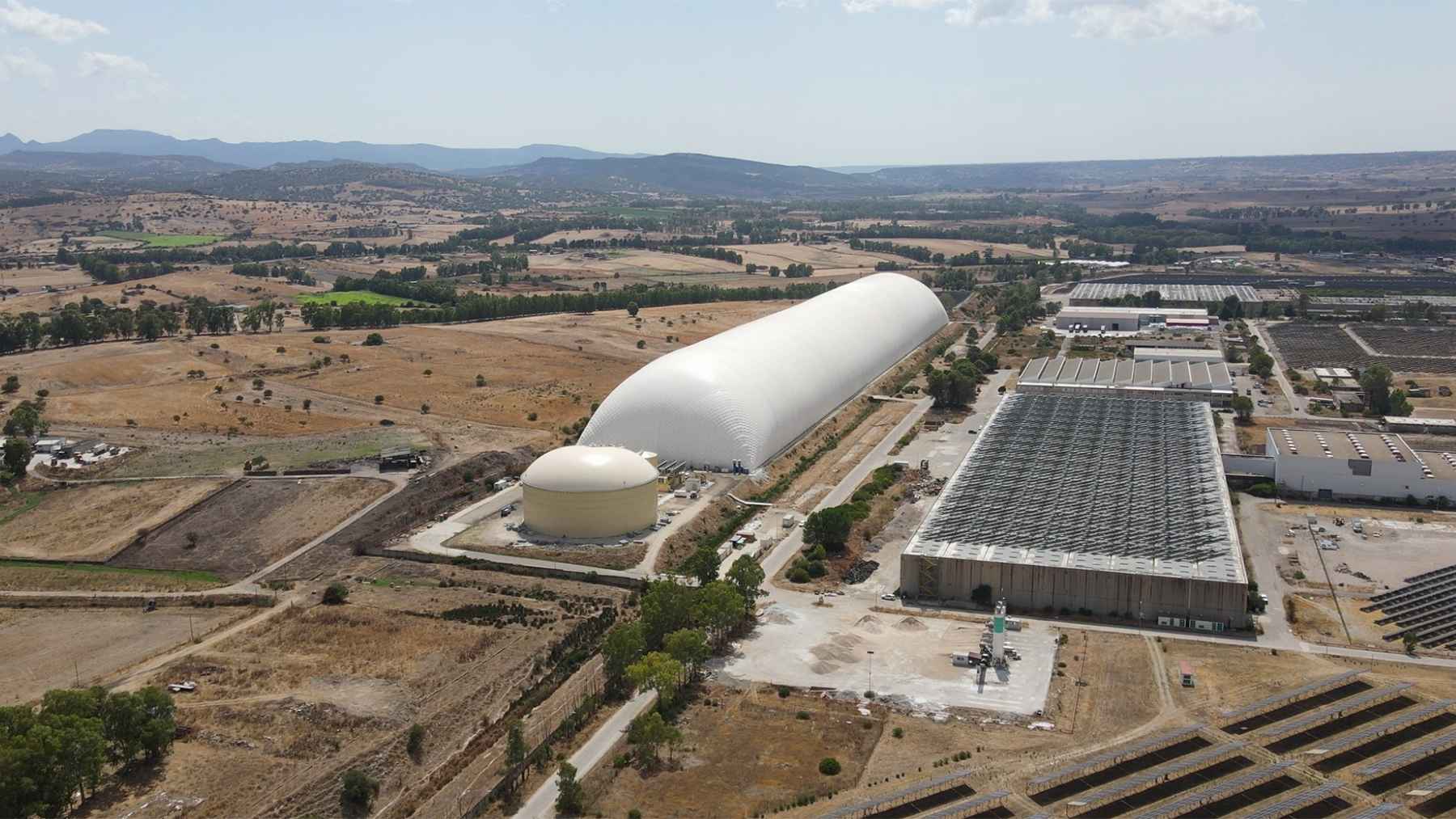
Start with the dome, because it is the part that makes people do a double take. It is a low-pressure gasholder, basically a huge sealed balloon, and it sits full of carbon dioxide gas at roughly the pressure of the air around you. When the grid has more electricity than it needs, usually midday solar that would otherwise be curtailed, the system uses that power to pull the CO2 out of the dome, compress it hard, and turn it into a liquid that gets parked in pressure tanks. That is the battery “charging.” The energy is now sitting there as cold, dense liquid CO2, waiting.
To discharge, it runs the whole thing in reverse. The liquid CO2 gets warmed up, it boils back into a gas, and that expanding gas spins a turbine that pushes electricity onto the grid. The gas then flows right back into the dome, ready to do it again tomorrow. Nothing gets burned and nothing gets vented. The same carbon dioxide just shuffles between liquid and gas inside a sealed loop, which is why the same molecules can run for decades without a top-up. There is no lithium, no cobalt, no rare earths, and nothing in the system that catches fire.
The Sardinia version has been doing this for real since July 2025
The proof sits in a gated industrial yard near Ottana, in the middle of Sardinia, and it is genuinely odd to look at. IEEE Spectrum reported that the bubble holds 2,000 tons of carbon dioxide, and the detail that catches people off guard is where the gas came from. It was not scrubbed out of a smokestack or pulled from the sky. It was bought from a gas supplier and sealed inside for good. The liquefied version lives in dozens of pressure vessels, each one about the size of a school bus.
The numbers are the part utilities care about. The plant is rated at 20 megawatts and holds 200 megawatt-hours, which works out to running flat out for 10 hours straight. That is the kind of stretch that actually covers an evening peak, not a 90-minute lithium sprint.
The French utility ENGIE signed a deal to buy and dispatch the output. And the build is quick for grid infrastructure: the dome itself inflates in about half a day, and the rest of the plant goes up in under two years on roughly five hectares of flat ground. If a serious storm is on the way, they can deflate the whole bubble in half a day by liquefying the gas, and the structure is rated to take winds of around 100 mph before it comes to that.
Three copies are now headed for the U.S. grid
This is where it gets real for American readers. The first CO2 battery in the country is going up in Columbia County, Wisconsin, run by the utility Alliant Energy. State regulators signed off in June 2025, construction starts in 2026, and the project is due to finish by the end of 2027.
It is the same 20 MW/200 MWh box as Sardinia, enough to power roughly 18,000 Wisconsin homes for 10 hours on a single charge, and the U.S. Department of Energy chipped in a grant of up to about $30 million. They are dropping it on the site of the existing Columbia Energy Center, which is the smart play. An old power plant already has the high-voltage wires and the grid hookup, so you skip years of interconnection paperwork.
Then came the news from this week. On June 16, Arizona’s Salt River Project announced a 19-megawatt, 10-hour CO2 battery at its Coronado Generating Station in St. Johns, a former coal plant being converted to run on gas. That one is slated to come online in 2029 under a 20-year deal where Energy Dome owns and operates the hardware and the utility dispatches the power. It is one of the first U.S. sites tied to Google’s partnership with Energy Dome, the global agreement and equity investment the search giant announced back in July 2025 to park clean power next to its data centers.
Outside that Google deal, the company has also signed on to feed a 1-gigawatt data center in Odessa, Texas. Three different American sites, three different reasons, same strange balloon.
The catch they don’t put on the rendering
None of this makes lithium obsolete, and it is worth being straight about why. The round-trip efficiency, meaning how much electricity you get back out compared to what you put in, sits around 70 percent by Energy Dome’s own numbers. A lithium battery clears something closer to 90, so you give up more of your power to the process here.
The dome also eats space: a CO2 battery needs roughly twice the land of a lithium system storing the same energy, and a balloon bigger than a stadium is not exactly easy to hide from the neighbors. The company says its technology is cost-competitive with lithium and runs for 25 years or more without degrading, which is the real pitch for long, slow storage. Those are still its own claims until a few of these have run for a decade.
The bigger thing is that this is the same trade a whole crop of stranger storage ideas is making right now: give up some efficiency, get something cheaper, longer-lived, or built from stuff nobody has to mine a war over. A British company is chasing it by freezing air into a liquid outside Manchester, and a Finnish town now heats itself off a silo of hot sand instead of a chemical cell. The CO2 dome is just the one that landed a real utility contract first.
And here is the part that reaches your driveway. Every EV charging overnight, every heat pump, every data center training the next model is making that evening demand bigger and meaner, right when solar clocks out for the day. Somebody has to stash cheap afternoon power somewhere until the grid screams for it at dinnertime, and the options that can hold it for 10 hours straight increasingly look nothing like the battery in your phone. One of them is a stadium-sized balloon full of the gas everyone spent the last decade trying to bury. It is running in Sardinia, it is coming to Wisconsin, and it does not need a single gram of lithium to pull it off.
 @arthurnelson ROOKIE2 months ago