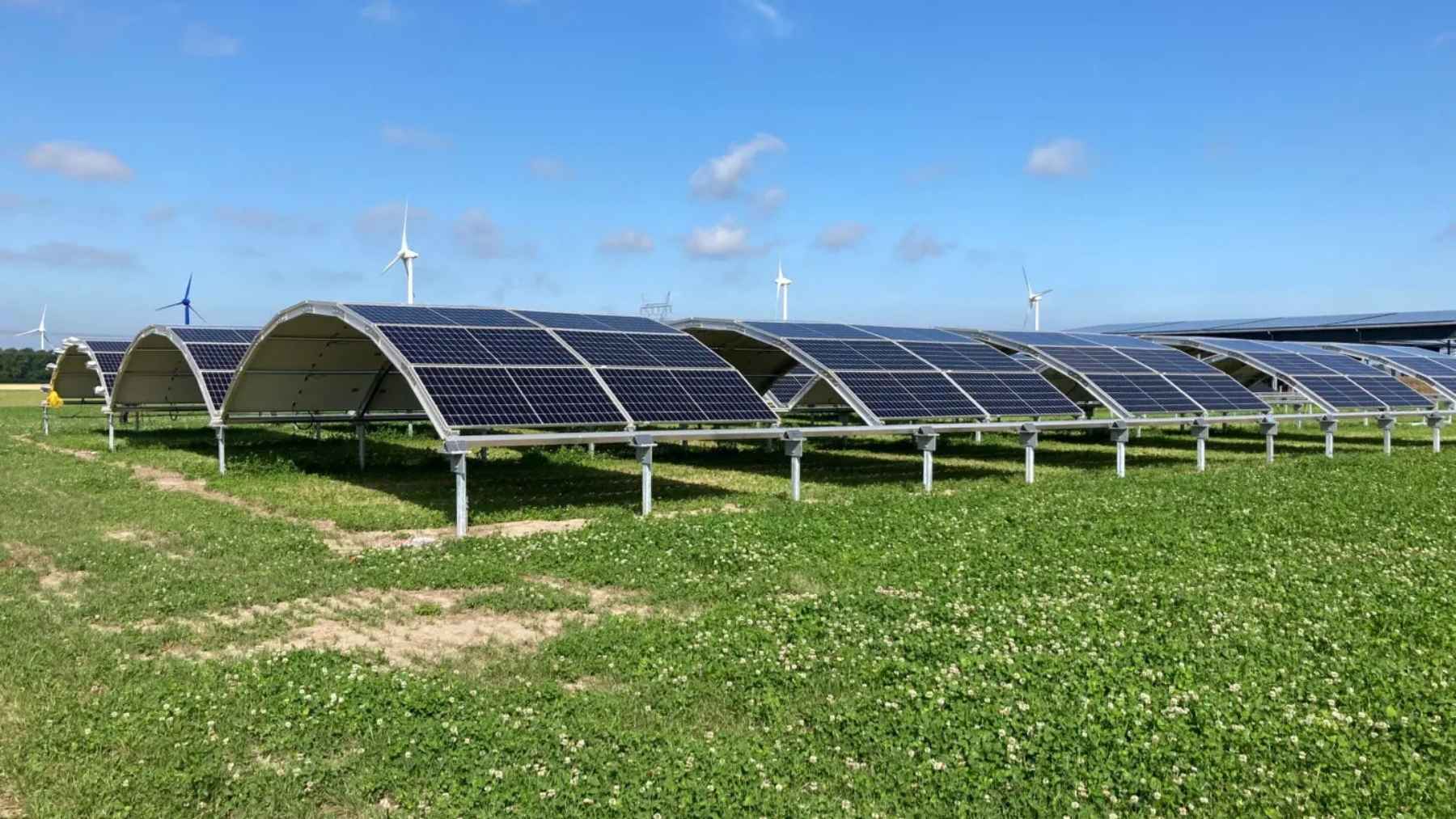

Solar developers and farmers have spent the better part of a decade fighting over the same acres. You’ve probably seen the script: a company wants to lease a field for panels, the neighbors point out that you can’t eat electricity, and the county board meeting runs long. A project outside Berlin just skipped the whole argument. Instead of choosing between the field and the panels, the builders stood 74,064 solar panels 11.5 feet in the air and kept the farm running underneath.
The plant sits in Selchow, pressed up against the southern runway of Berlin Brandenburg Airport, and it’s been on the grid since September 8. It’s rated at about 48 megawatts and covers roughly 173 acres of a 188-acre site owned by Berliner Stadtgüter, Berlin’s publicly owned farmland company. According to pv magazine Deutschland, the companies behind it call it the largest agrivoltaic plant in Germany paired with actual crop farming. Germany has bigger agrivoltaic sites on paper, like Vattenfall’s 76-megawatt plant in Tützpatz, but that one mixes its solar with livestock.
If you haven’t run into the term, agrivoltaics is basically the practice of running agriculture and solar on the same land instead of making them compete for it. We’ve covered the smaller American version of the idea, like the 3,276 panels shading a Colorado berry farm through a drought. Selchow takes the same concept, multiplies the panel count by more than twenty, and aims it at real row-crop farming instead of grazing.
So how do you farm under a solar panel?
Mostly by giving the machinery room. The module rows run north to south, spaced 36 feet apart, and 29.5 feet of that stays clear as working width for tractors and combines. The panels sit on single-axis trackers that follow the sun and tilt up to 60 degrees, which the project partners say brings in 25 to 30 percent more electricity than fixed mounting, mostly in the mornings and evenings.
Here’s where it gets interesting for the guy actually driving the tractor: when he needs extra clearance for a job, he can swing the rows out of his way himself instead of calling an operator and waiting. It’s his call, not the utility’s. Handing that switch to the farmer is a pretty smart piece of design, frankly.
The modules are bifacial, meaning they catch light on both faces, including whatever bounces up off the ground. And the strip of dirt directly under the tables isn’t wasted either. It’s reserved for wildflower strips grown from regionally sourced seed, set aside as habitat for insects and small animals.
The land itself had been farmed conventionally until now. The man taking it over is Sven Geelhaar, an organic farmer whose Landgut Geelhaar operation in Chorin runs about 740 acres, and who leased the ground under the panels. It’s supposed to stay at least 90 percent organic. Geelhaar told the German farm weekly Bauernzeitung that April brought no rain to this field, and the soil under the modules held onto its moisture anyway. That’s one farmer’s read on one dry month, but keeping water in the dirt is essentially the whole agronomic pitch for panels over a field, so it’s an encouraging early sign.
Corn is off the crop plan, and the airport is why
So what actually grows under there?
The first planting is a cover crop, which isn’t glamorous, but it gets the soil ready. From 2027, according to the German energy outlet Cleanthinking, the rotation calls for grain sorghum, alfalfa and forage grasses, possibly with poppy or rapeseed mixed in. One crop is banned outright, and that’s corn. The reason is the runway.
Tall crops pull in birds, which show up for the cover and the leftover grain. A flock working a field that touches an active runway is exactly how you get bird strikes, and a jet engine that swallows a bird can fail badly enough that airports don’t treat the subject as a nuisance. So the tallest, most bird-friendly crop in a German rotation stays off this particular field. I’d guess that clause took about five minutes to write and zero people argued with it.
Birds still get their share of the deal, just farther from the jets. Niederlausitz Aktuell reports that Berliner Stadtgüter set up 42 acres outside the site, near the villages of Ragow and Deutsch Wusterhausen, as compensation ground for breeding birds, mainly skylarks. Those acres come out of a 914-acre land pool the company keeps for exactly this. The plant is also one of six sites in a German research program running from 2025 to 2027, which tracks vegetation, birds, insects, reptiles and small mammals around the panels, plus the microclimate underneath them. The Leibniz Centre for Agricultural Landscape Research, TU Dresden and Germany’s federal conservation agency are doing the counting.
Nobody subsidized this one
Here’s the number I can’t give you: the price tag. The companies haven’t published what the plant cost or who’s buying the power, and when Niederlausitz Aktuell put both questions to the landowner, they got forwarded to the developer, and that’s where they still sat as of the outlet’s September 11 update.
We do know who owns it, and how it got financed. The plant belongs to klimaVest, a retail investment fund run by Commerz Real, and Elysium Solar’s chief operating officer, Richard Härtel, has said the project only penciled out without Germany’s renewable subsidy scheme because the fund carries it directly. Elysium developed the site, Goldbeck Solar built it in 11 months of construction, and a 110-kilovolt power line happens to run along the edge of the field, which spared everyone years of waiting on a grid connection.
For scale, we’ve written about the solar panels covering a former Soviet training ground in Germany, which is the kind of land big solar usually ends up on. Cropland this good next to a capital city doesn’t usually get offered to solar, and the term on this one runs 30 years. As far as I can tell, everything that’s been published about the plant so far is in German, which seems like an odd gap for a project this size.
Geelhaar’s first planting under the panels is that cover crop. The rotation of grain sorghum, alfalfa and forage grasses starts in 2027, with poppy and rapeseed listed as possibilities. Corn didn’t make the list.