
For as long as navies have hunted mines, the job has meant doing the single most nerve-wracking thing in seafaring: steering a small ship full of people slowly and deliberately into water you already know is rigged to blow up. Britain’s plan for the mined-up Strait of Hormuz is to stop doing that. The Royal Navy has sent its newest minehunting kit toward the Gulf, and the thing that will actually go poking along the seabed looking for Iranian mines is a 12-metre robot boat with nobody aboard.
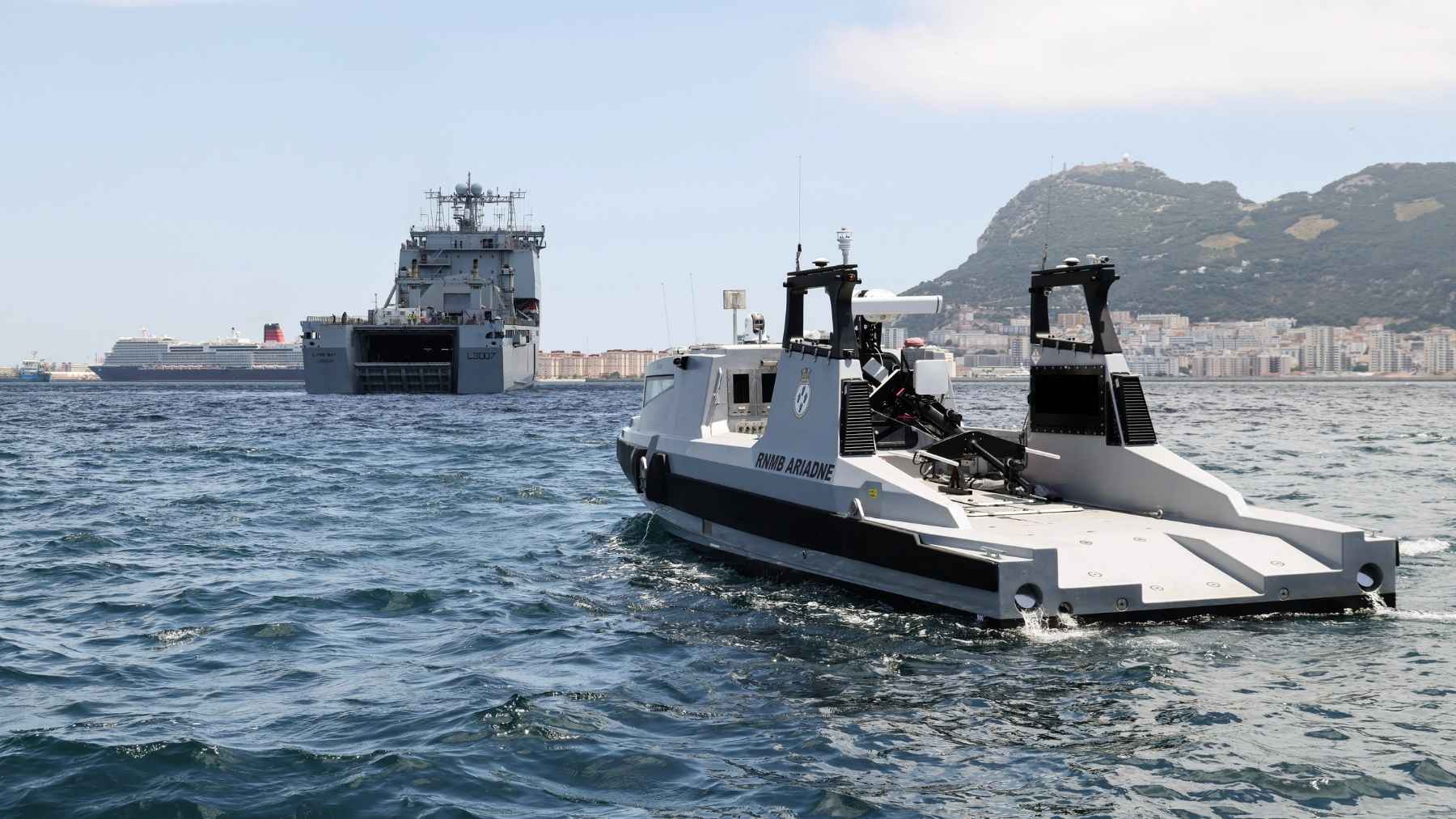
The boat is called RNMB Ariadne, and it has just been readied for a potential Hormuz mission. It is worth understanding how the thing actually works, because this is a real shift in how mines get cleared, not just a press release with a drone in it.
The robot that does the scary part
Ariadne is an uncrewed surface vessel, the first of four autonomous mine-hunting systems Thales is delivering to the Royal Navy under a long-running joint program with France. It can run fully on its own or be flown by operators sitting in a portable command shack, and the whole point of it is in the design brief: do the dangerous part so a human never has to.
What it tows is the clever bit. The Thales Towed Synthetic Aperture Multiviews sonar, or TSAM, is one of the most sophisticated towed sonars going, and instead of one grainy look at a contact it builds several synthetic-aperture images of the same object from different angles in a single pass. That matters because the killer in mine warfare is not missing a mine, it is false alarms: spend all day investigating rocks and old washing machines and you never clear the channel. Bolted on top is AI target recognition. Thales says its sonar-analysis software chews through the data up to four times faster than a human poring over a screen, which is the difference between sorting real threats from junk in hours rather than days.
The sequence is straightforward once you lay it out. A mother ship launches the boat, the boat tows its sonar across the seabed while the crew stays safely over the horizon, and when something looks like a mine, a remotely operated vehicle goes down to take a closer look and, if needed, plant a charge to destroy it. The Royal Navy rates the system to work in sea states up to State 4, which is naval-speak for “actual weather,” not just a flat calm test range. “Removing personnel from the danger of operating within a minefield” is how the program’s director summed up the entire idea, and for once the official line is also just the plain truth.
How it’s getting to the Gulf
Getting Ariadne to Hormuz has been its own small saga. The Royal Navy’s trials team first checked the towed sonar’s accuracy against a target that the survey ship HMS Magpie had already mapped on the seabed. The boat was then loaded into HMS Stirling Castle, a former civilian ship now flying the white ensign as a drone carrier, and shipped to Gibraltar, where, in a service first, it was driven into the flooded dock of the support ship RFA Lyme Bay and set down on a cradle as the water drained out.
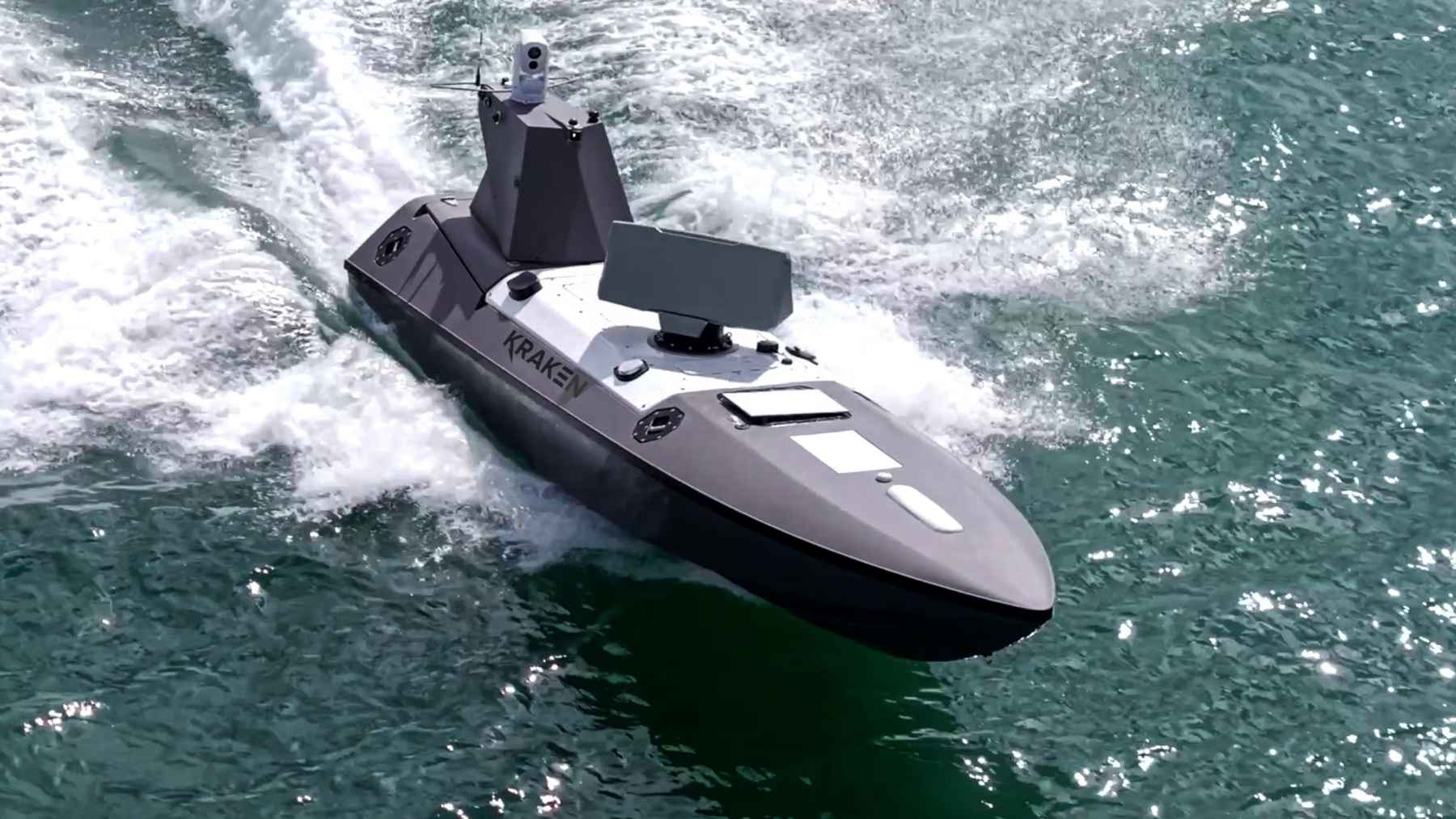
RFA Lyme Bay sailed from Gibraltar on 26 May with more than 100 mine-warfare specialists aboard, headed for Duqm in Oman. It is one piece of a wider British package the Defence Secretary pledged on 12 May: £115 million in new money for mine-hunting and counter-drone gear, the destroyer HMS Dragon, RAF Typhoons, and autonomous Kraken boats, all rolled into a multinational mission run with France and dozens of other nations. Nobody is in the strait clearing mines yet; the mission goes live “when conditions allow,” which means once the shaky US-Iran ceasefire holds long enough for anyone to chance it.
Why a robot instead of a ship
There are two reasons Britain is doing it this way, and it helps to be honest about both. The first is genuine doctrine. Navies everywhere are moving sailors off small wooden minehunters and onto motherships parked well clear of the blast radius, because a cheap mine that can sink a crewed ship cannot do much to a 12-metre boat you can replace. Uncrewed mine-hunting is where the whole field is going, and the same logic AutoNotion has watched a German hydrogen drone sub pitch for this very chokepoint applies here.
The second reason is less flattering. Britain’s crewed minehunter fleet has been run down hard, from sixteen hulls a decade ago to a handful now, and most of those are tied up in home waters. The Royal Navy used to forward-base minehunters in the Gulf for exactly this scenario, but the last of them, HMS Middleton, left the region in January 2026, weeks before Iran turned the strait into a hazard. So the robot boat is not only the smart option. It is very nearly the only option left on the shelf.
The contrast with the last time is stark. When Iran mined Hormuz during the Iran-Iraq war in 1987, the Royal Navy sent four crewed Hunt-class minehunters and a fat logistics tail, drawn from a fleet of more than forty mine-warfare vessels, and took a month to sail them out. The US Navy asked for that help precisely because Britain had hulls and expertise to spare. Forty years on, the answer is one support ship and a drone.
The catch nobody can engineer away
None of this means the job is easy now. The mines Iran is thought to have laid sit on the seabed or hang below the surface on a cable, triggered by a ship’s magnetic signature or the pressure change as a hull passes overhead, and the strait is barely 35 kilometres wide at its narrowest. Clearing it to a standard that satisfies not just admirals but the insurers who decide whether tankers sail is slow, painstaking work, robot or no robot. Pentagon officials privately told Congress it could take six months, a figure the Pentagon then publicly dismissed as “cherry picking and false.” Nobody really knows.
What is new is that Britain intends to find out without putting a single crew into the danger zone. Ariadne only entered service last year and is still working through its operational evaluation, so Hormuz would be a brutal first real exam: the most heavily watched, most heavily mined water on the planet. If the boat and its sonar do what Thales says they do, the Royal Navy gets to clear a minefield while its sailors watch from a ship miles away. That, far more than any horsepower or top-speed number, is the part worth caring about.