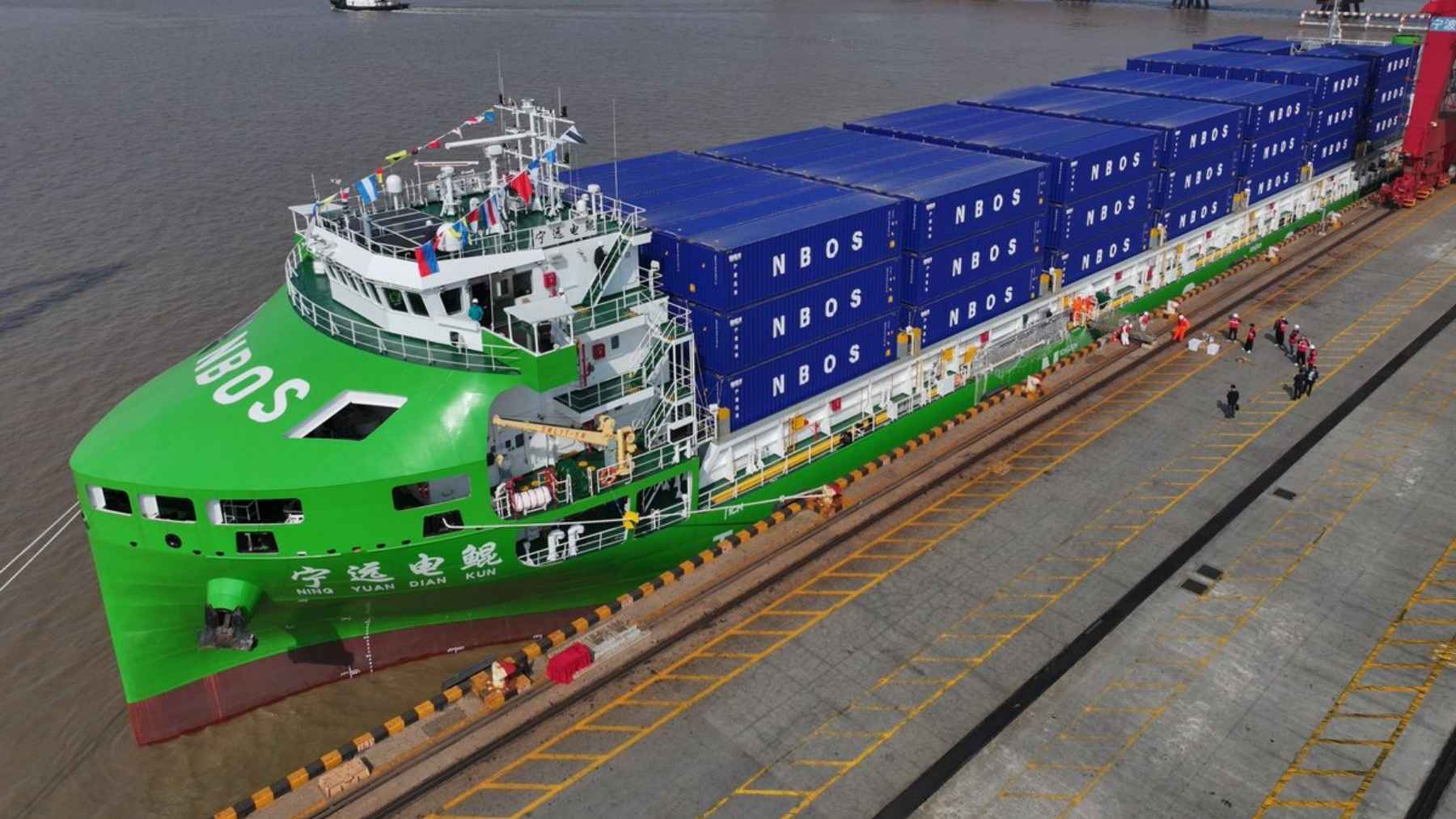

Almost everything in your house arrived by boat. The phone, the couch, the running shoes, the coffee maker. At some point most of it sat in a steel box on a container ship crossing an ocean, and that ship was almost certainly burning heavy fuel oil, the tar-like residue left over after a refinery has pulled everything valuable out of crude. It is cheap, it is filthy, and it moves something like 80 to 90 percent of world trade. So a 10,000-ton container ship that doesn’t burn a drop of it is a genuinely odd thing to watch pull out of port. China just put one into commercial service. The Ningyuan Dian Kun left the Port of Ningbo-Zhoushan on April 15 bound for Jiaxing, and its operator and Chinese state media are calling it the largest all-electric container ship in the world.
A 419-foot cargo ship with no tank to fill
The Ningyuan Dian Kun runs 419 feet (127.8 meters) long with a 71-foot beam, which puts it in feeder territory: the short-haul workhorse that shuttles containers between a big hub port and the smaller ports around it. It carries 742 standard containers and tops out at 11.5 knots, or about 13 mph, which is slow even by cargo-ship standards but plenty for the coastal runs it was built for. It was constructed by Jiangxi Jiangxin Shipbuilding for Ningbo Ocean Shipping and classed by the China Classification Society, and according to maritime trade outlet Baird Maritime it is the first 10,000-ton electric container vessel built and operated in China.
Instead of a diesel engine and a fuel tank, it runs on ten standardized battery containers feeding two 875-kilowatt permanent-magnet motors. The combined storage is about 20,000 kilowatt-hours, which Global Times notes is roughly the battery capacity of 300 household electric cars stacked into one hull. When the packs run down, the ship can plug into high-voltage shore power or have the whole containers swapped out for charged ones at the pier, the same trick a handful of Chinese EV makers already use on land. There are even solar panels on board, though those only feed the lights and the hotel load, not propulsion.
Container ships are some of the dirtiest machines on the water
The reason to care about a slow little feeder comes down to what these ships normally burn. Shipping as a whole puts out roughly a billion metric tons of carbon dioxide a year, close to 3 percent of the global total, according to the International Maritime Organization, and container ships are one of the three vessel types responsible for most of it. Heavy fuel oil is the bottom of the refining barrel, and burning it throws off not just CO2 but sulfur and fine particulates that settle over port cities. The American Chemical Society’s Chemical & Engineering News puts the global fleet’s habit at more than 300 million tons of fossil fuel a year.
Against that backdrop, one feeder is a rounding error, and it’s worth saying so plainly. Ningbo Ocean Shipping says the Ningyuan Dian Kun will save about 580 metric tons of fuel a year and cut more than 1,400 metric tons of CO2 compared with the diesel boat it replaces. That is real, and it is also tiny next to a fleet measured in the billions of tons. The point of a ship like this isn’t the single hull. It’s proving the coastal feeder leg can run on electrons at all.
The batteries are the whole story, and the whole limit
There’s a catch, and it’s the same one behind every electric car you’ve read about. Batteries are heavy and they hold a fraction of the energy that the same weight of fuel does. A feeder hauling 742 boxes is small. The diesel giants that actually cross oceans carry 20,000 or more, and no battery pack on Earth is shoving that kind of tonnage across the Pacific and back. Ma Jihua, a veteran tech industry analyst, told Global Times that battery range is still the main limit on large electric vessels, which is why they make sense on inland waterways and short coastal runs but not yet on open-ocean routes.
His more interesting argument is about where the technology comes from. The same battery, motor and electric-drive industry that turned China into the world’s biggest EV manufacturer is now bleeding sideways into shipbuilding, reusing the same cells and drive units in a different kind of hull. As Ma put it, “the significance of all-electric ships goes far beyond replacing oil with electricity.” Cars on the road, drones in the air, and now cargo ships at sea are all drinking from the same industrial well.
It mostly steers itself
The other half of the pitch is the word “smart.” The Ningyuan Dian Kun carries an integrated bridge and a suite of autonomous navigation tools built for open water: real-time panoramic monitoring around the hull, all-weather sensing, automatic route planning, collision-avoidance alerts, and the ability to hand control back and forth between the crew and the computer without drama. Ningbo Ocean Shipping says the system reads its surroundings, picks an efficient route, and flags hazards on its own, which is the maritime version of the driver-assist features slowly taking over the dashboard of every new car.
This part isn’t a one-off. On March 30, China rolled out a national action plan to push artificial intelligence into shipping, with a stated goal of more than 100 smart vessels and at least five pilot routes by 2027, per the Xinhua News Agency. The electric feeder is the first visible piece of a much larger bet that the country’s ships will get quieter, cleaner and more automated at the same time.
It’s the biggest electric container ship, not the biggest electric ship
One thing the headlines blur, because the superlatives pile up fast in this corner of the industry. The Ningyuan Dian Kun is the largest all-electric container ship, the kind built to haul freight. It is not the largest electric vessel of any kind. That title belongs to a ferry: the 426-foot China Zorrilla, the largest electric vehicle ever built, which carries roughly twice the battery capacity and is designed to move 2,100 passengers across the Río de la Plata rather than stacks of cargo. Different job, different record.
The electric-marine field is crowded with these niche firsts right now, from the 180-mph electric seaglider being tested off Rhode Island to a long line of battery ferries in Norway. The container ship is its own category, and China now has a second one close behind: the sister vessel Ningyuan Dian Peng was launched earlier this year and, per its operator, is due to enter service around June. Once both are running, they’re meant to anchor a scaled-up green feeder network out of Ningbo-Zhoushan.
None of this means a battery-powered ship is about to cross an ocean. The Ningyuan Dian Kun isn’t built for that, and nobody serious is pretending otherwise; the deep-sea legs still need something denser than today’s batteries, which is why the rest of the industry is chasing alternatives like the marine gas turbine recently cleared to burn 100 percent hydrogen. What this ship does is narrower and more useful than the headline number suggests. It shows that the short coastal hops feeding the world’s biggest ports can move 742 boxes of cargo without lighting anything on fire. In an industry that has burned the cheapest, dirtiest fuel it could find for the better part of a century, getting one 10,000-ton hull to do its job on stored electrons is further along than it sounds.