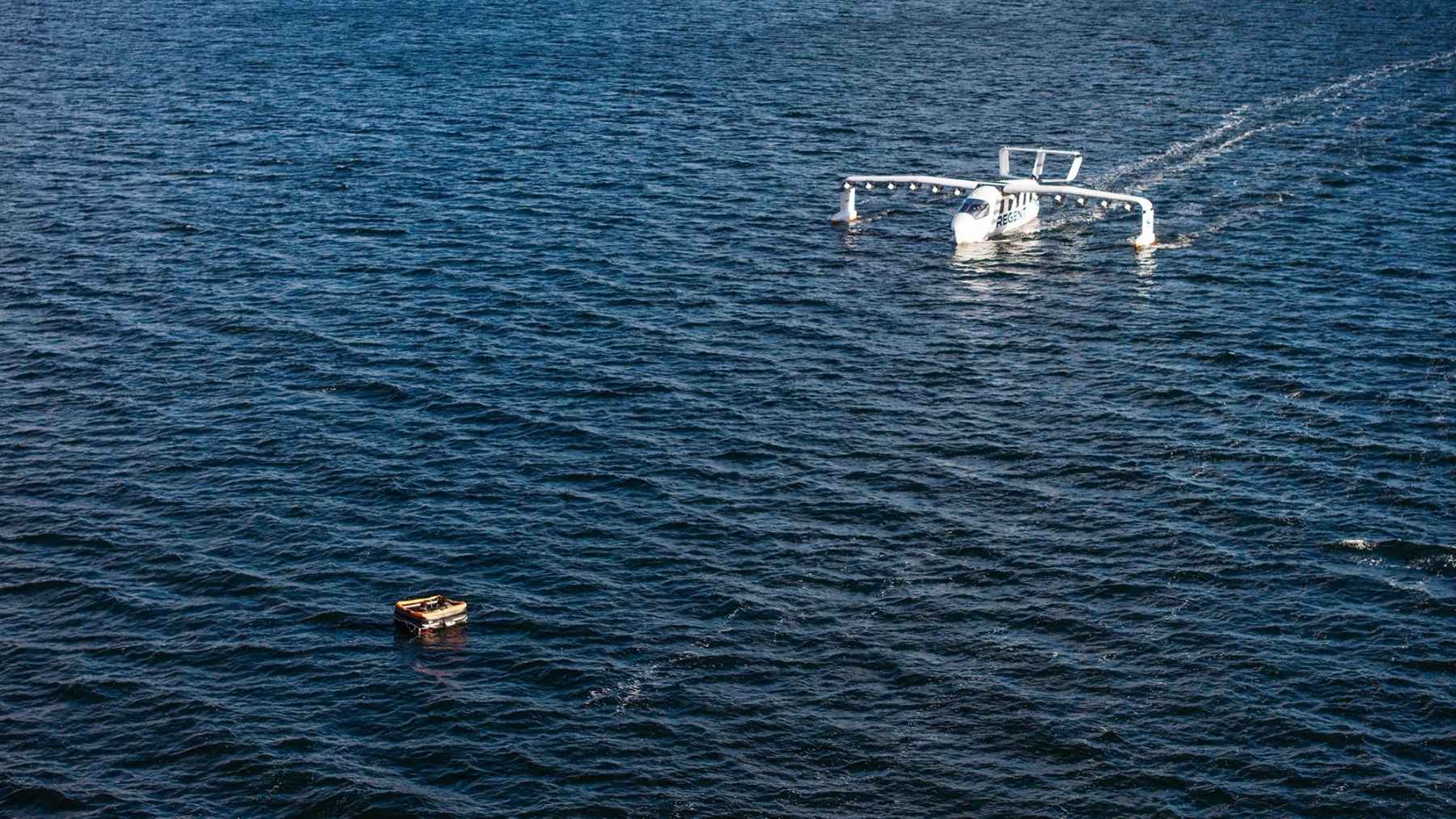

If you’ve ever taken the ferry out to Nantucket or across Puget Sound, you know the routine. You show up at the dock, you wait, and then a diesel boat hauls you across the water at a pace that hasn’t changed much in decades. American coastal travel still mostly runs on that formula, burning fuel and watching the clock. A startup in Rhode Island wants to scrap the whole thing, and the machine it built to do it is the largest all-electric flying vessel anyone has put in the water to date.
The company is REGENT, based in North Kingstown, and the vehicle is called the Viceroy. Its first full-scale prototype, christened Paladin, has been running sea trials in Narragansett Bay since March 2025. It’s a 55-foot craft with a 65-foot wingspan, built to carry 12 passengers and two crew up to 180 miles at 180 mph, all on battery power. REGENT has already booked more than $10 billion in commercial orders, plus a $15 million contract with the U.S. Marine Corps. Lockheed Martin, Founders Fund and Japan Airlines are among the backers who have put in over $100 million. For a boat most people have never heard of, that’s a lot of money riding on the idea.
Float, foil, fly, and never leave the water
The Viceroy isn’t an airplane, and it isn’t quite a boat either. It’s what engineers call a wing-in-ground-effect craft, which means it flies low enough that the cushion of air trapped between its wing and the water surface gives it extra lift. CEO Billy Thalheimer likes to compare it to a pelican gliding inches above the waves without flapping. The practical payoff is range: REGENT says flying in ground effect lets a seaglider travel roughly twice as far as a comparable electric aircraft on the same battery, about 180 miles today and a projected 400 to 500 miles once next-generation cells arrive.
It gets there in three stages. At the dock it floats on its hull like any other boat. As it picks up speed leaving the harbor, it rises onto retractable hydrofoils, which lift the hull clear of the chop for a smoother, faster ride (REGENT is targeting foiling speeds around 50 knots, roughly twice what production hydrofoil boats manage). Once it reaches open water, the foils retract and the craft accelerates onto its wing, cruising within one wingspan of the surface. You never climb into the sky, and you never need a runway. The whole trip happens a few feet above the water.
The economics are the real selling point. Thalheimer pitches the seaglider as something like six to ten times faster than a ferry and about half the cost of a regional aircraft, while cutting out the airport overhead, the security line, and the emissions. On a 100-to-200-mile coastal hop, his argument goes, you spend less time getting to and from the airport than you would just riding the seaglider dock to dock.
It’s legally a boat, which is the entire trick
What makes the Viceroy buildable this decade is the regulation. Because it never leaves the water’s wingspan, it’s classified and certified as a maritime vessel rather than an aircraft. REGENT is taking it through the U.S. Coast Guard and the classification society Lloyd’s Register, not the FAA.
That distinction sounds like paperwork, but it’s the difference between launching this decade and launching sometime in the 2040s. Ask Joby or Archer, the two American eVTOL companies still grinding through the FAA’s multi-stage type-certification process for their air taxis. By routing around the FAA, REGENT gets to bring a roughly 15,000-pound electric flying machine to market on a maritime timeline. It also made a propulsion choice worth underlining: the Viceroy runs on batteries, not hydrogen, which is the heavier, harder path that other clean-flight projects keep chasing. We recently looked at a piloted hydrogen-powered helicopter that flew a full airport circuit over Quebec, and the cooling and certification headaches in that story are exactly the ones REGENT sidestepped by sticking with cells. Founders Billy Thalheimer and CTO Mike Klinker, both MIT-trained aerospace engineers who put in time at Boeing, clearly did that math early.
The proof of concept is older than the hype. REGENT flew a quarter-scale seaglider back in 2022, which is what convinced investors the physics held up. The company is now building a 255,000-square-foot manufacturing plant at the Quonset Business Park in North Kingstown, expected to come online this year, in a corner of Rhode Island that already houses defense and marine heavyweights like General Dynamics Electric Boat and Anduril. If you’re going to build a flying boat for the Navy’s backyard, that’s not a bad neighborhood to do it in.
The Marines want one too
The commercial story is only half of it. REGENT spun up a dedicated defense arm, and the U.S. Marine Corps Warfighting Lab has been a customer since 2025, signing on after an initial $4.75 million feasibility contract. That partnership has since grown to a total of $15 million, and last November REGENT ran beach-extraction and open-water rescue demonstrations aimed at medical and casualty evacuation missions, according to the company.
There’s a clear logic to it. A craft that skims the water under radar, runs near-silent on electric motors and hops between islands at 180 mph is exactly the kind of platform the Pentagon has started thinking about again as it shifts its attention toward the Indo-Pacific and the problem of moving troops and supplies across long island chains. REGENT is also developing an uncrewed version called Squire, an autonomous seaglider drone, and on April 13, 2026 it completed its first ground-effect flight, which the company says is the first time a defense-specific wing-in-ground-effect craft has flown in the United States. Thalheimer called it a major success for the company’s defense program. The crewed Viceroy and the autonomous Squire share the same airframe approach and feed the same test campaign.
It hasn’t actually flown yet
This is where you keep your expectations honest. As striking as Paladin looks bobbing in Narragansett Bay, it has not yet flown in wing-in-ground-effect mode with people on board. The prototype has completed float-mode tests and a crewed foiling run, and REGENT counts the first human operations on a full-scale seaglider among its 2025 milestones. But the full airborne flight has slipped from its original mid-2025 target. The company now frames the first crewed flight as a 2026 milestone, with customer deliveries as early as 2027.
So when you read that this is the biggest electric flying machine ever built, the accurate version carries an asterisk. It’s the biggest one built to date, it has run on the water plenty, and it has foiled with a crew aboard. The flying part is still on the schedule, not in the logbook. To be fair, REGENT has never claimed otherwise, and the autonomous Squire flight in April is real flight-test data, just not on the passenger vehicle.
Who actually lines up to buy a flying boat
The order book is real even if the passenger flights aren’t yet. In January, a U.S. private members’ club called XXV ordered 30 Viceroys for premium East Coast routes starting in 2027, the kind of runs that connect New York to the Hamptons or Boston to Nantucket. UrbanLink has lined up service in South Florida and Puerto Rico, the German operator FRS signed on years ago, and WIRED named REGENT one of its top electric-vehicle companies of 2026.
None of that guarantees the Viceroy delivers as advertised once it’s carrying a full cabin at cruise speed. Clean-transport hardware has a habit of looking finished long before it actually is, and the 114-meter superyacht that was built around hydrogen fuel cells and then quietly shipped on diesel is a fresh reminder that a bold powertrain on paper and a working one at the dock are different things. But REGENT is making a specific bet: that a vehicle which is faster than a ferry, cheaper than an aircraft and cleaner than both can pull paying passengers off the diesel boats that still define the American coast. The prototype is in the water and the deposits are in the bank. Now it just has to fly.
 @wellardbutt ROOKIE5 months ago