
Shutting down an open-pit coal mine leaves you with a very big hole and a very long to-do list. The standard endgame is to push the spoil back in, plant something hardy, and spend a few decades hoping the groundwater behaves.
Germany went another way with the pit outside Cottbus, a city of about 95,000 roughly 80 miles southeast of Berlin. Starting in April 2019, engineers opened an intake on the Spree river and spent about five and a half years turning the worked-out Cottbus-Nord lignite mine into the country’s largest artificial lake by surface area, around 7.3 square miles of water with 16 miles of shoreline.
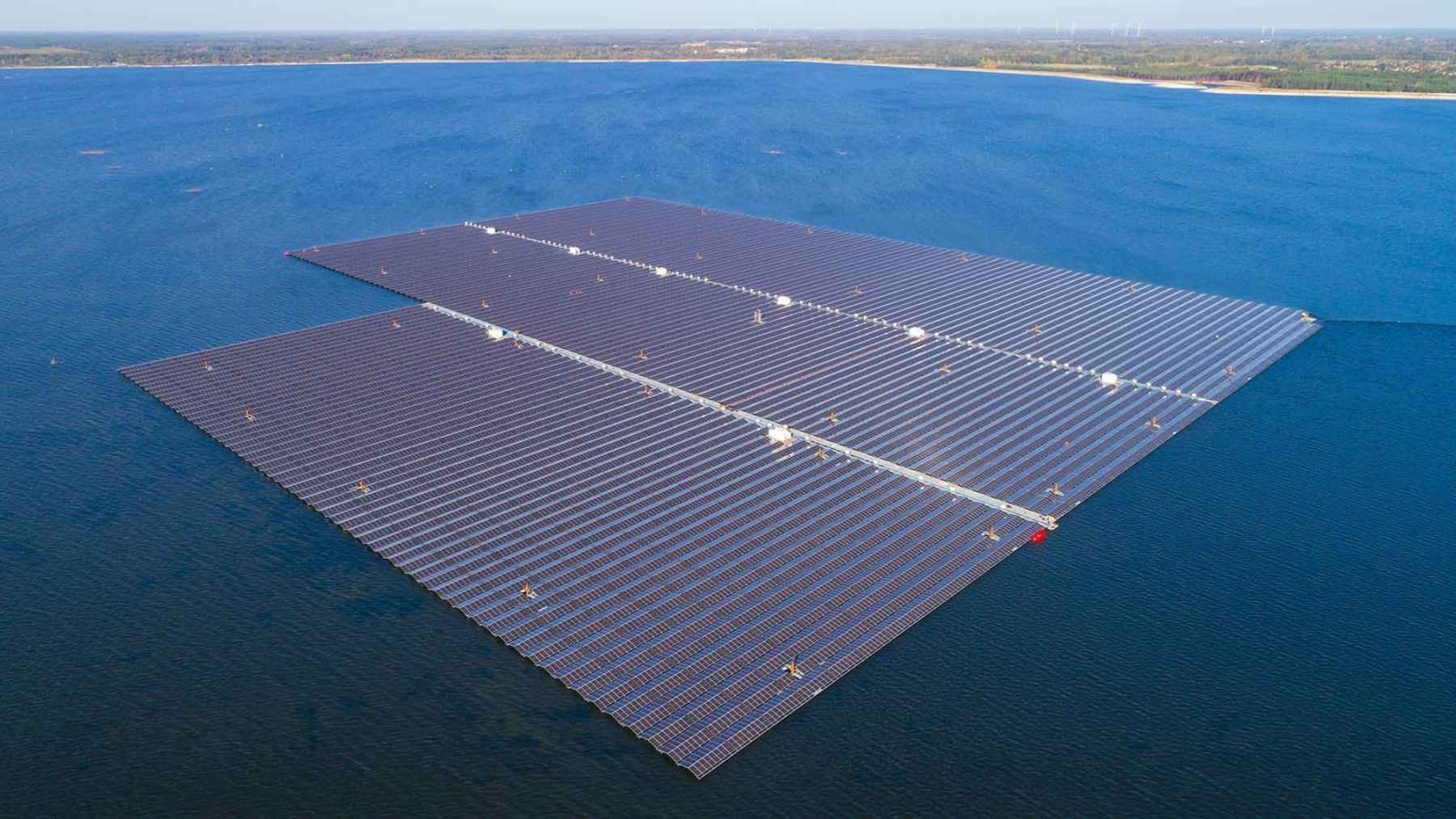
The first tenant on that brand-new water is Germany’s largest floating solar plant: 29 megawatts, more than 51,000 modules, moored to the old mine floor. And here is the part the ribbon-cutting photos skip. The array has been sitting finished since October 2024 without delivering a single kilowatt-hour, because the lake got to it before the grid connection did.
Thirty years of coal, then a faucet
Cottbus-Nord was the smallest of the five open-pit mines Vattenfall once ran in the Lusatia lignite district, holding about 83 million metric tons of recoverable coal. It existed for one purpose: feeding the Jänschwalde power station next door. It did that for more than three decades until digging stopped at the end of 2015, and the recultivation bill passed to LEAG, the company that took over the region’s lignite business.
Instead of backfilling, LEAG flooded it. Spree water ran in through an intake structure across ten separate flooding phases, roughly 170 million cubic meters in total, which is about 45 billion gallons. On December 23, 2024, the lake touched its target level of 62.5 meters above sea level for the first time.
The result measures 8 to 10 feet deep across most of its area and close to 100 feet at the deepest point.
Germans call it the Cottbuser Ostsee. “Ostsee” translates as “eastern lake,” and it also happens to be what Germans call the Baltic Sea, so a city of 95,000 effectively named its flooded coal mine after an ocean.
The plans lean into it: marinas, a ferry line across the water, several beaches. All of that is still on paper, though, and LEAG has been calling the lake a landscape construction site for years while crews stabilize banks that slumped during flooding.
You can’t throw an anchor into a filled-in mine
Floating solar usually moors the boring way, with anchor chains or deadweights on the bottom. Neither works well here. The “seabed” is compacted mine spoil rather than natural ground, and the water level was going to climb for years while the pit filled, which means chains would need constant re-tensioning as the surface rose.
So the builders borrowed from harbors instead. The array hangs on 34 dolphins, the steel piles that piers and ferry berths tie up to, each one a 49-foot (15-meter) tube rammed into pit floor that had been compacted back in the winter of 2021/22. A structure moored to dolphins slides up and down with the water level the way a jetty rides the tide.
According to LEAG, nobody had anchored a floating solar plant this way before. The last of the 34 went into the ground in May 2023, while the site was still mostly dry.
The original construction plan was stranger still. The idea was to assemble the entire array on the dry pit floor and let the rising lake pick it up. Rain and the flooding schedule moved faster than construction, pv magazine reported, so crews switched to pre-assembling sections on shore and floating them out over roughly five feet of water.
The finished plant puts more than 51,000 modules on about 1,800 floats the operator calls solar boats, wired through 88 inverters and eight transformer stations. It covers about 40 acres, roughly 22 soccer fields, and less than one percent of the lake.
Power leaves through cables pulled inside two pipes drilled about 1,400 feet under the lakebed to shore, then runs another 1.2 miles along the bank to a 110-kV substation. Assembly of the modules wrapped in October 2024, per project developer EP New Energies and LEAG’s own updates, with grid connection penciled in for the winter.
Then the lake threw its first winter at it
In mid-December 2024, a run of strong wind worked the array over. Modules tore loose along the edges, some slid off their mounts and sank into the murky water, and floats washed up on the shore. A privately shot drone video made the rounds on social media, showing greenish lake where panels were supposed to be.
LEAG put the damage at no more than six percent of the plant’s surface, and said the dolphins and transformer stations came through untouched.
The number that stings is the weather itself. German Weather Service readings in Cottbus for December 15 to 17 peaked at around 14 meters per second, about 31 mph, and the company told pv magazine that whether wind like that explains the damage was something experts still had to evaluate. For reference, 31 mph is the kind of day that flips your patio umbrella, not the kind that gets a name. The builder also acknowledged the exposed west side had picked up smaller weather damage in the second half of 2024, before the December event.
The politics arrived on schedule. The mayor of neighboring Teichland, Harald Groba, told broadcaster rbb he would welcome seeing the whole thing dismantled. LEAG declined, and LEAG Renewables chief Dominique Guillou framed the mess as the cost of building the country’s biggest solar plant on open water, where careful preparation only takes you so far against forces you cannot fully model.
The rebuild swaps the boats and hides behind a breakwater
Instead of putting the same structure back, LEAG spent 2025 and 2026 redesigning it. The outer rows are being switched from the original double-boat floats to reinforced single boats, a change meant to let the array flex with wind and waves rather than fight them. A large breakwater has gone in as well, and Radio Cottbus reported in late May that it was close to finished.
The revised target is power deliveries from late summer 2026, with no exact grid date named. On the calendar, that window is open right about now, and no switch-on announcement had landed as of this writing. Once the plant is fully on, LEAG expects around 29 gigawatt-hours a year, enough for roughly 8,250 households by the operator’s math.
Germany has been treating odd bodies of water as solar real estate for a while, and the 2,600 panels standing upright on a Bavarian gravel lake got there by way of a shading law rather than a mine. Winter is the recurring villain of the genre, and the cheapest known defense so far involved an aquarium pump bubbling ice away from a Canadian pond array. Cottbus is the expensive end of the same lesson: on 40 acres of open water, the waves get a vote.
The water has its own schedule
The lake is running behind too. After hitting its target level in December 2024, the surface dropped again as water kept seeping into the old mine spoil and evaporating off more than seven square miles of surface, and refilling depends on a Spree that runs thin in dry stretches. By last October, Radio Cottbus reported, about 217 million of a planned 256 million cubic meters had been delivered and the flooding remained paused. Reservoirs, fish ponds and the river itself get served first; the lake takes what’s left.
Big water bodies have carried power infrastructure for decades without ruining the postcard, as Loch Ness proves with two 900-tonne pump turbines that have run for fifty years under one of the most photographed lakes on Earth. Cottbus wants the same trick, with beaches attached.
So the machine and the water are both works in progress. If the array does light up this season, the pit that spent three decades shipping coal to a power station will finally push electricity back the other way, from the middle of a lake named after an ocean. Not a bad second act for a hole in the ground.
Image credit: Andreas Franke