
Solar projects get announced, photographed from a drone, and then everybody moves on. Nobody circles back in year nine to ask whether the panels are still doing what the press release said they would.
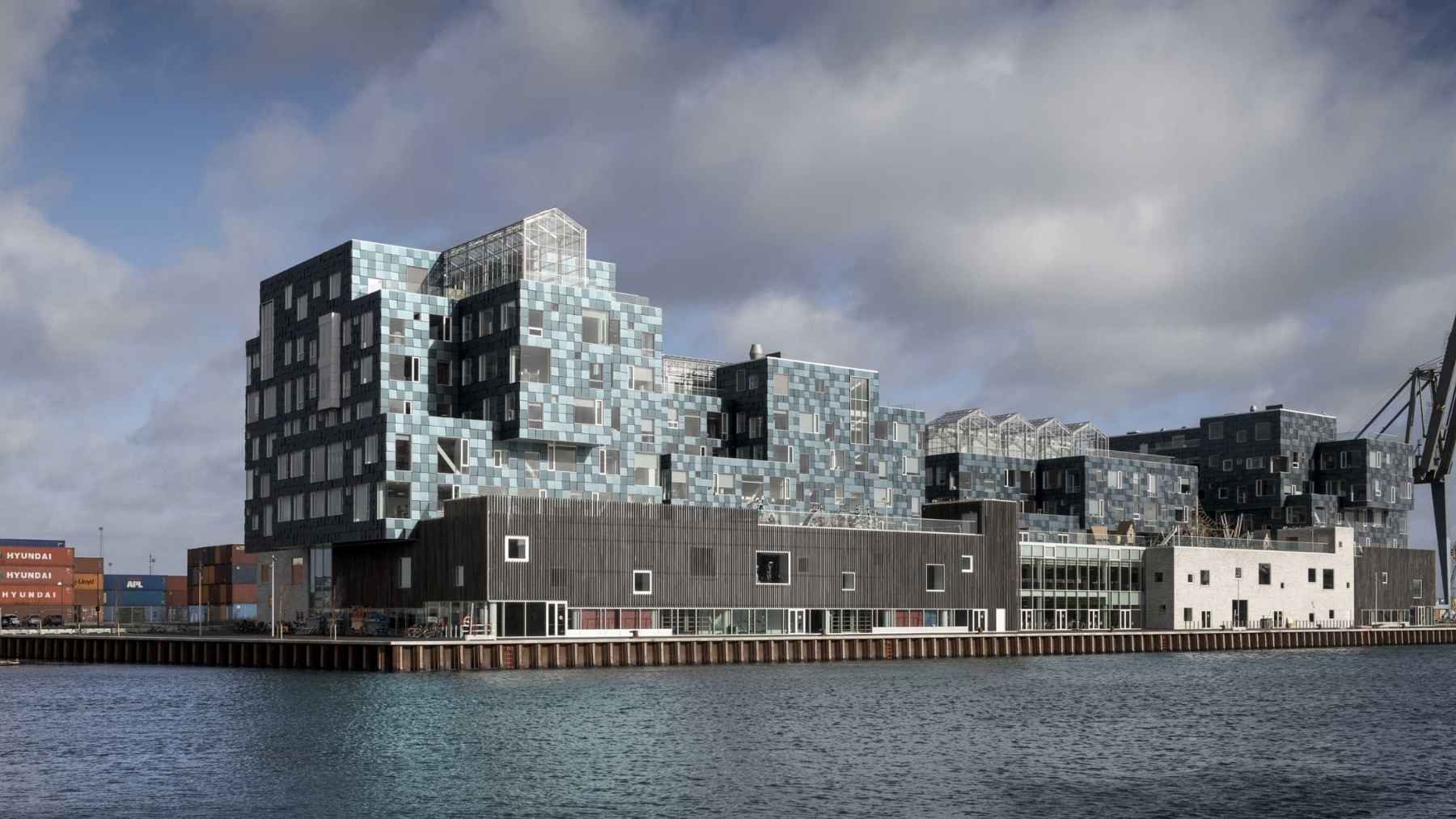
There is one in Copenhagen worth circling back to, because the panels are not on the roof. They are the walls. All 12,000 of them, wrapped around a building full of children, and they have been on the job since 2017.
The Copenhagen International School’s Nordhavn campus is skinned from the first floor up in sea-green photovoltaic tiles, each one 70 centimeters square, each one deliberately crooked.
C.F. Møller Architects, who designed the building, put the active area at 6,048 square meters. That is a little over 65,000 square feet of working facade on a 280,000-square-foot school holding 1,200 students and 280 staff.
And the green is not paint. There is no pigment anywhere on that building.
The color is a physics trick, not a can of paint
Pigment would have killed the whole idea. A colored coating sitting on top of a solar cell absorbs the light the cell needs, so you buy your nice facade by giving up output. The way around that is structural color, where the hue comes from light interference in a stack of ultra-thin layers instead of from a chemical.
If that mechanism sounds familiar, it should. It is the same principle behind the terracotta-colored panels Fraunhofer showed off at Intersolar this summer, and behind the blue on a Morpho butterfly’s wing. Different labs, different decades, same physics.
The Copenhagen version came out of EPFL in Lausanne. Researchers there spent years learning to deposit filters onto glass in nanometer-thick layers, so that one narrow band of light bounces back and everything else passes through to the cells.
The tolerances are unforgiving. Andreas Schüler, who leads the Nanotechnology for Solar Energy Conversion group at EPFL’s Solar Energy and Building Physics Laboratory, has said that a mismatch of five nanometers was enough to throw the color off.
Getting from a lab sample to a building took 12 years. Part of the holdup was industrial rather than scientific: the coating machines have to be at least 100 meters long, and EPFL says European glassmakers passed on the risk. A Dubai factory took it instead, and the glass shipped from there under the Kromatix brand.
Every tile is crooked on purpose
Look at photos of the building and it reads like fish scales, or sequins, depending on who is describing it. That is not a rendering effect. Every panel is tipped four degrees off the wall plane and rotated to face one of four directions.
Four degrees is nothing. It does not meaningfully improve the angle of incidence on a vertical wall at 55 degrees north, and that is not really why it is there.
SolarLab, the Danish company that engineered and built the facade, says the scattered tilt was chosen to make the coating’s iridescence do something with the light. The point was to break up the mass of a very large school so it felt less imposing to small kids.
So the whole surface shifts color as clouds move and as you walk past it. On paper that is an architectural indulgence. In practice it is the reason the building got built at all, because a school board that would never approve 12,000 blue-black rectangles will approve something that looks like the harbor.
What it actually produces, and where the numbers get slippery
Here is where I would push back on most of the coverage this building got in 2017. The figure everybody repeated was 300 megawatt-hours a year, which came from the glass supplier before the thing was switched on. It was a projection, not a meter reading.
C.F. Møller’s own project page is more conservative and has stayed that way for nine years: the facade supplies more than half the school’s annual electricity, off 720 kilowatts of installed capacity. The Active House assessment of the building, which scored it after occupancy, logs facade electricity production at 10.7 kWh per square meter of floor area against a total energy demand of 30.1.
Those are compatible claims, not contradictory ones. They are also a long way from “the school runs on sunlight,” which is roughly what the internet decided the story was.
The building also hit a problem nobody puts in a press release. Eurac Research, the Italian institute that catalogs building-integrated solar projects, documented in its case study that the array ran briefly and then sat switched off for months while the local grid operator worked out how to accept the power.
A 720-kilowatt generator turning up on a distribution network that was not expecting one is a paperwork problem before it is an engineering problem. It is also the single most predictable thing that goes wrong with projects like this.
For scale, Cardiff’s Principality Stadium bolted 3,296 ordinary panels to a roof it already owned and expects payback in two to three years. Nobody is claiming the Copenhagen facade pencils out like that.
The pitch for a solar facade is different. It replaces cladding you were going to buy anyway, so the comparison is against stone or aluminum composite, not against a field of racked modules.
The company that built it now runs an office in Brooklyn
SolarLab is based in Aarhus and has been at this since 2012. In 2024 it borrowed 1.6 million euros from Nefco, the Nordic Green Bank, specifically to pull its lamination line back to Denmark and open a sales office in the United States. That office is now listed at 370 Jay Street in Brooklyn.
Chief executive Anders Smith, an architect by training, has explained the sales logic bluntly: Danes call big ground-mounted arrays “iron fields,” and a facade does not need a field. The company cited American tax conditions as the reason to come over.
Its North American work so far is Canadian. Fanshawe College in London, Ontario opened Innovation Village in January 2024, a 126,828-square-foot, CA$55.9 million building by Diamond Schmitt wrapped on all sides in SolarLab cladding. Red River College Polytechnic in Winnipeg has a SolarLab facade. The University of Toronto Scarborough has a health sciences complex coming this year with integrated PV cladding in three tones.
None of those are in the United States. That is not an accident of timing.
The American window for this narrowed on July 4
The One Big Beautiful Bill Act rewrote the math. Per the Solar Energy Industries Association’s breakdown, the residential 25D credit died on December 31, 2025, and commercial solar under 48E now has a hard fork: begin construction on or before July 4, 2026, or be placed in service by December 31, 2027.
That first date has passed. Any American building that had not started by Independence Day this year is now working to a placed-in-service deadline sixteen months out.
Sixteen months is not a facade schedule. The Copenhagen school was commissioned in 2013 and finished in 2017.
Custom BIPV panels have to be designed around the elevation, sampled, mocked up, wind-tunnel tested, manufactured and then hung. At Copenhagen that meant roughly 70 separate facade sections with protrusions running in every direction. Nobody does that in a year and change.
So the near-term American version of this is likelier to look like the 13,000 panels going onto a JFK terminal roof than like 12,000 tinted tiles going onto a wall. Same rough panel count, entirely different job, and one of them can be procured off a shelf.
Nine years is the part that matters
The reason to write about this building in 2026 rather than 2017 is that the interesting claim was never the color. It was whether a coating measured in nanometers survives a decade of Baltic weather on a wall nobody can easily reach, and whether a facade made of electrical equipment behaves like a facade.
SolarLab’s own description of the project is more honest than the coverage was. It says the installation was the largest of its kind for many years, past tense, and now functions mostly as an industry reference. That is what a technology looks like when it stops being a stunt.
The kids inside get the better end of it anyway. The array feeds the school’s physics and math classes as a live data set.
Which means somewhere in Nordhavn there is a teenager who has spent a semester arguing with a spreadsheet about what the north wall did in February. That is a better education than most buildings hand out, and it came out of a cladding budget the school was going to spend regardless.