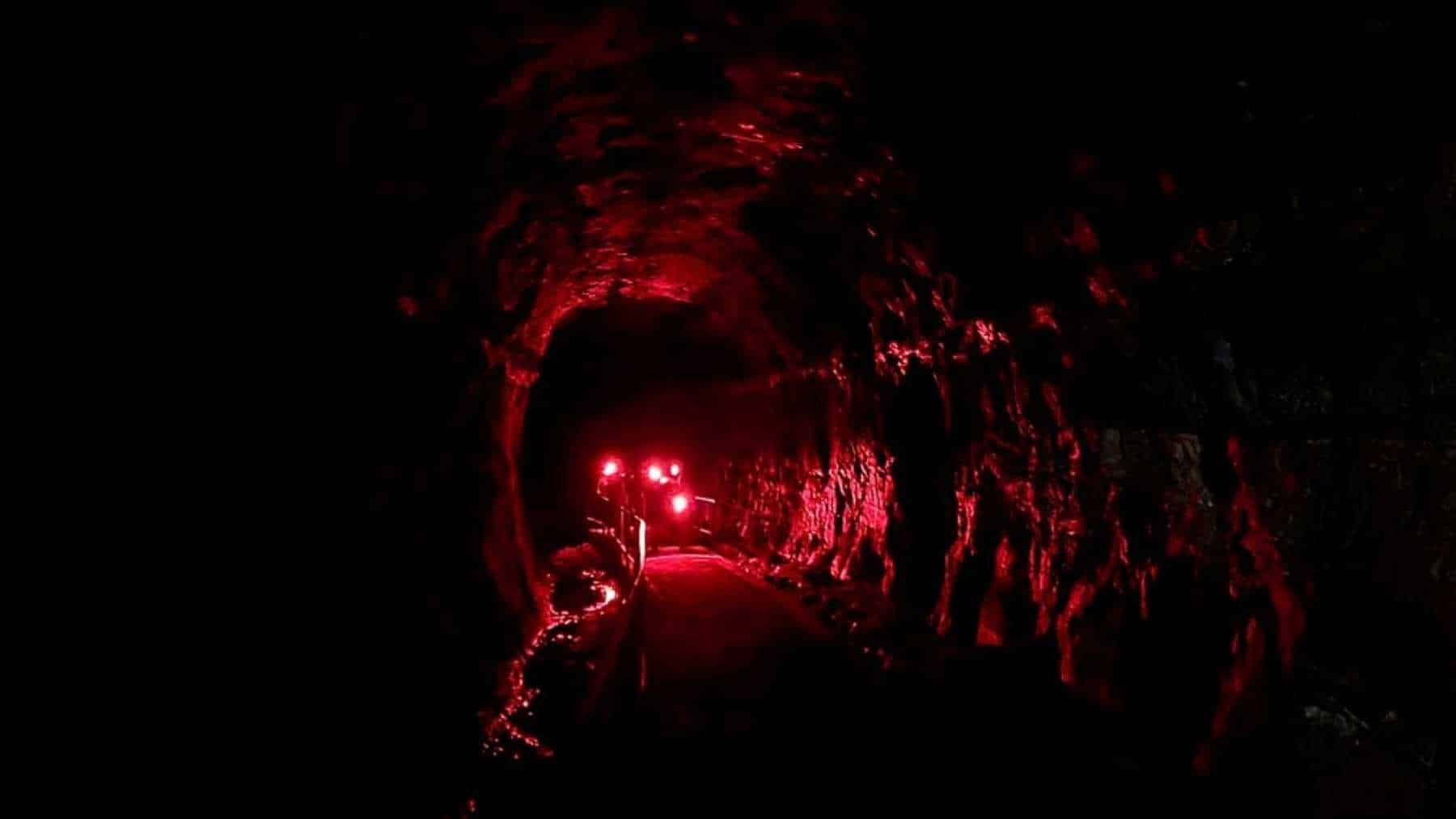

There is a railway tunnel about two hours west of Sydney that has not seen a train since 1932. It runs 1,270 feet through sandstone, it is completely dark in the middle, and there is a creek running along the floor of it.
That combination made it excellent real estate for something. Within a few years of the last train, thousands of glowing fly larvae had moved in and set up on the ceiling.
Which was fine until New South Wales decided the walking surface inside needed rebuilding. Then the state discovered it had a construction site where it could not use a single machine.
No gasoline engines. No power tools. Not even a white work light, because these particular animals react to a white beam by switching themselves off.
So 386 tons of material went in on foot, carried more than half a mile through forest, and about 30,000 bricks arrived one wheelbarrow load at a time, according to the ABC, which got access to the job.
The tenants moved in when the trains stopped
The tunnel is called the Glow Worm Tunnel, and it sits in Wollemi National Park near Lithgow. It was bored in the early 1900s to serve an oil shale mine at Newnes, and the ABC reports the glow worms took over after it closed in 1932.
They are not worms. National Parks lists the species as Arachnocampa richardsae, the larval stage of a fungus gnat.
The larval stage is the long one, six to nine months. After that comes 14 days in a cocoon and roughly three days as an adult fly, which exists purely to mate and lay eggs before dying.
The glow comes out of a transparent section at the back end and works as bait. Sticky silk threads called snares hang down from each nest, and small flying insects that come toward the light get caught in them. The creek matters because it breeds the insects they eat.
Nothing with an engine was allowed through the entrance
Joanne Cox, a senior project officer with the NSW National Parks and Wildlife Service, told the ABC there was no gas and no electricity on site at all, and that the work had to be done manually.
Her reasoning was straightforward. Fuel-burning machinery inside a tunnel puts exhaust and chemicals directly into the space these animals live in. Power tools were out as well, and ABC’s captions from inside confirm none were used.
That left the light problem, which is the one that makes the job genuinely odd. You can work in a dark tunnel with lamps. You cannot work in a dark tunnel with lamps if the thing you are protecting responds to lamps by going dark.
386 tons went in by boot, wheelbarrow and helicopter
Cox told the ABC the closest car park sat 0.87 miles from the work. So anything that could not be walked or wheeled down had to be flown down.
The state’s own project update from the department confirms the helicopter lifts, and shows how seriously they were taken: a whole access road and its car park were closed specifically so the aircraft could work safely overhead.
Beyond the 386 tons and the 30,000 bricks, there were another 331 tons of fill. The department lists the rest of the scope as resurfaced tracks, new drainage, replacement steps, creek crossings and signage.
The centerpiece is a raised, brick-edged walkway running through the tunnel. It exists to keep visitors out of the creek and, more to the point, to keep them from brushing against the snares hanging off the ceiling, which is where these animals catch everything they eat.
None of this was a vanity project. The funding came from the state’s Bushfire Local Economic Recovery Fund, and the damage being repaired came from the 2019 bushfires and the floods that followed them.
Red light works because the larvae cannot see it
The workaround came from David Merritt, an honorary associate professor at the University of Queensland who has spent decades studying these insects. He advised the crew, and his answer was to run the entire job under red lamps.
“Glow-worms don’t see red lights,” Merritt told the ABC.
He also flagged the cost of that, which is that human eyesight in red light is noticeably worse than in white. The crew laid 30,000 bricks anyway.
A glow worm is not like a firefly. It can dial its own output up and down, and it will shut off when something disturbs it, which is exactly the behavior that made white work lights impossible.
A 2025 paper in Arthropod Structure & Development co-authored by Merritt used micro-CT scanning to reconstruct the light organ of a related Australian species in 3D, mapping how it sits against the animal’s Malpighian tubules and its breathing tubes. The authors write that the control is likely neural, acting either on the light-producing cells directly or on how much oxygen reaches them.
A time-lapse camera checked whether it actually worked
The crew did not simply declare the colony unharmed at the end. They installed a time-lapse camera in the tunnel and let it run for the duration.
Glow worms brighten and dim on a 24-hour rhythm. If the construction were stressing them, that rhythm is the first thing that would fall apart.
Merritt told the ABC the footage showed the pattern holding all the way through. A camera on a tripod is a cheap instrument, and it did a job that much larger projects skip entirely.
Animals write the site rules more often than you would think
Oregon holds every truck at an entire renewable plant to 20 mph because of a half-pound ground squirrel. On a 7,100-acre solar farm in the Mojave, the most consequential piece of design turned out to be an eight-inch gap under a fence that threatened tortoises walked straight through.
In New Mexico, GPS collars now show pronghorn using the aisles of a 200-megawatt array. Most of those cases end with a buffer zone, a speed limit or a hole in a fence.
The Glow Worm Tunnel is the one where the animal did not get a concession. It got the entire construction method.
What you get for 386 tons
The walk is 3.7 miles round trip from the Glow Worm Tunnel car park, rated Grade 3, two to three hours. National Parks counts more than 80 steps on it, including about 30 stone ones with no handrail dropping to a bridge and another 30 narrow timber ones going back up.
Bring a flashlight, ideally one with a red mode. The tunnel is pitch black, the ground is wet and uneven, and there is no cell service anywhere near it.
The walk itself is open. Everything around it currently is not, because the surrounding reserve is in the middle of a large state build-out of roads, lookouts and campgrounds, and the National Parks alerts page is worth checking before you drive out.
Which is the part worth sitting on for a second. There is heavy machinery working within a few miles of that entrance right now, cutting road and hauling timber, and none of it is allowed to cross the threshold.
Inside, it is still 30,000 bricks that somebody pushed there in a wheelbarrow. Turn your light off in the middle and give your eyes a minute. The ceiling takes a while to show up.