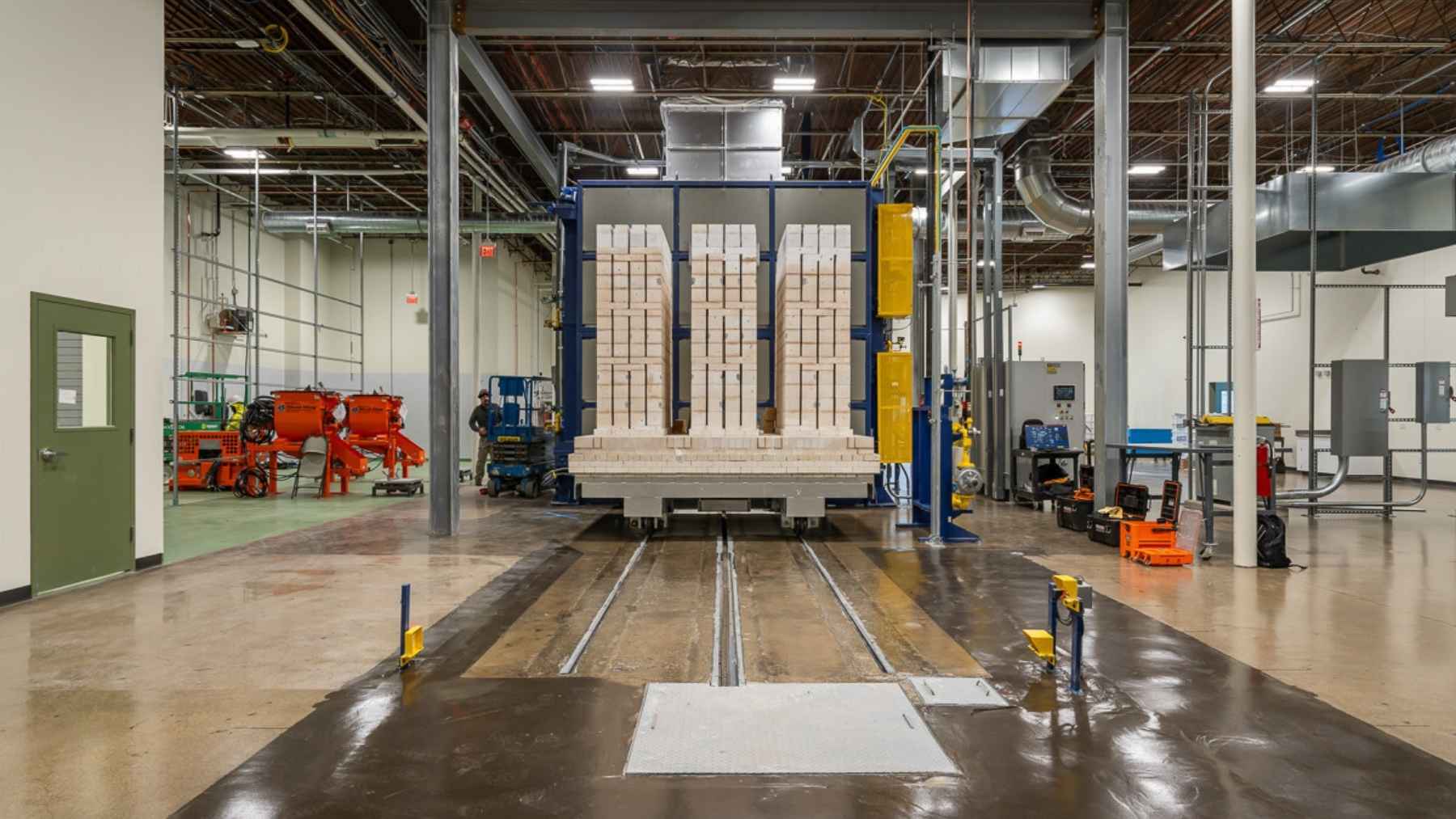

Putting solar cells on a car roof is one of those ideas that keeps almost arriving, and this week it got a little closer. Fuyao Group, the largest automotive glass manufacturer on the planet, confirmed it has solar sunroof glass with the cells laminated inside and the capacity to build it at scale. The trade-off is the one you would expect. Cells go in, light stops coming out the other side, and your sunroof stops being a window in any useful sense.
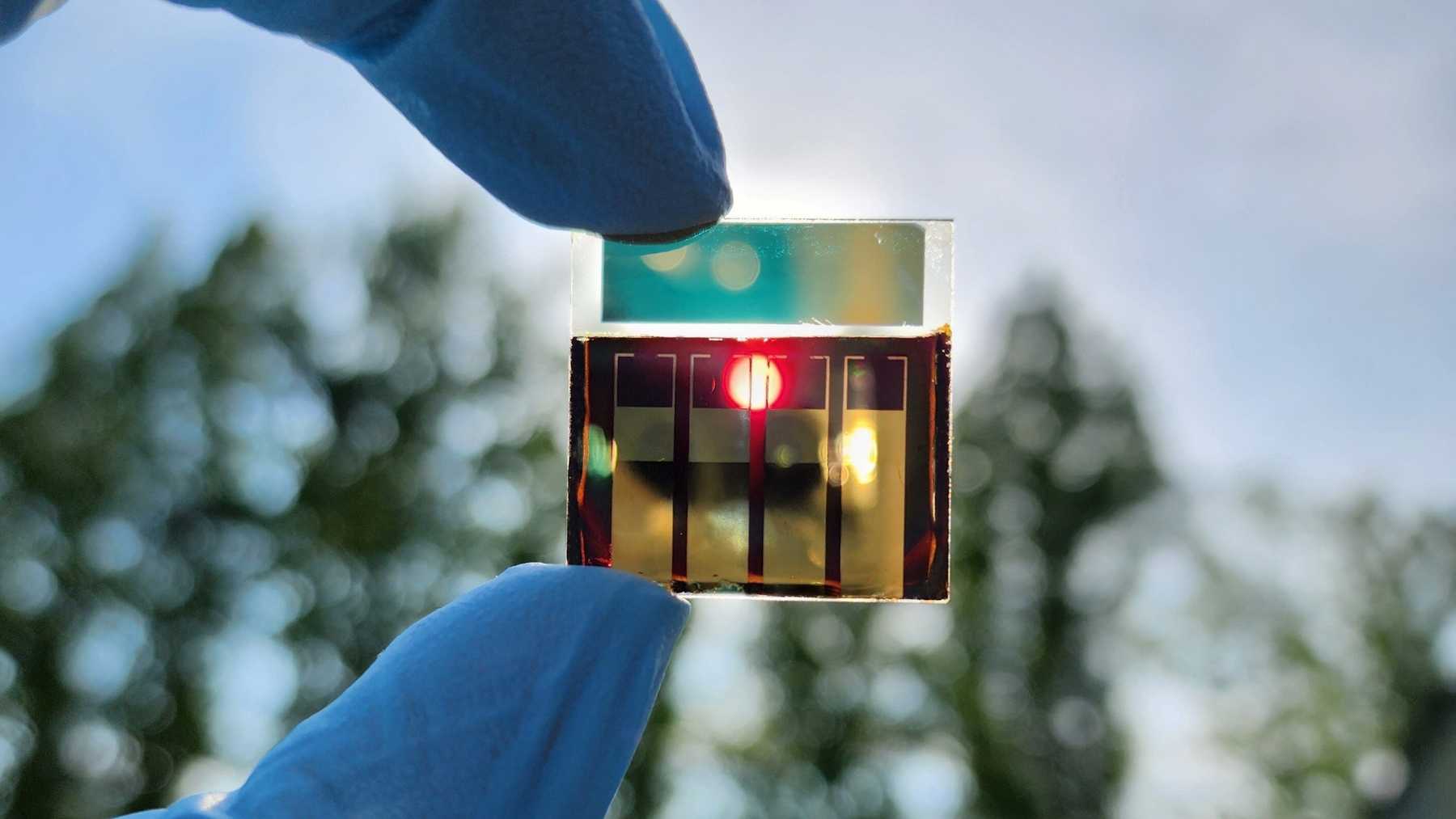
A team led by University College London has been working the opposite version of that problem, and published it a few weeks earlier. Their solar cells let 31.1% of visible light through, which is dim but genuinely see-through, and they still generate power.
The number that got the writeups when UCL announced the work on July 17 was the indoor one. Under a 1,000-lux LED, roughly the lighting in a decently lit office, the cell converted 22.41% of what hit it into electricity.
There is a Chinese electric-vehicle research center sitting in the author list. And the senior author’s stated next step is glass on cars.
Every transparent solar cell pays the same tax
The problem with making a solar cell you can see through is that the light you let through is light you did not convert. Those two numbers fight each other, so the field grades itself on a combined figure called light utilization efficiency, which is just transparency multiplied by efficiency.
There are ways to dodge that fight. A Swiss greenhouse hung modules over its tomato rows that take only the infrared the plants never use, which works when your customer is a plant. A human looking out of a window wants the whole visible spectrum, so UCL had to pay the tax and then argue about the rate.
The UCL champion device hits 13.78% conversion efficiency under standard full sunlight at 31.1% average visible transmittance. Multiply those and you get 4.29%, which the paper in Advanced Energy Materials describes as among the best reported to date. Window-integrated solar generally needs at least 25% transmittance to be worth calling a window at all.
They got there by attacking three things at once. The light-absorbing perovskite layer is about 185 nanometers thick, which UCL puts at roughly 500 times thinner than a human hair and three to four times thinner than the layer in a normal perovskite cell. Thin layer, more light through, less absorbed.
Then there is the electrode, which in most perovskite cells is a slab of gold that blocks everything. This one is 8 nanometers of gold sandwiched between 4 and 6 nanometers of molybdenum oxide, an arrangement that cuts reflection and gets the stack to 59.9% transmittance instead of zero.
The third piece is a molecule with a name nobody is going to enjoy reading: 3-trifluoromethyl-1H-1,2,4-triazole. Ultra-thin perovskite films are full of defects where electrons get stuck, and this thing plugs them. Carrier lifetime went from 208.7 to 383.1 nanoseconds, the fill factor climbed from 72.88% to 77.97%, and the hysteresis index dropped from 9.3% to 3.0%.
The office-light number is smaller than it sounds
Here is the thing about indoor light that headlines tend to skip. The test used a 2943 K LED at 1,000 lux, which the paper measures at 291.8 microwatts per square centimeter. Full sunlight at standard test conditions is 100 milliwatts per square centimeter.
Office lighting is therefore about 1/343 the power of sunshine. Converting 22.41% of it is a real engineering result and also a very small amount of electricity.
Run the paper’s own indoor numbers and the cell produces roughly 65 microwatts per square centimeter. That is the right order of magnitude for what the authors say it is for: sensors, Internet of Things hardware, the small always-on electronics in a smart building. It is not the right order of magnitude for charging anything you own.
The scope of the record matters too. The claim is the first efficient indoor operation of a semi-transparent perovskite cell, not the best indoor cell full stop. The paper’s own reference list includes opaque indoor perovskites at 44.72%, and the same UCL group published a 37.6% indoor device last year. Making the cell see-through costs you roughly half your indoor performance, and 22.41% is what is left.
The 30-centimeter panel does not do 22 percent
This is the part worth getting right, because it is the easiest thing in the paper to misread. The 22.41% indoor figure and the 13.78% sunlight figure both belong to a small champion cell in a lab. They are not the panel.
The panel is a 30 by 30 centimeter module, and it does 8.2% in full sun and 7.4% under dim light at a fifth of full sun. Those are different, much lower numbers, and they are the ones that describe the only large thing the team actually built.
Work it out and 8.2% across 900 square centimeters of noon sunshine is a little over 7 watts, assuming the whole pane is active area. At the dim-light setting it is about 1.3 watts. The module was never tested at 1,000 lux at all.
The dim-light figure is the more interesting half. Holding 7.4% at a fifth of full sun means it does not fall over when the sky greys out. Norway attacked the same problem from the other end by standing 6,400 panels dead upright on an Arctic roof.
Durability is the other honest caveat. Unencapsulated cells held 79.6% of their starting efficiency after 268 hours of continuous light soaking at 65°C, against a control that fell to 36.4% inside 200 hours. UCL’s own summary rounds that up to 80% over 300 hours. Either way, 268 hours is 11 days, and nobody buys a car window that needs replacing in 11 days.
The researchers brought up cars, not us
Automotive glass is not a stretch applied to this paper from outside. It is in the announcement, from the senior author.
Dr Mojtaba Abdi-Jalebi of the UCL Institute for Materials Discovery said the longer-term aim is flexible films applied “directly on to vehicle glass, sunroofs, and other transparent surfaces,” and named car windows alongside the curved glass on London’s Shard as the shapes the team wants to reach next. Lead author Siming Huang made the related point that a cell letting through 31% of the light behaves like a tint, which cuts the cooling load underneath it.
Anyone who has come back to a car parked in July already understands that argument better than a building manager does.
The author list backs it up. Affiliation six on the paper is the Sichuan New Energy Vehicle Innovation Center, a Chinese EV research outfit, and its contributor Kai Qiu is credited with part of the computational modeling. A commercial solar company in Zhejiang built the large module. This is a building-integrated photovoltaics paper with automotive fingerprints already on it.
Scale it to a car and the arithmetic stays modest. A big panoramic glass roof is on the order of a square meter, and a square meter of that module at 8.2% comes out around 82 watts at noon. Before you subtract for curvature, dirt, shade, a roof angled away from the sun, and the fact that this glass is see-through, which is the entire point.
Fuyao is not waiting for the lab
While the London work sits at 900 square centimeters, the commercial version of the idea is already being built the boring way. pv magazine reported on August 19 that Fuyao has confirmed solar sunroof glass with cells laminated into the panel and the ability to make it at volume. Fuyao described it as a solar sunroof rather than a roof-wide array, and told investors back in May 2024 that it already had mass-production capability.
Chinese automotive outlets have been reporting since February that the system was developed with BYD for the Han and Tang, as a CNY 8,000 option, roughly $1,190, with a 720-watt peak and 23.18% efficiency from heterojunction cells. Neither company has published specifications or a joint announcement confirming any of that, and Fuyao declined to name customers or pricing at a March investor briefing, calling both commercially confidential. Treat those figures as claims, not specs.
What is not in doubt is who Fuyao sells to. Carscoops notes its customer list runs through Ford, General Motors, Subaru, Tesla and the VW Group, and its plants at Fuqing Yangxia and Hefei each hit three million sets of automotive glass a year by the end of 2025. When a supplier that size says a thing is production-ready, the question stops being whether it works and becomes whether anyone orders it.
pv magazine’s own read is worth repeating, because it is the least exciting and most accurate thing anyone has said about vehicle solar: there is not enough surface area on a car for this to replace plugging in. The realistic job is auxiliary loads while parked, ventilation, and stopping the 12-volt system from bleeding out in a long-stay lot.
A panel does not have to make electricity to earn its spot, either. Target has more than 600 roof panels that look like solar and generate exactly zero watts, because dumping heat off the building was worth more than the power. Huang’s tinting argument is that same trade in miniature.
Two roads to the same modest destination
Solar glass on cars keeps getting sold as a range story and keeps arriving as a parasitic-drain story. Both versions in front of us do the same small job. One does it with opaque cells where your sunroof used to be, and it exists. The other does it with glass you can still see out of, and it is a paper with a 900-square-centimeter panel attached.
What makes the UCL result worth filing away is not the 22% figure, which describes a lab cell under a lamp. It is that a see-through cell did anything useful under indoor light at all, and a car cabin spends most of its life as indoor light. If that ever gets cheap, durable and curved, the interesting surface on a car stops being the roof and starts being all the other glass.
None of which helps the version you can order today, which is still an opaque panel bolted where the view used to be.
 simonrockman DRIVER1 month ago