
Solar efficiency records have gotten routine. Every few months a lab somewhere adds a few tenths of a percent, a press release goes out, and nothing on anyone’s roof changes. China’s LONGi renewed the tradition on July 14 with a 35.5% perovskite-silicon tandem cell, a genuine world record, independently certified in Europe.
Then, two days later, Qcells announced something with no record attached at all. No new decimal. Just paperwork: a certification from TÜV Rheinland, the German testing body headquartered in Cologne, confirming that its perovskite-silicon tandem cells and modules meet the same IEC and UL reliability and safety standards that ordinary silicon panels have to pass before anyone will finance a field full of them.
Qcells says nobody else in the world holds that certification for tandem technology. And that quiet stack of documents answers the one question perovskite has been dodging since researchers first got excited about it back in 2009: fine, it’s efficient, but does it survive?
The efficiency was never the problem
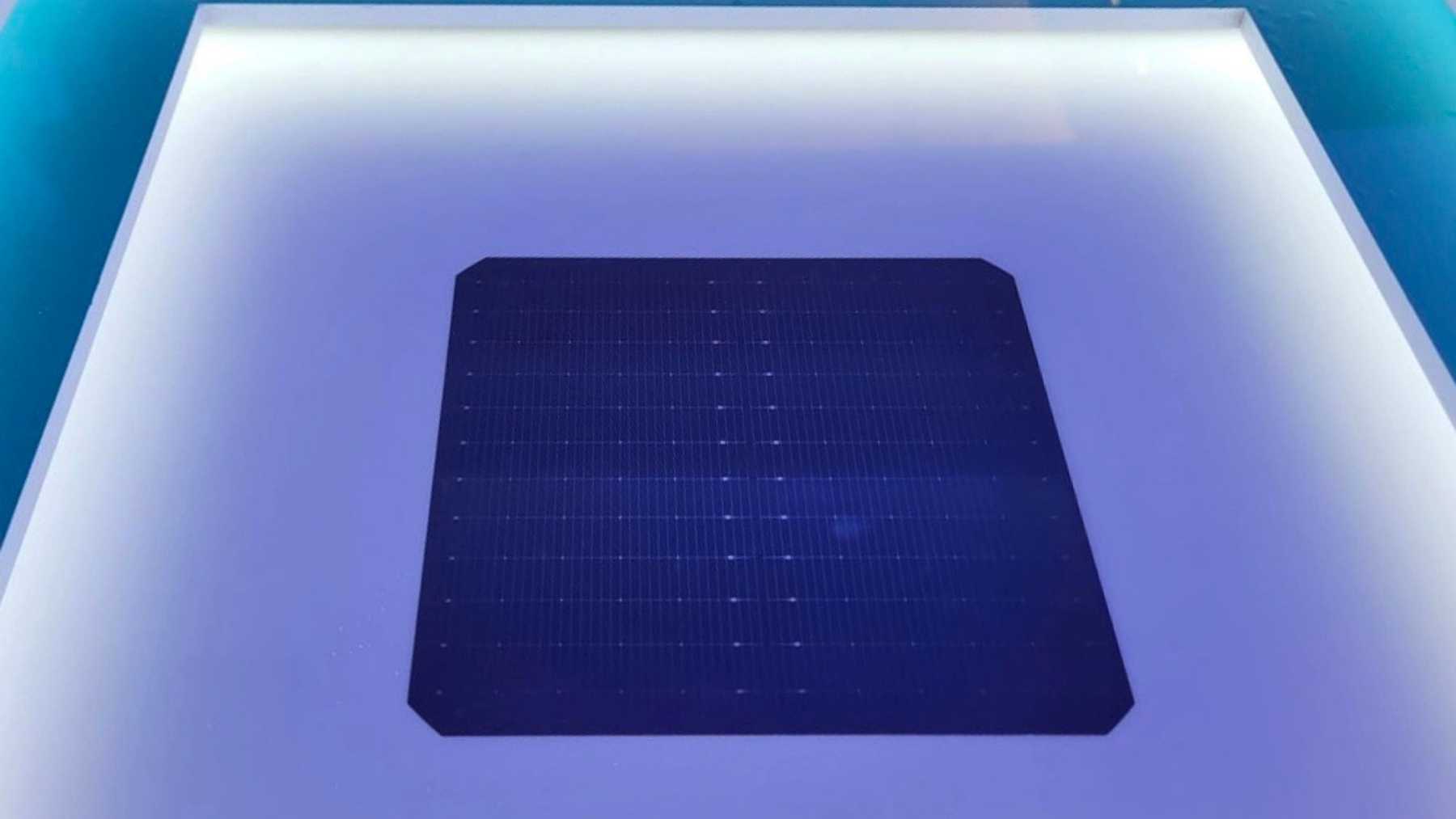
A tandem cell is exactly what it sounds like. You print a thin perovskite layer on top of a standard silicon cell, the perovskite grabs the high-energy end of sunlight, and the silicon underneath catches the lower-energy light that passes through.
Two layers, one cell, more electricity per square foot. LONGi’s release pegs the theoretical ceiling for the stacked design at 43 percent, against roughly 33.7 percent for a single junction. So the physics case has been closed for years.
The problem is that perovskite crystals are famously fragile. Heat, moisture and UV light break them down, which is why the technology built a reputation for dazzling in the lab and fading outdoors. A panel is supposed to sit on a roof for 25 years. A material that degrades in months is not a product, it’s a demo.
Banks know this, which is why the industry runs on a standard called IEC 61215, plus its American counterpart UL 61215. Pass, and your panel is considered reliable enough to finance. Fail, or never take the exam, and you can post all the efficiency records you want, because nobody with a checkbook is watching.
The test schedule reads like a grudge
So here is what the Qcells hardware went through, per the company and the pv magazine report on the certification. Thermal cycling: 200 round trips between minus 40 and 185 degrees Fahrenheit. Minus 40, if you’ve ever wondered, is the one temperature where Fahrenheit and Celsius finally agree on something.
Damp heat: 1,000 straight hours, about 42 days, at 185 degrees and 85 percent humidity. Humidity-freeze: 10 cycles that soak the module in hot, wet air and then freeze it, so any water that snuck inside expands into ice where it can do real damage. Plus UV preconditioning at 15 kilowatt-hours per square meter to bake the materials that sunlight likes to eat first.
Panels degrade a little under all this. The standard allows it. What it does not allow is power loss beyond a set threshold, and measuring power on a two-layer cell is its own headache, so the results also had to comply with IEC TS 60904-1-1, the measurement rulebook written specifically for multi-junction modules.
The certification covers four standards in total: IEC 61215-2:2021 and UL 61215-2:2021 for reliability, plus IEC 61730-2:2023 and UL 61730-2:2022 for safety. The certified cells and modules came off the company’s tandem pilot line in Bitterfeld-Wolfen, Germany, built on full-area M10 wafers, using processes Qcells says are feasible for mass production.
“We are getting closer to bringing a product to market,” said Fabian Fertig, Head of Tandem R&D for Qcells Germany, in the announcement. Which is careful language, and appropriately so. Certification is not a product launch. But it’s the document a product launch requires.
China is winning a different race
None of this takes anything away from LONGi. Its 35.5% result is real, certified by the European Solar Test Installation, part of the European Commission’s Joint Research Centre in Italy, and it caps a genuinely relentless run: 33.9% in late 2023, 34.6% in 2024, 34.85% in April 2025, and now this.
But the record cell is a laboratory device, and LONGi didn’t disclose its active area. More telling: as of June, the company said it had no active mass-production plan for tandem cells, with work still needed on large-area coating, manufacturing yield, encapsulation, long-term stability and cost.
Qcells took the opposite road. Its own record, set in December 2024 and verified by the CalLab at Fraunhofer ISE, is a comparatively modest 28.6%. The difference is that it was measured across a full M10 wafer of 330.56 square centimeters, a shade over seven inches on a side, cut from a standard industrial silicon wafer that slots straight into a normal module.
Britain’s Oxford PV deserves its footnote here too: it shipped the first commercial tandem panels back in 2024 from its own German line. So Qcells isn’t the first to sell a tandem panel. It says it’s the first to hold the double IEC and UL certification, and that distinction matters, because records tell you what the technology can touch on its best day, while certification tells you what it should still be doing in year 20.
Georgia is already building the boring version
Here’s where this stops being a European lab story for American readers. Qcells is the largest silicon-based solar manufacturer in the United States, and on June 9 it started making solar cells at its Cartersville, Georgia factory, the first plant in the country to take a panel from raw ingot to finished module under one roof.
At full speed, expected by the end of the third quarter, Cartersville will turn out 3.3 gigawatts each of ingots, wafers and cells, plus 3.5 gigawatts of modules a year. Add the Dalton plant 30 miles up the road and Qcells’ Georgia operations will build 47,000 panels a day, 8.6 gigawatts of annual module capacity, which the company says is roughly the power for 1.3 million American homes, with about 3,800 direct jobs across two counties.
To be precise about what’s what: everything coming out of Georgia today is conventional silicon. The certified tandem hardware exists on a pilot line in Germany, and Qcells has not announced where, or when, tandem modules would be mass-produced. Anyone telling you tandem panels are rolling out of Cartersville is ahead of the facts.
Still, the pieces are now sitting on the same table for one company: a certified next-generation cell in Germany, and the biggest American solar factory ever built running in Georgia. That combination is rare, and everybody in the industry can do the same math.
Solar hardware surviving abuse is becoming its own genre, whether that’s American solar farms tilting their panels to dodge four-inch hail or Australia’s printed solar film getting tested in orbit. And every panel that goes up eventually comes down, which is why Georgia also hosts the plant that strips old panels back into silver, copper and glass. The industry is quietly building the whole life cycle, cradle to grave, and now the paperwork in the middle.
What the certification does not settle: the price per watt, the yield when a pilot line becomes a real one, and whether decades in an actual field match six weeks in a chamber. The panel that survived all of this still has no price tag and no order form. But for the first time, a perovskite panel holds the document that gets solar projects financed. In this business, that piece of paper moves more hardware than any world record ever has.