
The math behind modern air defense has turned into a running joke in defense circles, and it’s the kind of joke that ends with somebody’s budget on fire. You launch an interceptor that costs as much as a suburban house to swat down a drone that costs about as much as a used pickup, you win the engagement, and you quietly lose the war on a spreadsheet. The U.S. Army has been buying Patriot PAC-3 interceptors at somewhere between $3 million and $4 million a shot, and according to Breaking Defense, those same interceptors have reportedly been used to knock down Iranian-made Shahed drones that run about $4,000 apiece. Do that enough times and the drone wins, even when it loses.
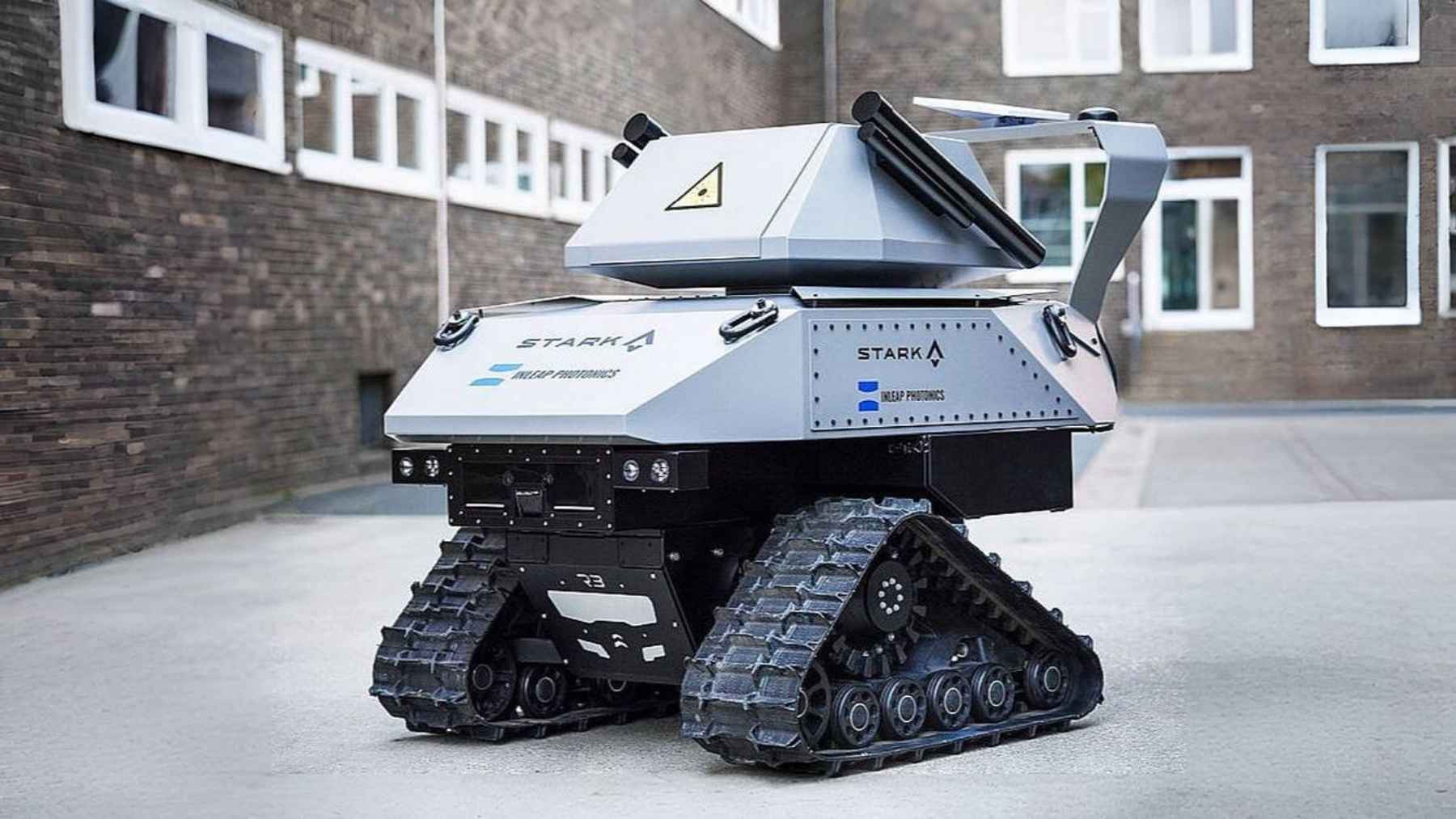
A small German company called INLEAP Photonics just rolled out its answer to that spreadsheet, and there’s no interceptor anywhere in it. The pitch is a laser effector bolted to an autonomous ground robot, aimed at the cheap-drone problem from the one direction that doesn’t involve a magazine you can empty: light. It burns the drone instead of intercepting it, the company says it does the job in under a second, and the only thing it runs out of is electricity.
A Laser Effector, an Austrian Robot, and Somebody Else’s Software
The system showed up for the first time on May 12, 2026, at a technology demonstration the Bundeswehr Innovation Centre hosted at Erding Air Base, as part of a capability assessment for the kind of small and tactical drones NATO files under UAS Class I and II. It’s a three-company build. INLEAP Photonics, a Hanover outfit that spun out of the Laser Zentrum Hannover, supplies the laser effector. A company called Hentschel System supplies the robot it rides on. And STARK, a German defense-software firm, supplies the counter-drone software that decides what to shoot and when.
The robot is the part with the better backstory. Hentschel’s finished vehicle is called the Ziesel, and underneath it is the ROVO3, a heavy-duty electric tracked platform built by Hawe Mattro in Schwaz, in the Austrian Tyrol. As Militär Aktuell lays out, the ROVO3 hauls up to 300 kilograms (about 660 pounds) and, usefully for something carrying a laser, can feed power to whatever it’s carrying. Mattro builds the bare electric platform with swappable batteries; Hentschel adds the autonomy kit, the cameras and the lidar that let it drive itself or take orders remotely. So the headline “German laser” is sitting on an Austrian chassis, which is the kind of detail that disappears the moment a system gets nicknamed a Terminator.
INLEAP’s own claim is narrower and more honest than the nickname: this is the first time it has put its laser effector on a ground robot at all. The company describes the result as “deploying our laser effector on an unmanned ground platform for the first time.” The demonstration pulled in some serious brass, including Lieutenant General Christian Freuding, the Inspector of the German Army, and Rear Admiral Christian Bock, who runs the Bundeswehr’s drone innovation center and hosted the event.
Why a Beam of Light Beats a $4 Million Missile on the Spreadsheet
The appeal of a laser in this fight isn’t that it’s exotic. It’s that it changes the per-shot arithmetic from “millions” to “the cost of running a generator.” A missile is a single-use object you have to buy, store, transport and replace. A beam is just energy, so the magazine never empties as long as the batteries hold and the optics stay cool. That’s the whole reason militaries keep circling back to directed energy despite decades of false starts.
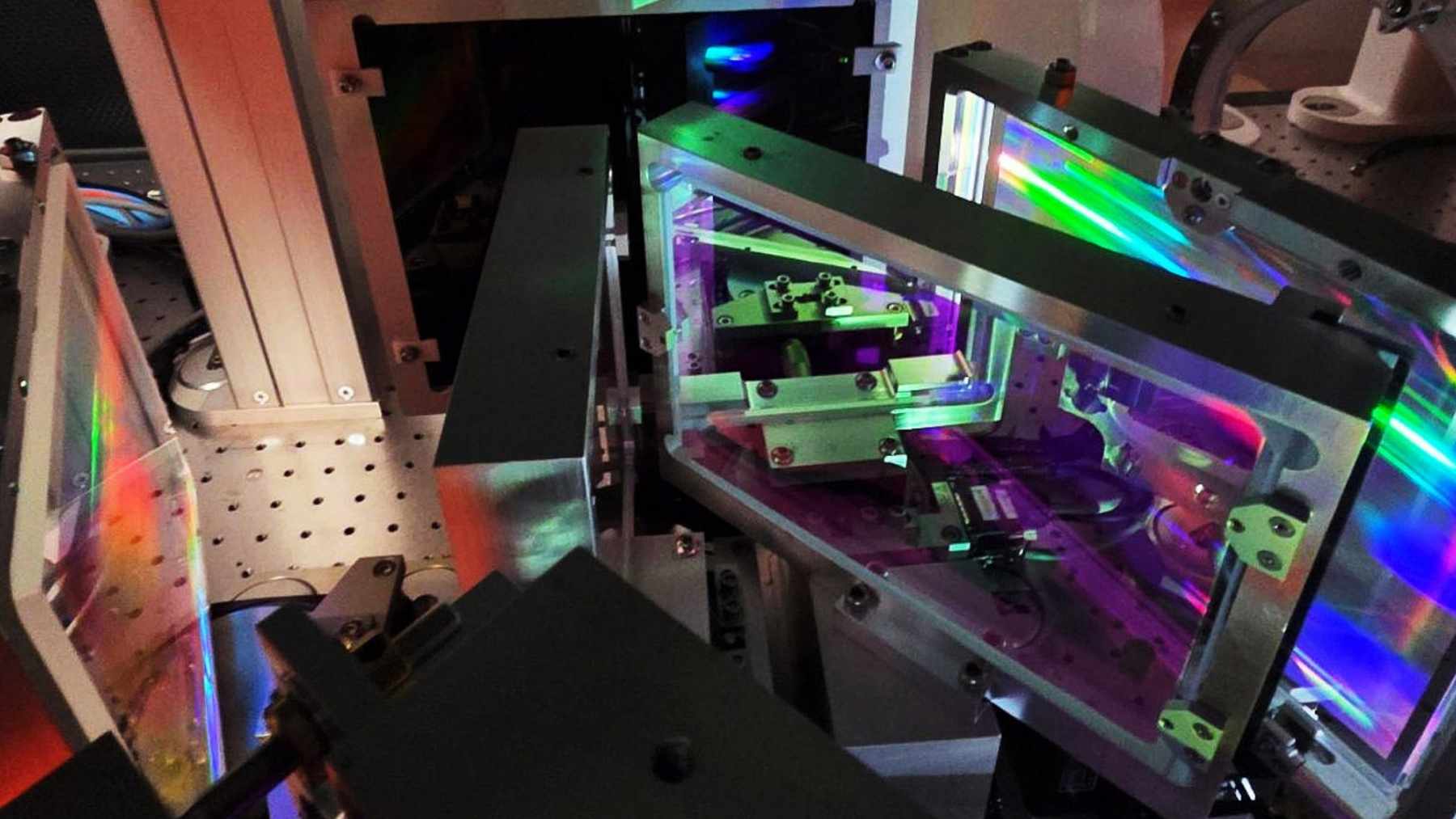
INLEAP’s particular trick is speed of aim. Its FASTLIGHT technology, originally built to steer industrial lasers for jobs like 3D printing and battery-cell production, claims to point the beam up to 2,500 times faster than conventional systems. Instead of slowly drilling a hole through a drone, the idea is to park a precisely controlled spot of light on a small structural or control component and break it. Because the beam is steered electronically rather than slewed around on a heavy gimbal, it can in principle jump between targets fast, which is the part that matters against a swarm rather than a single quadcopter. The company also says the system is eye-safe for people standing nearby and leaves no debris field of spent interceptors behind, which is the sort of thing that matters when you’re defending something in a city instead of a desert.
As for range, the figure making the rounds is 3,000 meters, roughly 1.9 miles. That number comes from the company’s own declaration as reported by the Ukrainian defense outlet Militarnyi, not from an independent test, so treat it as a manufacturer claim rather than a measured result. Same goes for the under-a-second engagement time. Impressive if it holds up in the field. The field is usually where these things get humbler.
The Same Robot Family Just Fired 17 Missiles in Five Days
If the laser Ziesel looks like a science project, the platform underneath it has been busy proving otherwise. In mid-May, Diehl Defence, this time with Israel’s Rafael and the EuroSpike consortium, ran a live-fire campaign that put a Spike LR anti-tank missile on its own armed version of the Ziesel and fired it for real. Over five days the robot launched 17 guided missiles, and Diehl says it was the first time anyone has fired a modern guided missile from an unmanned ground vehicle. The point of that exercise wasn’t the missile, which is a known quantity. It was proving the little electric robot could absorb the recoil and structural punishment of repeated launches without shaking itself apart.
It helps to keep the two configurations straight, since the same name covers both. The Spike test used Diehl’s armed Ziesel with Diehl’s PLATON autonomy kit. The laser version is Hentschel’s Ziesel with INLEAP’s effector and STARK’s software. Different integrators, same Austrian-built bones. What the two demonstrations share is the underlying bet: that a cheap, quiet, autonomous tracked platform is a useful thing to hang an effector on, whether that effector throws a missile or a beam of light.
The US Is Solving the Same Problem With More Drones, Not Lasers
This is where it gets interesting for an American reader, because the Pentagon is staring at the identical spreadsheet and reaching for a different tool. The U.S. answer to cheap drones has mostly been more cheap drones. In May, the Pentagon handed Perennial Autonomy an indefinite-delivery contract with a $500 million ceiling for small interceptor drones, which Defense Daily counted as the largest counter-drone award the department has issued. On the offensive side, the military has been buying the $35,000 LUCAS one-way attack drone and wiring it up with autonomy software, the bet being that you flip the economics by making the other side spend the expensive interceptors.
The U.S. is also chasing software fixes and directed energy, just on a different shape of problem. An Army test at Fort Hood showed that an existing turret, fed by a commercial radar and a software fire-control stack, could hit small drones in seconds without anyone building a new platform around them. And the Pentagon’s counter-drone task force has a pilot underway to get high-energy lasers onto a handful of installations, after an AMP-HEL laser test at White Sands in March and a fresh airspace-safety agreement with the FAA. The tell is in that last detail: the American laser effort is largely about defending fixed bases, and it moves at the speed of federal airspace rules. INLEAP’s pitch is the opposite shape. Put the laser on a robot that can drive, so it protects a unit that’s moving instead of a fence line that isn’t.
It’s a Demonstrator, Not a Deployment
For all the firepower-on-a-robot energy, this is a system being shown, not a system being fielded, and the honest version of the story says so. INLEAP has been running a separate six-month evaluation called Laserdome with the Bundeswehr’s Cyber Innovation Hub, testing the Fastlight Shield laser against drone swarms under field conditions on military ranges. The Innovation Centre that hosted the May demo has said it wants systems ready for trials in the third quarter of 2026 and deliveries starting in 2027. So the robot you’re picturing torching a swarm today is, right now, a capability assessment with a 2027 delivery date attached.
Lasers also come with a well-known list of bad days. Fog, heavy rain, dust and smoke all scatter and weaken a beam, which is exactly the weather a drone operator would pick if they got a vote. A 3,000-meter range on a clear morning at a test range and a 3,000-meter range over a contested, hazy battlefield are not the same number, and nobody outside the company has independently confirmed either one. The concept is sound and the economics are genuinely attractive. Whether the beam still wins the spreadsheet once the weather and a real swarm get their say is the part Germany is now spending six months and a chunk of Bundeswehr range time trying to find out.