
Every airplane you have ever boarded has the same hard limit built into it, and it sits in the wings. Fuel decides range, endurance, loiter time, and how long anyone can stay over one patch of ocean before somebody has to turn around and go home.
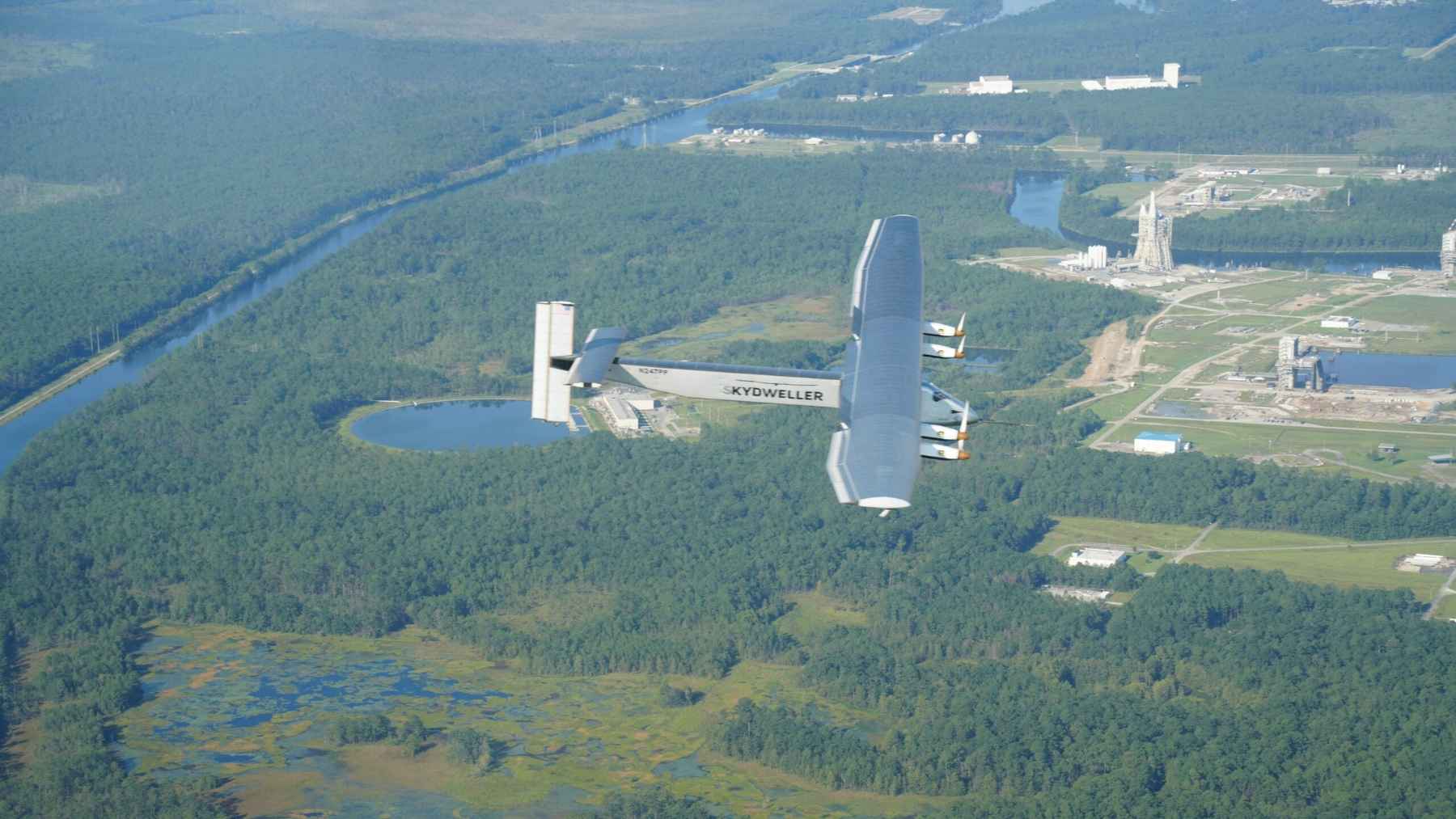
Skydweller does not carry fuel. It is a 236-foot solar aircraft operated out of Stennis International Airport in Mississippi, and this spring it stayed up on a Navy maritime patrol for 8 days and 14 minutes with nobody on board and nothing to refuel.
Then it went into the Gulf on purpose, four days after the exercise it was flying for had already ended. Both halves of that sentence are the story, and some of the coverage in May ran them together.
The flight was a Navy job, not a stunt
It was flown as part of FLEX 26, the annual Fleet Experimentation event run by U.S. Naval Forces Southern Command and U.S. 4th Fleet. The Navy’s own account puts the dates at April 24 to 30 out of Key West, and is blunt about the point of the thing: unmanned systems and AI, run through a full kill chain against captured drug boats used as targets.
Skydweller’s aircraft, tail number N247PF, left Stennis at around 6:15am on Sunday, April 26. A tailwind pushed it into the Key West operating area that same night, ahead of schedule.
For the next four days it flew autonomous maritime patrol while the exercise ran underneath it. It generated radar tracks with an AN/ZPY-8, the radar that used to fly on the MQ-8C, ran a FLIR 380X HDc for day and night video, listened to AIS traffic, and pushed all of it into government dissemination networks.
The company’s photo of the aircraft from that week is captioned as taken from USS Wichita on April 30, which is the Freedom-variant littoral combat ship the Navy had working the at-sea portion alongside MH-60 helicopters. If you want a sense of how far unmanned kit has crept into that mission, we recently covered a 305-pound American drone boat that shadowed a Chinese destroyer and filmed it.
Four college students helped fly it
The part nobody knew until the middle of July is who was actually running the shifts. Skydweller and the University of Oklahoma both published accounts in the same week describing four OU students who worked the campaign as interns.
Mackenzie Moore, an OU flight instructor and military aviator, and Nathan Ungetheim both qualified as air vehicle operators on the aircraft after about four weeks of training. Jasper Chan, an air traffic management major heading into his junior year, handled mission planning: energy modeling, routing and contingencies.
Liam Thompson, who graduated from OU’s School of Meteorology this spring, forecast clouds. On a solar aircraft that is not a comfort item. If the airplane wakes up under a dark cloud, the day’s energy budget is already in trouble before anyone has done anything wrong.
“We ate, breathed, and slept the aircraft flight manual,” Moore told the University of Oklahoma.
The mission ran from three places at once: a control center in Oklahoma City, a support site at Stennis, and a station in Madrid, Spain. Every eight to ten hour shift needed a mission director, an air vehicle operator, a mission planner, a meteorologist, a flight safety engineer and an administrator.
An aircraft with nobody in it still takes six people at a time, around the clock, across two continents.
The airframe held. The batteries did not.
When FLEX ended on April 30, the aircraft did not come straight home, because a large cold front was parked over the Gulf. It held near Key West through May 1, then repositioned south of Cuba and north of the Cayman Islands and loitered there for roughly a day and a half.
A window opened on Sunday, May 3, and the team started the transit back to Stennis. Overnight the weather turned out to be worse than forecast. In its own account of the flight, Skydweller describes vertical air movement driving climb and descent rates more than ten times what the aircraft normally sees.
Holding altitude through that costs energy. By sunrise on May 4 the solar cells were producing again, but the batteries had already been pulled down past the point where the airplane could dig itself back out.
At about 6:30am the operators put it in the water northwest of Cancún, still under control, with propulsion, flight controls and airframe intact. The composite structure is not buoyant, so it sank. Nobody was on board and nobody was hurt.
Robert Miller, co-founder and CEO of Skydweller Aero, gave Forbes the shortest possible version of the telemetry: “Everything was green except the battery level.”
He also told Forbes that time pressure had stopped the team from fitting a complete set of new batteries before the campaign, and that with fresh cells the aircraft might have pushed through. The Navy and the company are still investigating, and no final findings have been made public.
Every other big solar airplane came apart instead
Running out of energy versus coming apart in the air is the whole ballgame for this technology, because the second one is what has killed the field for thirty years.
NASA’s Helios prototype hit turbulence over the Pacific in 2003 and disintegrated. Google’s solar program folded after a wing section separated from its Solara 50 in 2015. Facebook’s Aquila never recovered from a heavy landing in 2016. A Zephyr broke up in severe weather in 2019, and another was lost to storm turbulence in 2022.
“That’s what’s killed every other solar-powered aircraft to date,” Miller told AIAA’s Aerospace America, talking about aeroelasticity, the business of predicting how a structure bends and twists under aerodynamic load.
Skydweller flew through the turbulence that finished it. What ran out was margin in the pack, not strength in the wing.
It weighs six times what a solar drone is supposed to weigh
That toughness is not luck. The aircraft is heavy for its class because it started life carrying a person.
The airframe is Solar Impulse 2, the Swiss machine Bertrand Piccard and André Borschberg flew around the world in 2016 on 17,248 photovoltaic cells spread across a 72-meter wing. Miller’s side bought it in 2019 and the structure is nearly unchanged.
Built for a pilot means built with a pilot’s margins. Aerospace America puts the weight at about 2,500 kilograms, roughly a full-size pickup, hung on a wingspan longer than a 747’s. Forbes pegs that at around six times what NASA’s Helios weighed on a similar span.
The rest of the numbers follow from there. Four propellers, up to 800 pounds of payload, a 45,000-foot ceiling, and a cruise speed Miller has given as 43 km/h, which is 27 mph. Landing it takes two technicians on electric scooters running in under each wingtip with poles so the ends do not scrape the runway.
Altitude is storage on this airplane. It climbs while the sun is up and glides down slowly overnight so the batteries do less work, and its software treats forecast thunderstorms as solid objects to be routed around, like a three-dimensional obstacle course. Redundancy is triple, with Miller working toward quadruple.
Eight days is nowhere near the record, and that is fine
The word record got thrown around a lot in May, so it needs a boundary. The longest continuous flight belongs to AALTO’s Zephyr, which came down on April 28, 2025 after 67 days, 6 hours and 52 minutes in the stratosphere, ending with a deliberate termination over a sanctuary area in the Indian Ocean.
Zephyr carries almost nothing. Skydweller ran a military radar, an EO/IR ball and an AIS receiver at the same time, for eight days, and fed the take to Navy networks while it did it. Hours in the air are easy to advertise. Hours in the air with a working radar are what the Navy is buying.
Other people are chasing the same gap from other directions. A New Mexico outfit called Sceye spent 12 days in the stratosphere with a 270-foot solar airship, and at the opposite end of the flight envelope, a German battery-electric drone clocked 434 mph in level flight this summer.
The next one is already being built
Miller told Forbes in June that a second aircraft is under construction with more efficient motors, better solar cells, new propellers and better batteries, and that he hopes to have it flying in 12 to 18 months. One candidate upgrade is onboard weather radar, so the aircraft can see what the forecast missed instead of flying into it.
The design target has not moved: 30 to 90 days aloft. For scale, Aerospace America framed a seven-day flight as roughly four times what an MQ-9 Reaper manages.
The Navy is not slowing down either. Its release on FLEX 26 called this year’s Key West event a prelude to further experimental operations at Comalapa, El Salvador, later in the year.
What the Gulf swallowed on May 4 was the company’s only flying prototype, and there is no way to write that as anything other than a setback. The consolation is that the failure was boring in the best possible sense. No structural break, no loss of control, no mystery: a battery pack ran out of margin at the worst hour of the night, on the way home, after the job was done.
That is the kind of problem you fix with better cells and a radar that sees the storm coming, which is precisely what the second airplane is getting. The 8 days and 14 minutes stay on the board either way.