
Making steel has looked about the same for 150 years. You dig up iron ore, burn coal to pull the oxygen out of it, and you are left with iron plus a column of carbon dioxide going up the stack. It is one of the dirtiest things people do at industrial scale, responsible for somewhere between 7 and 9 percent of global carbon emissions, and for all the money thrown at the problem, nobody had built a better version that actually ran at full size.
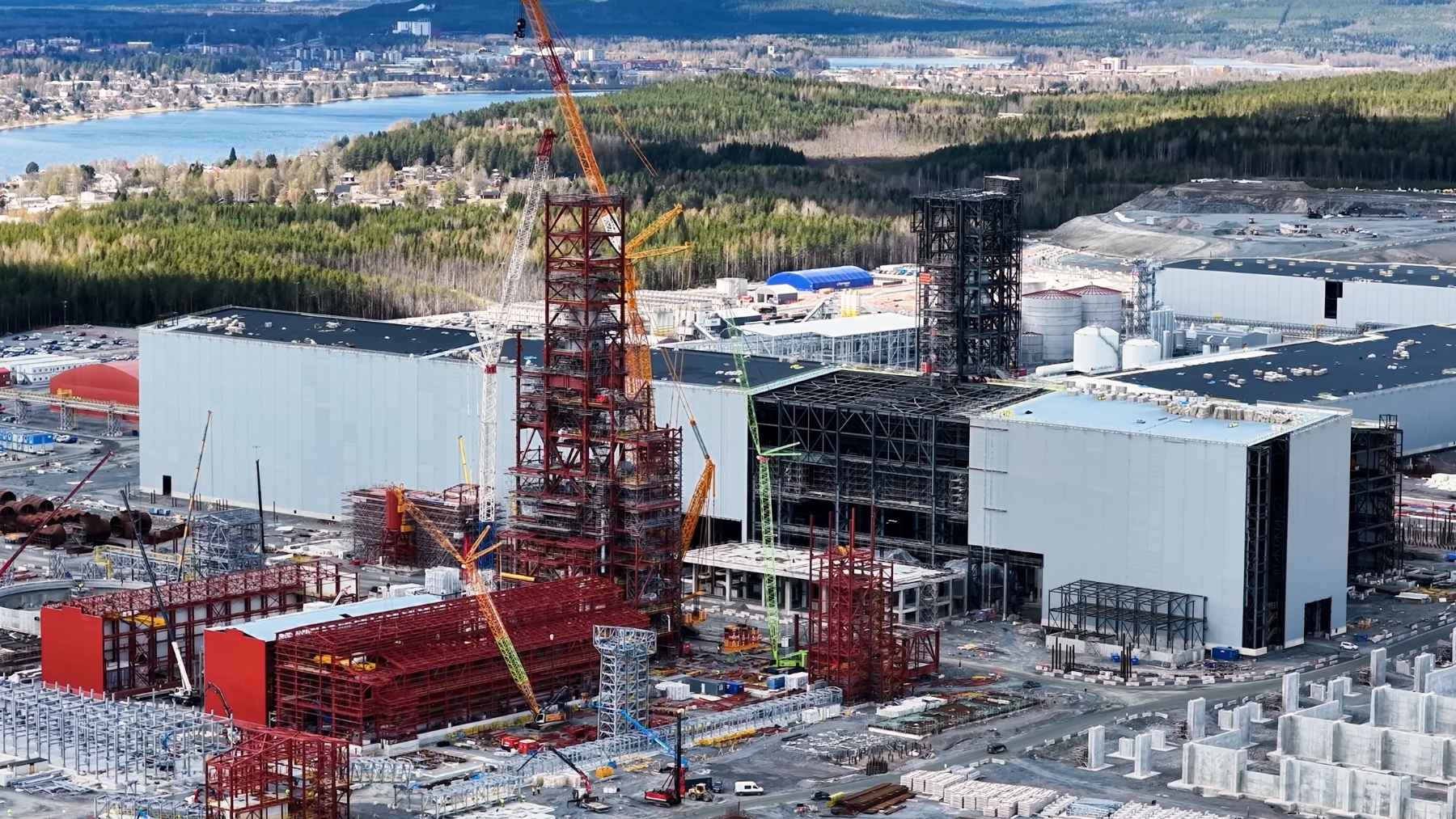
In a stretch of forest just south of the Arctic Circle in northern Sweden, a company called Stegra is betting it can change that by feeding the furnace hydrogen instead of coal, so the reaction gives off water rather than carbon. The plant is not finished. For a stretch last winter it looked like it might never be. Then in April it got pulled back from the edge.
The rescue came from one of the oldest names in Swedish industry. A consortium led by Wallenberg Investments, the arm of a dynasty whose holdings include Ericsson, Atlas Copco and the bank SEB, agreed in April to put €1.4 billion ($1.7 billion) into Stegra to finish the job. That is on top of the nearly €6.5 billion the company had already raised. The money matters, but the more interesting part is what it is paying to complete: a plant that, if it works, would be the world’s first large-scale steel mill run on green hydrogen, and the first new steel mill built from scratch in Europe in roughly 50 years.
Hydrogen does the job coal has done for 150 years
The chemistry here is not new, which is the part people tend to miss. Stripping oxygen out of iron ore is called reduction, and for most of steel’s history the thing doing the stripping has been carbon, from coal or coke. The carbon grabs the oxygen and leaves as carbon dioxide. That is the CO2 you see in the climate math. Swap in hydrogen as the reducing agent and the same reaction runs, except hydrogen grabs the oxygen and leaves as H2O. Water vapor. Steam off the top instead of carbon up the stack.
Doing that at the scale of a real steel mill is the hard part, and it takes three big machines bolted together on one site. The first is an electrolyzer, a 700 MW bank of equipment that runs renewable electricity through water from the Lule River and splits it into hydrogen and oxygen.
Stegra says it is the largest electrolyzer in Europe, and the supplier, Germany’s thyssenkrupp nucera, finished installing all 37 of its 20-megawatt modules earlier this year. The hydrogen feeds the second machine, a 145-meter direct-reduction tower where it does the oxygen-stripping on the iron ore and turns it into what the industry calls sponge iron. The third is an electric arc furnace inside a 110-meter melt shop that melts the sponge iron together with steel scrap and casts it into finished steel, all of it powered by renewable electricity.
Direct reduction itself is a known process, and plenty of plants already make sponge iron this way. The catch is that almost all of them use natural gas as the reductant, which is cleaner than coal but still fossil. Hydrogen is starting to do real industrial work in Europe in other forms too, like the Finnish-built engine that recently ran a power plant on Spain’s grid burning nothing but hydrogen. Using it to chemically pull oxygen out of iron ore, at this volume, is a different and newer job, and the bet nobody had pulled off commercially before.
When it is running at full tilt, the plant is designed to turn out 2.1 million tons of iron and 2.5 million tons of steel a year, with a plan to reach 5 million tons by 2030. Stegra likes to frame that output as enough steel for around three million car bodies, or 30 Golden Gate bridges, which is the kind of comparison that sounds invented until you remember how much steel a single bridge holds. The company says the process cuts CO2 by up to 95 percent against a conventional blast furnace, and that a fully running plant would keep more than 7 million tons of carbon out of the air every year.
The buyers signed up before the steel exists
Here is the part that makes Stegra more than a science project: the customers were lined up before a single coil came off the line. Microsoft has a customer agreement. So does Porsche, which signed a deal for CO2-reduced steel to clean up the emissions math on its cars. Ingka Group, the largest IKEA franchisee, wants green steel for warehouse racking. Italian steel group Marcegaglia signed on for seven years. These are mostly companies at the premium end, the ones that can pass a green premium on steel down to a buyer already paying six figures for a car and never feel it.
There is also a regulatory tailwind that did not exist a couple of years ago. Europe’s carbon border tax, known as CBAM, started phasing in this year, which makes importing high-carbon steel from outside the EU more expensive over time. At the same time, the free CO2 allowances European steelmakers have leaned on under the bloc’s emissions trading system are set to shrink. Put those together and the market is slowly tilting toward exactly the kind of steel Stegra is building to make.
Green hydrogen is where these projects go to die
None of this guarantees anything, because the expensive, unglamorous truth of green steel is that the hydrogen is the part that keeps killing these projects. Making hydrogen with renewable electricity still costs roughly two to four times what making it from natural gas does, and across Europe a string of would-be green-steel and green-hydrogen ventures has stalled or been scrapped over exactly that math.
We dug into the wider version of this in a look at the green-hydrogen supply gap the whole transition is leaning on: the International Energy Agency actually cut its own 2030 forecast for low-emissions hydrogen, and ArcelorMittal walked away from a €2.5 billion green-steel plan in Germany even with €1.3 billion in subsidies sitting on the table.
Stegra got close to that fate. Construction had reached about 60 percent by last fall when the money got tight, and the project spent months running well below speed while the company hunted for more cash. It did not help that Stegra shares a founding investor, Vargas Holding, with Northvolt, the Swedish battery maker that went bankrupt late in 2025 and spooked anyone standing nearby. Earlier Financial Times reporting said one of Stegra’s lenders, Citigroup, had signaled it wanted to stop lending over concerns about the company’s future. A €165 million government grant Stegra had been counting on from Sweden’s environmental agency fell through, and costs kept climbing.
Leif Johansson, the veteran industrialist the Wallenberg consortium wants to install as Stegra’s new chairman, was blunt about the state of the site. A half-built mill, he said, was running at “perhaps a quarter of the speed it should be.” The new money is meant to fix that.
The machines are nearly built. The date keeps slipping.
What the €1.4 billion buys is the finish line, not the ribbon-cutting. The financing was agreed in principle in April and is due to close this month, after the usual lender and regulatory approvals, as Canary Media reported. With it, Stegra says it will ramp construction back up after the slow stretch. Wallenberg Investments, through the consortium, becomes the largest shareholder once the round closes, with €250 million coming directly from the family and existing backer Altor sliding into second place.
The harder question is when actual green steel exists, and the honest answer is that the date keeps moving. The plant was once supposed to be operating by the end of 2025. That came and went. Rail-logistics partners now talk about the Boden facility being ready in early 2027, and Stegra itself says the project timeline is “under review” rather than fixed. CEO Henrik Henriksson has said it takes somewhere between 18 and 24 months to actually produce steel once a plant like this is finished. So the steel is real, the buyers are real, the machines are mostly built, and the one thing nobody can hand you a firm number on is the calendar.
For a sector that has burned coal to make steel since before anyone alive was born, a tower near the Arctic that gives off steam instead of a column of carbon is a real swing, and for a few months it looked like it would join the long list of green-hydrogen plans that never made it past a press release. The rescue means it will most likely get built. Whether enough carmakers, builders and tech firms will pay extra for steel made this way is the actual bet, and that one gets settled at a cash register, not a ribbon-cutting.