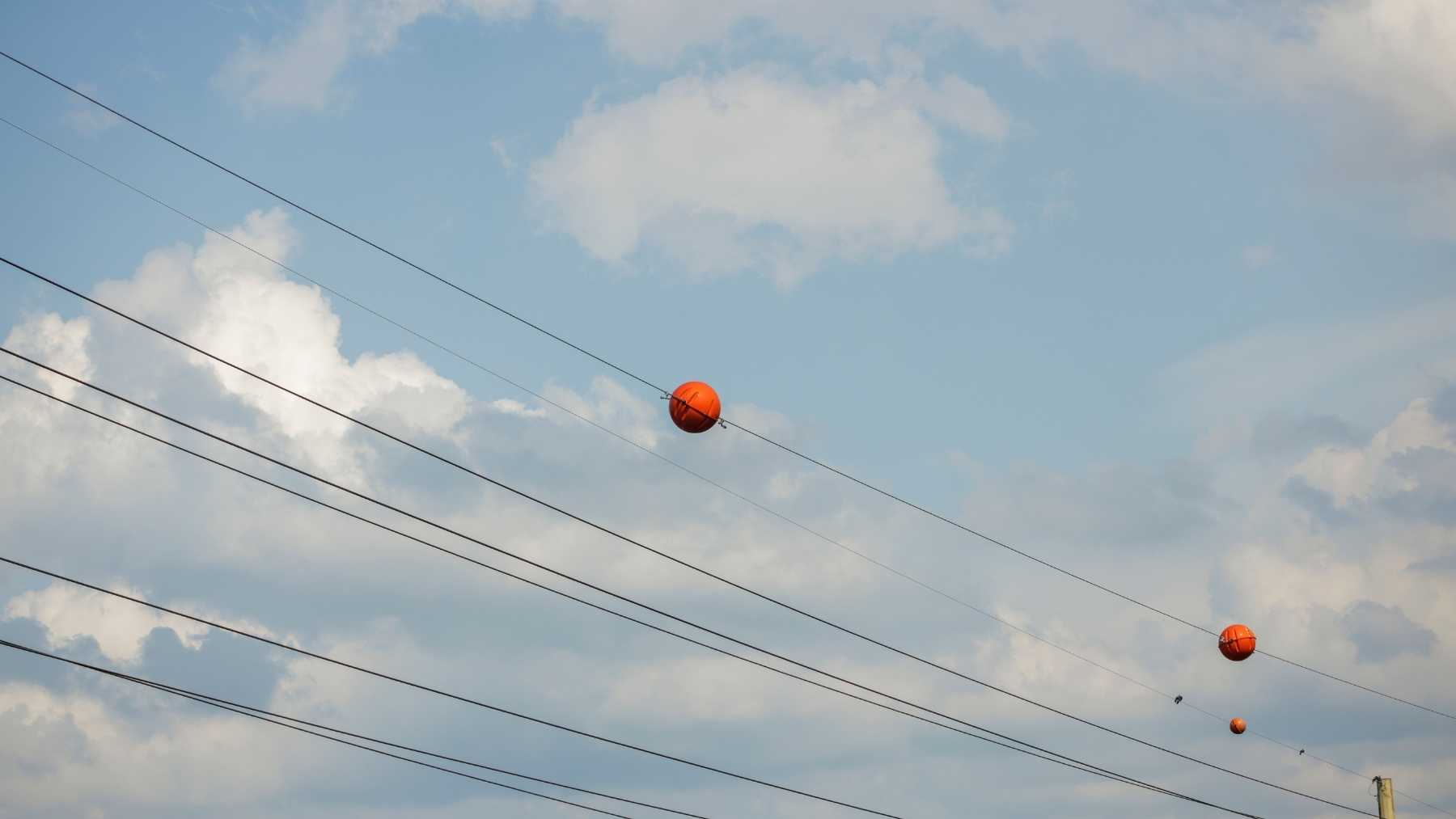

If you have spent any real time driving the highways out West, you have looked up and seen them. Big orange spheres threaded along the power lines where they cross over the road, spaced out like beads on a necklace nobody asked for. Most people glance up, decide they are some kind of electrical thing, and keep driving. A few assume they are counterweights, or lightning protection, or just there to look friendly. None of that is what they do. Those balls have one job, and it is keeping airplanes and helicopters from flying straight into a wire they never saw coming.
It sounds like an overreaction until you sit with how the geometry actually works. A transmission line is a thin metal cable strung across open country, and from a cockpit moving at a hundred-plus miles an hour it more or less disappears against trees, water, or a brown hillside. Pilots who fly low for a living rank wires among the nastiest hazards in the job, and the accident files have a long, grim habit of proving them right.
The wire is the part a pilot can’t see
Power lines are deceptively hard to spot from the air. The towers holding them up are obvious. The wire strung between those towers, often the highest conductor in the whole span, can vanish completely depending on the light and the background behind it. That is the entire problem the orange balls exist to solve. They are not there to protect the line. They are there to give a pilot a row of bright, basketball-sized dots to track, so the cable underneath them stops being a surprise. They are officially called aviation marker balls or spherical markers, and the color is doing all of the work.
So utilities concentrate them exactly where aircraft are most likely to get low and meet a wire: on the approach paths near airports and heliports, across canyon and river crossings, over reservoirs where floatplanes land, through mountain passes, and on the long spans that jump a valley or a busy stretch of interstate. You do not see them on the lines down your residential street, because nothing is supposed to be flying low enough there to care.
How real the danger is got an ugly reminder this year. On January 2, 2026, an MD Helicopters 369FF struck a recreational slackline rigged across the mountains near Telegraph Canyon, south of Superior, Arizona, killing the pilot and three passengers from one Oregon family. That was a climbing line rather than a power cable, and according to the NTSB’s preliminary report covered by AVweb, it had aviation markers on it and a Notice to Air Missions had already been filed. The helicopter was even fitted with a wire-strike protection system, and the cutters did not engage the synthetic webbing. Tom Anthony, who directs the Aviation Safety and Security Program at USC, told the Associated Press that wires and unmarked cables are a perpetual hazard for helicopter pilots precisely because they are so hard to see. A second helicopter reportedly came within about ten feet of a remaining line an hour later.
There are only going to be more of these spans to mark, too. The grid is growing fast to keep up with demand, from new utility-scale generation like the power plant Tesla is building in Utah to data centers big enough to pair themselves with their own nuclear reactor, and every long new line that crosses a valley or a flight path is a candidate for a row of orange. It is the same quiet infrastructure you pass constantly without a second thought, right down to what is going into the road surface under your tires.
The FAA has opinions about the color of a ball
Because this is the United States, there is a federal document governing how you are allowed to do this. The Federal Aviation Administration’s Advisory Circular 70/7460-1M, the obstruction marking and lighting rulebook that took effect in November 2020 and picked up a revision in October 2024, lays out the whole system. Anything taller than 200 feet above the ground generally needs to be marked or lit, and for the wires strung between towers that means spherical markers.
The color choices are not random either. Markers come in aviation orange, white, or yellow, and the guidance has them alternated along the span with an orange marker on each end. When a crossing uses fewer than four of them, they are all supposed to be orange, since orange holds up against the widest range of backgrounds. The official shade even has a name, International orange, with a government spec number sitting behind it. Spacing runs at roughly 200-foot intervals, tightening to something like 30 to 50 feet near the ends of runways where precision matters most. There is even a rule that the highest marked wire can sit no more than 25 feet above the highest unmarked one.
Then there are the lit ones. On high-voltage lines, defined as 69 kilovolts and up, near airports or canyons, the FAA allows lighted spherical markers that have to be recognizable from at least 4,000 feet away at night and burn at a defined minimum brightness. Most of the balls you actually drive under are unlit. The paint does all the work in daylight, which is the only time a low-flying aircraft is realistically going to be threading that gap anyway.
The spec sheet behind one of these is more involved than it looks:
Getting them up there takes a helicopter
The part that turns this from trivia into a story worth telling is how they get up there in the first place. Those transmission towers can stand 200 feet tall, they sit in canyons and across rivers, and the wire is usually still energized while crews work. You are not backing a bucket truck up to most of these. So a lot of marker balls go on by helicopter, with specially trained linemen lowered to the conductor to clamp each one in place while the line stays hot.
The marker itself is built for that. It comes in two halves that wrap the cable and bolt shut, with internal bushings sized to grip wires from an eighth of an inch up to an inch thick. The earliest versions were glass, which broke constantly, then plastic took over in the 1960s, and P&R Technologies introduced the first vacuum-formed ABS marker in 1977. For the really punishing lines, the ones running at hundreds of kilovolts or carrying enough current to melt plastic, manufacturers switched to aluminum markers that are fully conductive, so the electrical field passes right through them. To get a sense of the scale of this work, Southern California Edison once documented installing 162 markers on a single transmission project.
None of it is low-risk. Flying alongside live wires to inspect or rig them is one of the most demanding kinds of aerial work there is, and it still goes wrong. On August 7, 2025, a Hughes 369D helicopter struck power lines and went down onto a barge on the Mississippi River near East Alton, Illinois, killing two people. The utility, Ameren, confirmed that a contractor and subcontractor had been repairing and replacing tower lighting and marker balls on the transmission lines when it happened. The very safety hardware these crews install is part of what makes that job necessary in the first place.
A broke boat builder in Arkansas built the modern one
The FAA had been nudging utilities to mark their lines since the 1950s, but the marker ball as a mass-produced object traces back to one oddly specific moment in the early 1970s. Winthrop Rockefeller, a former governor of Arkansas, was on a flight with Eddie Holland, who ran the state’s Department of Aeronautics, when he looked out the window on the approach and saw wires flash past the aircraft. By the account Holland’s contact later gave United Press International, Rockefeller’s reaction was roughly, “What in the hell was that?”
Holland took the problem to a man named Jack Rutledge, who at the time was running a not-especially-successful fiberglass boat plant in Little Rock. Rutledge worked out a brightly colored ball that could clamp onto a wire without spinning around in the wind like a windsock, and founded Tana Wire Marker Co. to make them. He started with a 20-inch ball and kept scaling up as utilities brought him stranger requests, eventually building a 54-incher to mark a gorge crossing for an Idaho co-op. In that same 1983 interview he priced his basic marker at around $30 and the giant at roughly $300, and mentioned that the Canadian government once ordered special markers internally coated with silver beads, to deal with how the northern lights washed them out, at about $2,500 apiece. By the 1980s his company was one of the leaders in the business.
The geese came out ahead too
There is a bonus the orange balls deliver that has nothing to do with aircraft. Birds hit power lines constantly, especially large ones like geese trying to land in bad weather, and a marked wire is a wire they can actually see. Field research has found that adding markers can cut bird collisions by well over half. The numbers around animal strikes are not small either. The southern utility Entergy has estimated that animals caused more than 22,000 of its outages in Mississippi, with over a thousand of those pinned specifically on birds. The same bright sphere that saves a pilot turns out to save a fair number of geese on the side.
So the next time traffic has you parked under a set of them, you will at least know what you are looking at. Not decoration, not anything to do with how the electricity flows, and definitely not lighting. Just a 15-pound plastic sphere that somebody bolted onto a live cable from a helicopter, hanging there in International orange so a pilot a few hundred feet up gets a real chance to see the wire before the wire finds them.