
Making green hydrogen has always been a two-machine job. You put up solar panels to turn sunlight into electricity, then you feed that electricity into an electrolyzer that splits water into hydrogen and oxygen. Both machines cost serious money, both need maintenance, and the second one usually wants a grid connection, which quietly undercuts the whole “energy independence” sales pitch. Then a four-person spin-off from Germany’s Karlsruhe Institute of Technology showed up at Hannover Messe this spring and said you can fire the middleman.
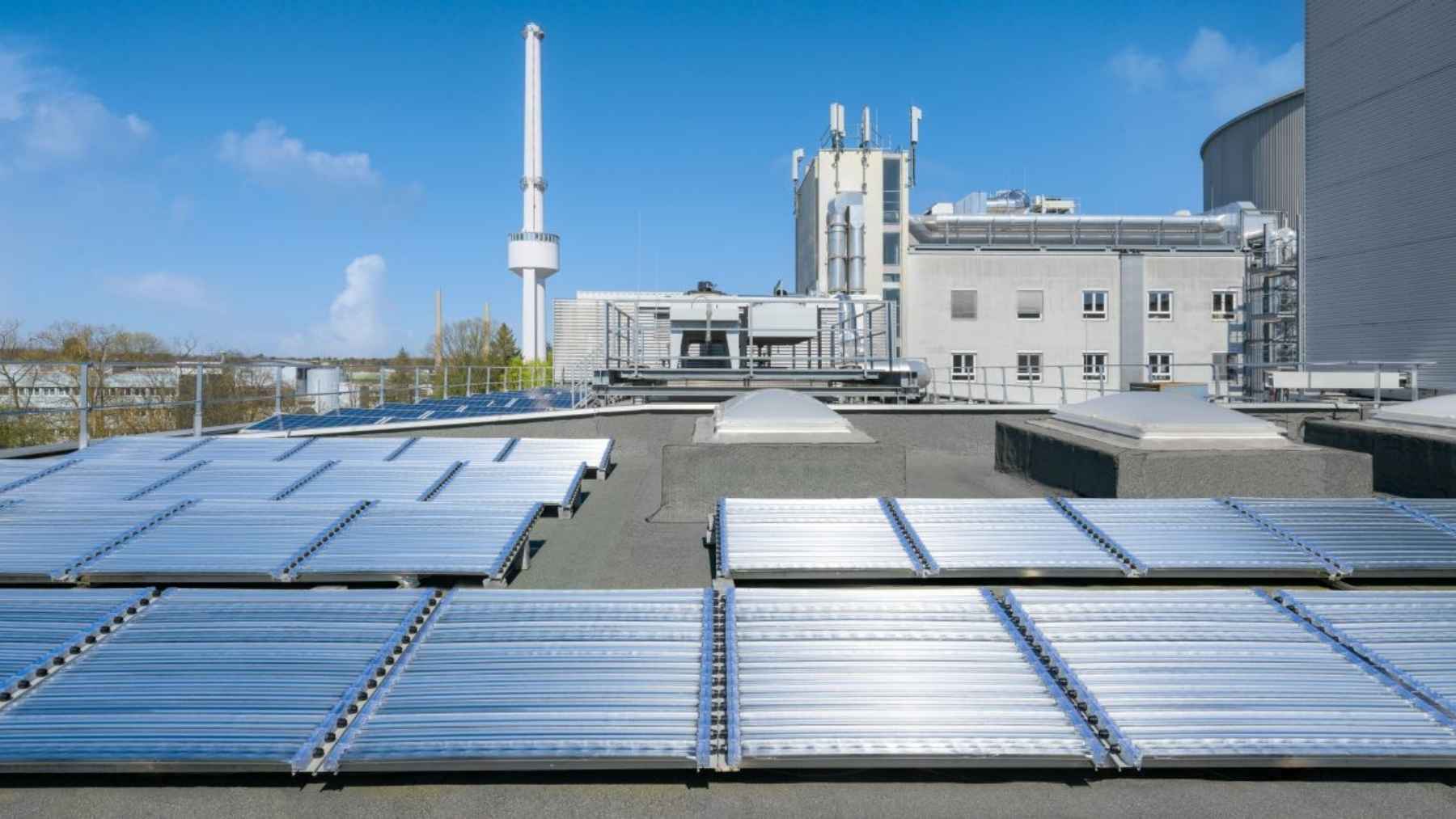
The startup is called Photreon, and its product is a photoreactor panel that takes in sunlight and water and gives back hydrogen directly. No electrolyzer, no electricity consumed anywhere in the process, no grid. The team brought a working 1-square-meter prototype (about 11 square feet) to the KIT booth at the fair, which ran April 20 to 24, and KIT announced it has filed a patent application for the panel’s internal geometry. If you have ever wondered why nobody just builds a panel that makes fuel instead of electricity, the short answer is that plenty of people have tried. The longer answer is what makes this one worth your five minutes.
Sunlight goes in, hydrogen comes out, and there is no electricity in between
The trick is a process called photocatalysis, and it is genuinely different from what happens on your neighbor’s roof. A photovoltaic panel absorbs light and converts it into electric current. Photreon’s panel absorbs light with specially engineered light-sensitive materials that kick electrons into an excited state, and those charged-up electrons drive a chemical reaction on the spot: water molecules get split into hydrogen and oxygen right there in the panel. The energy never takes the form of electricity at any point. Sunlight becomes chemical fuel in a single step.
According to co-founder Paul Kant, a researcher at KIT’s Institute for Micro Process Engineering, the design skips the detour through electrolysis entirely and produces chemical energy straight from sun and water. The part KIT actually filed the patent application on is the reactor’s internal geometry, which Kant says was engineered so that three jobs happen at once inside the panel: light gets guided onto the active material, the water-splitting reaction runs, and the gases produced get pulled out efficiently. That last job matters more than it sounds. A panel that makes hydrogen but can’t collect it cleanly is a science fair project, and the field has produced plenty of those.
Maren Cordts, the other co-founder out of the same KIT institute, frames the payoff in system terms: one panel replaces both the photovoltaic array and the electrolyzer, which cuts cost and complexity in one move. Considering that electrolyzers lean on expensive catalyst metals like iridium and platinum, an entire research industry exists just to shave the precious metals out of them, so deleting the machine altogether is a fairly direct way to win that argument.
The efficiency numbers are brutal, and they’re the part nobody puts in a headline
Here is the thing Photreon’s pitch lives or dies on, so let’s not bury it. Photocatalysis has historically been terrible at converting sunlight into hydrogen. Not slightly worse than the two-step route. Terrible. A landmark Nature paper from 2021 put real-world photocatalytic water splitting at solar-to-hydrogen efficiencies of only around 1%, while lab setups pairing solar cells with electrolyzers have hit 30%. The same paper documented Japan’s famous 100-square-meter outdoor array of photocatalytic panel reactors, which ran for a year and peaked at 0.76% conversion efficiency. That demo also flagged a safety headache this field carries around: the raw output is a mixed stream of hydrogen and oxygen that has to be handled and separated without incident, which is part of what Photreon says its extraction geometry is built to manage.
The best published number anywhere is 9.2%, achieved in a 2023 study using an indium gallium nitride catalyst, concentrated solar light, and carefully tuned reaction temperatures. Impressive work, but concentrated light and lab conditions are not a rooftop in the real world, and the same team measured about 7% on tap water and seawater. Researchers commonly cite 10% solar-to-hydrogen as the threshold where the technology starts to make commercial sense. The field’s everyday reality has been a single digit, and usually the low end of a single digit.
Photreon’s bet is cost, not performance
So why would anyone build a company on a technology with those numbers? Because Photreon isn’t selling efficiency. It’s selling cheap. The panel is designed around standard mass-production processes and low-cost materials, and the whole thing is modular, so the same unit works as a handful of panels on a factory roof or as thousands of them wired together into what KIT calls solar hydrogen farms. The economic logic is closer to flooring a desert with inexpensive panels than to squeezing every photon for maximum yield. If each square meter is cheap enough to stamp out like drywall, a mediocre conversion rate stops being a dealbreaker and starts being a land-use question.
The customers Photreon is naming tell you exactly where it thinks that math works first. Mid-sized companies in specialty chemicals, food production, and metalworking that want to cover their own hydrogen demand on-site instead of trucking it in. Large solar projects in regions with abundant sunshine. And places that have neither a power grid nor a hydrogen pipeline within reach, where the alternative isn’t a cheaper electrolyzer, it’s nothing at all. “Our technology opens up new possibilities for local production,” Cordts said in KIT’s announcement. That on-site framing is also the honest one, because the demand side of this market is very real and very underfed: governments on three continents have written fuel mandates that quietly assume someone will produce enormous amounts of green hydrogen that, so far, nobody is producing.
You should still file every forward-looking claim here under “plans.” There is no price per kilogram, no production capacity, no announced pilot customer. What exists today, verifiably, is one working square meter and a patent application.
Germany didn’t start this race, and it isn’t running alone
Photreon’s announcement reads like a breakthrough if it’s the first photocatalysis story you’ve seen. It isn’t the first. Israel’s QD-SOL has been working the same direct sunlight-to-hydrogen idea with nanoparticle catalysts and said in September 2025 it had connected multiple photocatalytic panels into a single continuously producing array, its step from one panel toward many. SunHydrogen, a publicly traded outfit based in Iowa, brought on the University of Tokyo professors behind that Japanese 100-square-meter demonstration as consultants back in 2023 to help engineer its own panels. Everyone in this field is chasing the same prize, which is hydrogen production simple enough to skip the electrolyzer industry entirely, and everyone is stuck behind the same single-digit efficiency wall. Whoever combines a tolerable conversion rate with genuinely cheap manufacturing first wins, and right now nobody has. The catalyst research feeding this race moves fast, and occasionally a result lands that rewrites the assumptions, so the wall may not hold forever.
What separates Photreon’s entry is the pedigree and the framing. KIT is one of Europe’s heavyweight engineering institutions, the reactor geometry is specific enough to file a patent application on, and the founders are openly positioning the product around manufacturability instead of record-chasing. In a field that has spent two decades publishing efficiency papers, a pitch built on “ours will be cheap to stamp out” is at least a different kind of bet.
A 1-square-meter panel is not a factory. It’s a very promising window. The distance between the two is where most of these projects go quiet, and Photreon now has to cross it with a technology whose core physics has humbled better-funded teams for twenty years. The reason to keep this one on your radar anyway: every other path to green hydrogen requires two machines and a grid, and this one requires a panel, water, and a sunny day. If the cost numbers ever back up the simplicity, the electrolyzer business has a problem.