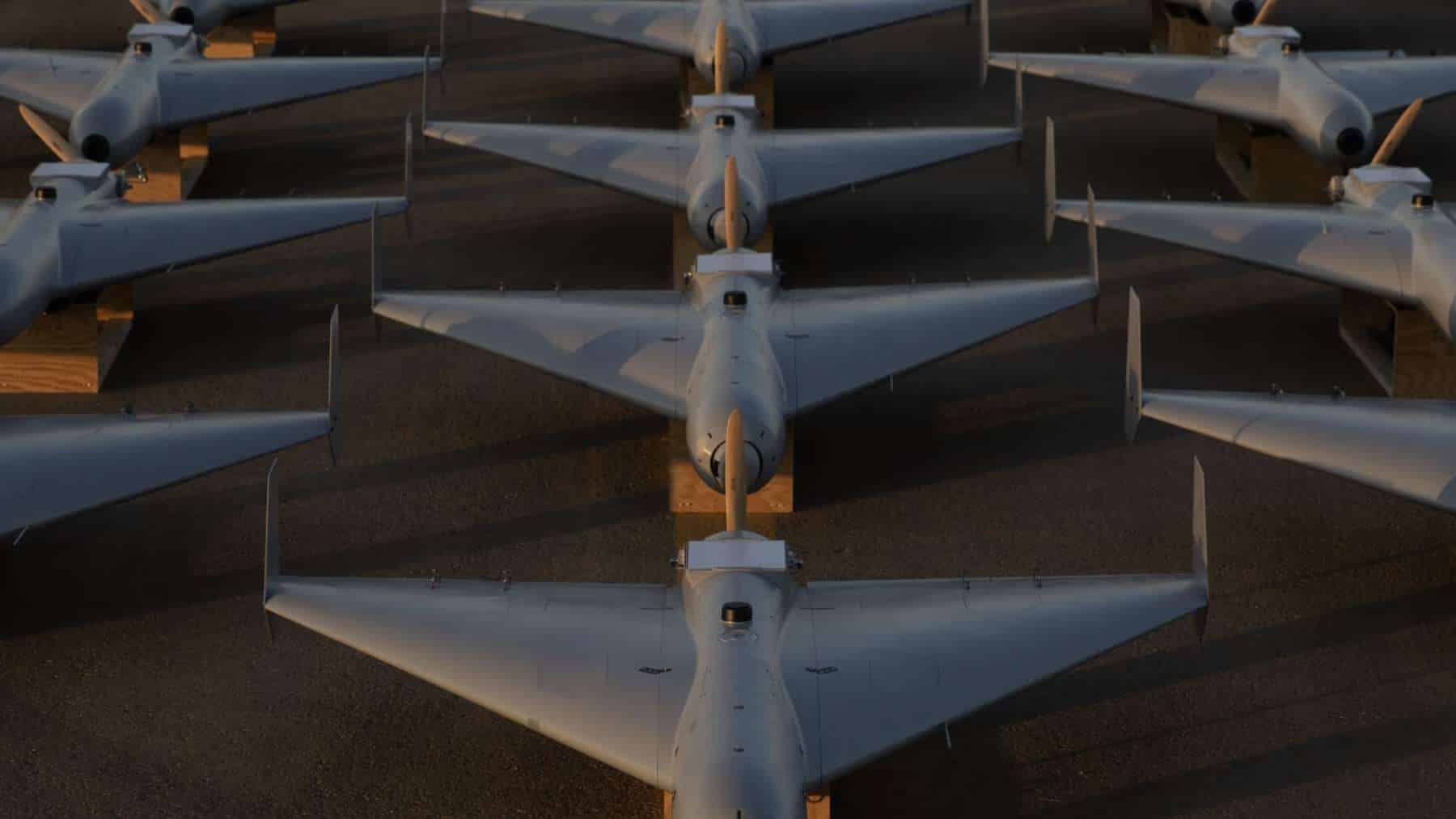

On May 19, 2026, eight days ago, the Office of the Under Secretary of War for Research and Engineering quietly issued a contract that puts the next phase of American attack-drone doctrine on a calendar. The Pentagon selected San Diego-based Shield AI to integrate its Hivemind autonomy stack onto the Low-Cost Uncrewed Combat Attack System — LUCAS — the Shahed-class one-way attack drone the U.S. military used in combat for the first time during Operation Epic Fury against Iran on February 28, 2026. The integration is on a deadline. Shield AI’s own press release says the operational demonstration of the autonomous swarm is scheduled for this fall.
That last sentence is the one defense planners are watching. The LUCAS that flew in February was, by the Pentagon’s own characterization, an early-generation system, each airframe following a pre-planned route with human operators handling the high-level decisions. The LUCAS that demonstrates in October or November of this year will be commanded by a single operator giving the swarm intent, and the airframes themselves will divide a target set, route around pop-up threats, and re-task when one is lost. Brandon Tseng, Shield AI’s president and co-founder, framed the difference in the company’s release: “LUCAS is about delivering affordable mass, but mass without coordination is limited in value.” The two halves of that sentence are the entire story.
What LUCAS actually is
The airframe is unremarkable on purpose. According to Breaking Defense, LUCAS is about 10 feet long with an 8-foot wingspan, built by Arizona-based SpektreWorks around commodity components and a two-cylinder piston engine displacing 215 cubic centimeters. It is, in mechanical terms, a reverse-engineered HESA Shahed-136, the Iranian one-way attack drone Russia has been firing at Ukrainian cities since the autumn of 2022. The delta-wing layout and the propeller-driven, low-and-slow flight profile are deliberate copies of the Iranian original. What is not a copy is the autonomy roadmap.
The Pentagon has cited a unit cost of roughly $35,000. The Department of War’s own disclosures put the broader family at $10,000 to $55,000 depending on configuration and payload, and the operational radius at 434 nautical miles, or about 500 statute miles. Either price point is well under two percent of a Block V Tomahawk cruise missile. The launch options Centcom has confirmed include catapult, rocket-assisted takeoff, and mobile ground or vehicle systems. On December 16, 2025, U.S. Navy personnel carried out the first at-sea launch of a LUCAS drone from the Independence-class littoral combat ship USS Santa Barbara in the Arabian Gulf, demonstrating that the system can be operated from compact maritime platforms as well as land bases. The combat-configured warhead has not been officially specified, though the underlying FLM-136 airframe the drone is derived from is rated for approximately 18 kilograms, or 40 pounds, of payload.
The combat debut, in what little we know about it
On February 28, 2026, at 01:15 Eastern Time, U.S. Central Command commenced Operation Epic Fury against Iran in coordination with Israel, which ran its own simultaneous campaign under the codename Operation Roaring Lion. The opening salvo killed Iran’s Supreme Leader Ali Khamenei, Defense Minister Aziz Nasirzadeh, and IRGC chief Mohammad Pakpour. CENTCOM described the strike as “the largest regional concentration of American military firepower in a generation.” Inside that strike package, alongside Tomahawks, F-15Es, F-18s, F-35s, and B-2 Spirits, was the combat debut of LUCAS, fielded by Task Force Scorpion Strike — the U.S. military’s first dedicated one-way attack drone squadron, stood up at CENTCOM on December 3, 2025 under directives from Secretary of War Pete Hegseth.
DefenseScoop’s reporting on the strike, citing CENTCOM spokesman Navy Capt. Tim Hawkins, described the LUCAS deployment as “the first time in history” American-made long-range one-way attack drones were used in real-world combat. CENTCOM has confirmed the strikes hit their targets. It has not said how many LUCAS airframes launched, how many reached their aim points, or how many were lost to Iranian air defenses on the way in. What is on the record is that the drones “remained ready for employment,” which means LUCAS was not a one-time demonstration but a forward-stockpiled capability the U.S. now expects to use repeatedly.
The operation closed on May 5, 2026. By the third day of combat, the Strait of Hormuz was effectively closed. At least 13 U.S. servicemembers died and more than 380 were wounded over the course of the campaign, according to Pentagon casualty figures. Iran’s retaliation hit Camp Buehring in Kuwait, Al Udeid Air Base in Qatar, Al Dhafra Air Base in the UAE, and Ain al-Asad Air Base in Iraq, where U.S. personnel were wounded by ballistic missile strikes. An AN/TPY-2 THAAD radar at Muwaffaq Salti Air Base in Jordan — a critical piece of one of just eight THAAD batteries the U.S. operates worldwide, with the radar alone valued at roughly $300 million — was destroyed. That is the broader context of the strike package LUCAS flew inside. It was not an isolated demonstration. It was a regional war.
What Hivemind changes
Hivemind is the autonomy stack Shield AI has spent the last several years developing for the V-BAT vertical-takeoff drone, the X-BAT tail-sitting combat drone the company unveiled in late 2025, and the Anduril YFQ-44A Fury — one of the two airframes selected for the U.S. Air Force’s Collaborative Combat Aircraft program. The same software, ported across airframe classes, is what the Pentagon is now bolting onto LUCAS. Shield AI’s framing is consistent across those programs: the operator gives intent, the swarm figures out execution.
Inside a LUCAS swarm under Hivemind, individual drones can re-task themselves if one is lost, divide a target set among the survivors, and reroute around pop-up threats without waiting for a satellite link back to a ground station. The War Zone reported the integration is being run through the Office of the Deputy Assistant Secretary of War for Prototyping and Experimentation under OUSW R&E, which makes the fall 2026 demonstration the procurement milestone rather than a research deliverable.
That is a meaningful change from current U.S. practice, where each unmanned aircraft is typically tied to a specific human pilot or sensor operator. The MQ-9 Reaper, the most prolific U.S. combat drone of the last two decades, is flown by a rated officer sitting in a ground control station, often at Creech Air Force Base in Nevada, with a sensor operator beside them and a chain of command above. LUCAS with Hivemind onboard does not work that way. A single operator monitors a swarm of airframes. The drones handle which airframe attacks what, in what order, and from what direction.
Why this lands now
The American defense-acquisition pivot toward what the Pentagon calls “affordable mass” did not start with LUCAS. The framing has been showing up in budget documents and procurement justifications since at least 2024, when the air war in the Red Sea began stress-testing the U.S. magazine. Standard Missile-2 interceptors, at roughly $2 million each, were being expended against Houthi-launched Shahed-class drones that cost an order of magnitude less. The Pentagon was blunt that the trade could not continue indefinitely. LUCAS exists to flip the equation: cheap mass on the offensive side, forcing the adversary to spend the expensive interceptors.
The same logic, on a different timeline, has been visible in the U.S. defense industrial base’s push to secure rare-earth supply chains for the permanent-magnet motors that go into both EV traction systems and military guidance packages, and in the procurement contracts the Department of War has been writing for hydrogen-powered ISR drones from Heven AeroTech and rare-earth oxide supply from Lynas USA. The common thread is a Pentagon that has stopped buying small numbers of exquisite platforms and started buying large numbers of attritable ones. LUCAS is the most visible piece of that pivot because it is the one that just shot at Iran.
What the Pentagon has not said
Several pieces of the LUCAS story remain on the classified side of the wall. The Pentagon has not disclosed how many airframes it has bought, who all the suppliers are, or what the rules of engagement look like for a swarm where no single human is approving each individual terminal maneuver. Shield AI’s public statements describe Hivemind as keeping a human in the loop at the mission level, but the company has not detailed how that loop holds together if communications are jammed or the swarm is split. The fall demonstration is supposed to surface answers. It is also being run by the same Pentagon office that wrote the contract, which means the early performance data on collaborative autonomy will reach the public through the same procurement channel that has an interest in the program continuing.
There is also no public accounting of how LUCAS performed inside Operation Epic Fury itself. CENTCOM confirmed the strikes hit their targets. It has not said how many LUCAS drones launched, how many reached their aim points, or how many were lost to Iranian air defenses on the way in. Until that data shows up, either through an Inspector General’s report or a congressional hearing, the program’s real combat effectiveness is something the Pentagon and its suppliers are asserting rather than proving.
What is clear is the direction of travel
The U.S. has flown LUCAS in combat, has contracted Shield AI to make it swarm, and is talking publicly about scaling the buy. SpektreWorks is no longer a name only defense reporters recognize. American air power, from the B-29s over Tokyo in 1945 to the F-35s rolling off the Fort Worth line today, has been built on a single assumption: an American pilot, eventually, makes the final call. LUCAS with Hivemind does not work that way. The operator gives the swarm a mission and a target set. The drones handle the rest, including which airframe attacks what, in what order, and from what direction.
The B-21 Raider will still get the magazine-cover treatment when it enters service. The aircraft that may end up doing more of the actual shooting is the one nobody is sitting inside. The fall demonstration is on the schedule. What the Pentagon does with the data after that, between now and the FY2027 budget cycle, is the part of the story worth watching.