
Nuclear power plants are famously hard to get rid of. When one shuts down in the US, the fuel usually leaves first, and the building can sit behind a fence for years afterward while the radioactivity left in its steel slowly fades. The Army’s first reactor did that for the better part of 50 years at Fort Belvoir, Virginia, about 17 miles south of downtown Washington.
Now it’s gone. The Army Corps of Engineers’ Baltimore District announced on September 10 that it had finished all the field work on SM-1, as the plant was officially known. The spot where it stood has been graded and seeded. That’s about as undramatic as an ending gets for a nuclear site.
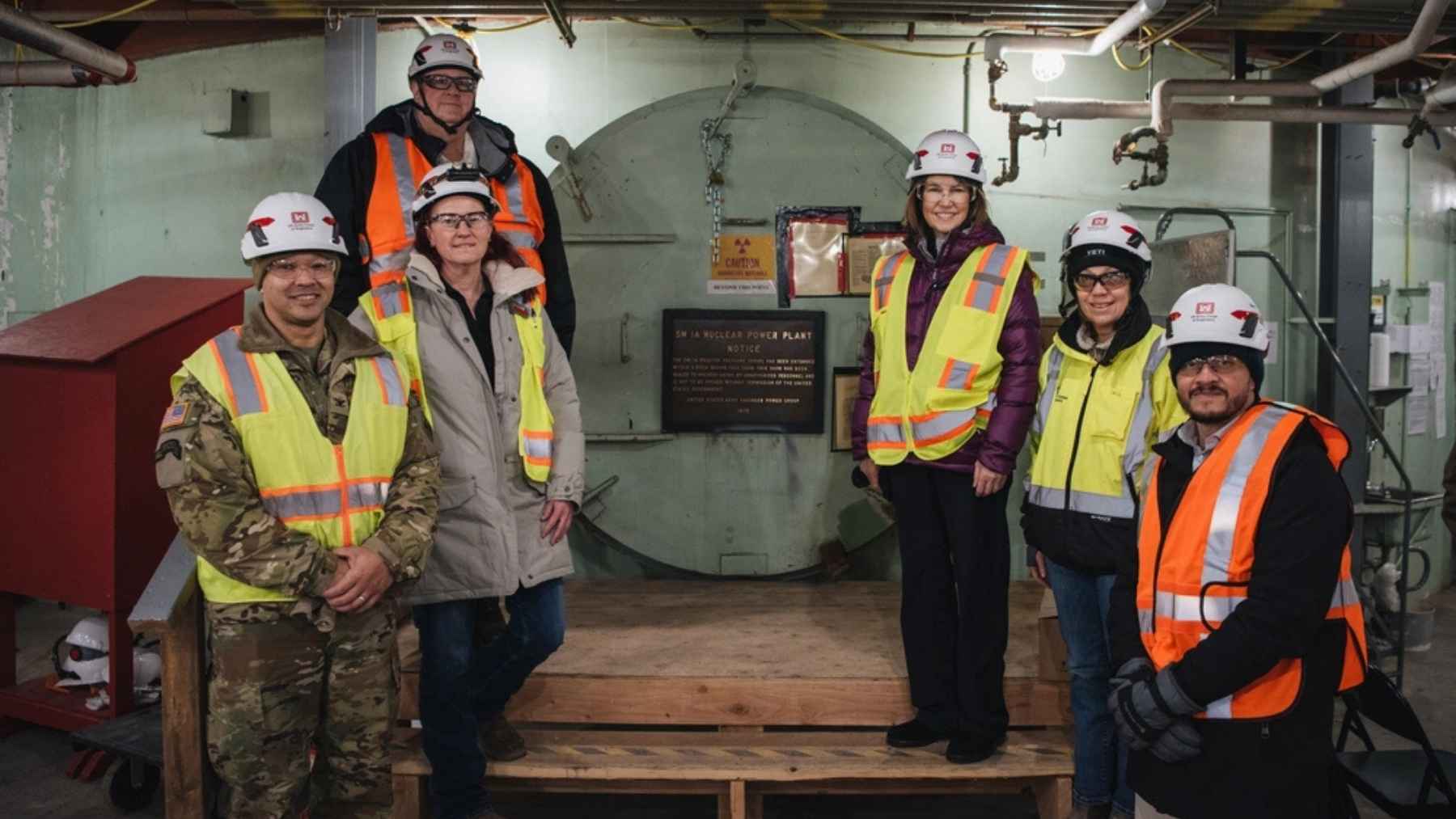
The team marked it with a close-out ceremony on September 9, posing with the plant’s original 1957 building marker. Col. Francis B. Pera, who commands the district, said the crew set out “to execute a complex mission methodically.” For five years of work on a reactor that was switched off during the Nixon administration, I’d say that’s a fair description.
What was SM-1, exactly?
SM-1 was a small pressurized water reactor. Most American nuclear plants running today use that basic design, just a whole lot bigger. The uranium heats water that’s kept under so much pressure it can’t boil, and that water heats a second loop that does boil and spins a turbine. According to the Corps’ project history, SM-1 made 10 megawatts of heat and turned it into 1,750 kilowatts of net electricity.
The American Locomotive Company built it. That’s who you’d call in the 1950s if you needed a train, and apparently also if you needed a reactor. It went critical in April 1957 and fed part of Fort Belvoir’s power. It also trained Army, Navy and Air Force crews to run the small plants the Army wanted on remote bases. It kept going until March 1973.
Its real claim to fame is that the Corps calls it the first plant in the US to supply nuclear power to a commercial grid for a sustained period. That last qualifier’s doing a lot of work.
If you know your nuclear trivia, you’re probably thinking Idaho got there first, and you’ve got a point. An experimental reactor called BORAX-III lit up the town of Arco for about an hour back in 1955 before the local utility took over again. SM-1 wasn’t a one-hour demo, though. It fed the local grid for years, and by most accounts it was already doing so months before Shippingport in Pennsylvania, the plant most history books point to, came online in December 1957.
So why wait almost 50 years?
When SM-1 shut down, the Army deactivated it over 1973 and 1974. Crews pulled out the fuel and control rods, shipped off the radioactive waste, sealed the reactor pressure vessel and put up warning signs and monitoring gear. Then the plant went into what the industry calls safe storage, which is basically locking the door and waiting.
The waiting had a point. Even with the fuel gone, the steel around a reactor core stays radioactive, because years of neutrons flying out of the fuel turn some of the atoms in that metal into unstable versions of themselves. Some of those, like cobalt-60, lose half their radioactivity every five years or so. The idea was to let that stuff fade, so there’d be less waste and lower doses for whoever eventually took the place apart.
It didn’t fully work out. The Corps says later studies found decay alone wouldn’t bring the contamination down enough to release the site without serious cleanup, and radioactive waste disposal kept getting more expensive while the plant sat there. Not everything in that steel runs on a five-year clock, either. Nickel-63, another common product of neutrons hitting steel, takes about a century to lose half its punch.
SM-1 didn’t exactly sit empty all those years. The Corps says the Army kept using it for training until 1977 and then as a museum for its nuclear power program into the 1980s, which is a fairly unusual retirement gig for a reactor. The Corps also ran environmental checks on the site every quarter.
Taking it apart took about five years
The Baltimore District spent years planning the teardown before it got a decommissioning permit in 2020. It hired a joint venture of APTIM and AECOM for about $68 million, and crews showed up in 2021. When it signed that deal, the Corps figured the job would take about five years, and that’s pretty much how it played out, which for a federal teardown is honestly impressive.
Most of the radioactivity went early. By November 2023, the Army says the team had pulled every reactor component out of the plant’s containment structure, which it calls the vapor container, and that took about 95% of the site’s radioactivity with it. After that, crews went after what was left below ground and the contaminated soil.
How much stuff are we talking about?
The lead contractor’s own project page, last updated a little over a year before the job wrapped up, said it expected to ship roughly 60 million pounds of waste by road and rail to a radioactive waste disposal site about 1,700 miles away. It also listed around 19,000 cubic yards of contaminated soil to dig up and ship out. The Corps’ September announcement doesn’t give a final tally, so I can’t tell you whether the real number landed there. Either way, that’s a pretty wild amount of material to haul out of a plant whose output was in the ballpark of the microreactors the Army’s shopping for these days.
The Army wants reactors on its bases again
The timing’s kind of neat. In late August, the Army picked five companies to build and run microreactors on its posts under a program called Janus, and it expects more than 20 of them eventually. The Army won’t own a single one, either. They’ll be contractor-owned and contractor-operated.
SM-1 was arguably a microreactor decades before anyone was using the word. A 1960 Nuclear News article that the American Nuclear Society pulled from its archive this week laid out the pitch for plants like it. One core for an SM-1-type plant weighed about 800 pounds, could ride in a single C-47 (the military version of the old DC-3 airliner) and did the work of 60,000 barrels of fuel oil. That’s pretty much the same logistics argument the Army’s making for Janus now, just with more PowerPoint.
The Army says finishing SM-1 helps it understand the full life cycle of nuclear power, from building a plant to scrubbing it off the map. The plan’s been to hand the land back to Fort Belvoir for unrestricted use, though the September announcement doesn’t say what the post wants to do with it. I haven’t seen the Army say who pays to tear down the Janus reactors when they’re done, either. My guess is that owning the reactor means owning that bill too, and frankly that sounds like a smart way to set it up.
Not every old reactor gets this kind of send-off, for what it’s worth. The government still mows the grass over a sodium-cooled reactor in Nebraska, which has sat buried under a mound since 1969.
With SM-1 finished, the Army’s down to one old reactor left to take apart. SM-1A at Fort Greely, Alaska, was based on the Belvoir design and went critical in 1962, and the Corps is taking it apart now under a contract worth about $95.5 million. According to a notice local officials and the Corps put out in February, pieces bound for disposal go by truck to Fairbanks, by rail to Whittier, by barge to Seattle and then on to Texas. That’s a heck of a road trip for a load of old reactor parts. The Army expects to be done with SM-1A by 2029.