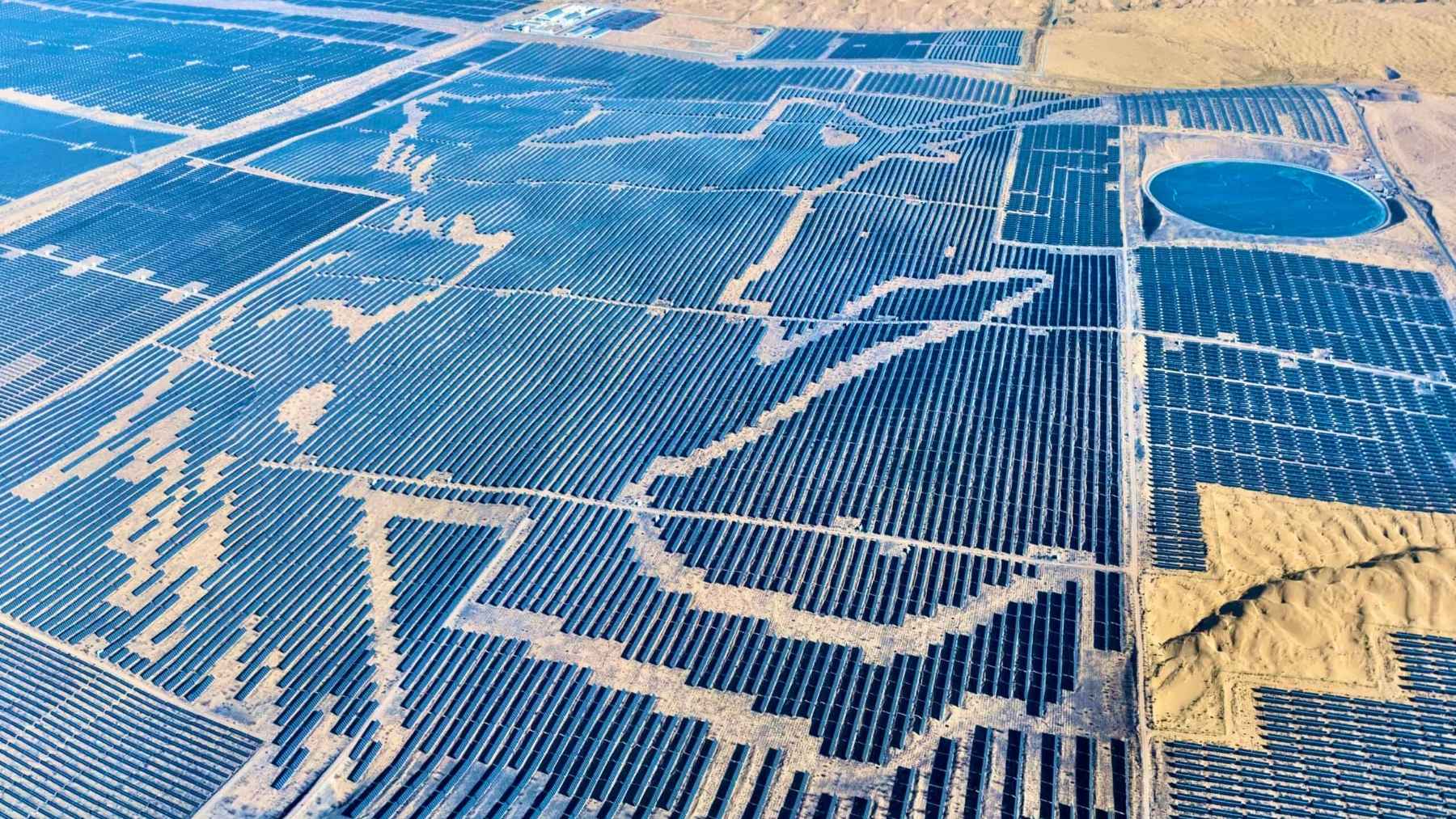

Getting a new power line approved in the US is a multiyear slog of hearings, permitting, and the occasional lawsuit, all before a single steel tower goes up. China is running the opposite playbook, and the results are visible from orbit. Along the northern edge of the Kubuqi Desert in Inner Mongolia, solar panels are filling in a strip that planners want to run 250 miles end to end, part of a build the Chinese press has taken to calling a “solar great wall.” NASA’s Earth Observatory lined up two satellite frames of the same ground, one from December 2017 and one from December 2024, and the change between them barely needs a caption. Where there were bare dunes, there are now grids of panels wide enough to pick out from space.
The full plan, which Chinese officials expect to wrap around 2030, calls for a band roughly 250 miles long and 3 miles wide with a maximum capacity of 100 gigawatts. NASA frames that as enough to power Beijing. As of the most recent official count, late in 2024, about 5.4 gigawatts of it was actually installed. So the wall is real, the satellite evidence is real, and the gap between what is built and what has been promised is real too.
NASA’s two frames, and the giant horse hiding in one of them
The images come from the Operational Land Imager on Landsat 8 and its successor on Landsat 9, shot over the same band of dunes just south of the Yellow River, between the cities of Baotou and Bayannur. Side by side, December 2017 and December 2024, they show the footprint going from a few scattered blocks to a near-continuous mosaic. It is the rare infrastructure project where the construction timeline is legible from low Earth orbit.
One feature in the frames is hard to miss once you know to look for it. The 300-megawatt Junma Solar Power Station, built by State Power Investment Corporation and finished in 2019, was laid out in the shape of a galloping horse. It holds a Guinness World Record for the largest image ever made out of solar panels, and it pushes out roughly 2 billion kilowatt-hours a year, enough for the annual needs of 300,000 to 400,000 people. Junma means “fine horse” in Mandarin, which is the kind of detail that sounds like marketing until you see it from space and realize they actually built a horse the size of a small city.
The flagship piece also burns coal
The single biggest chunk of the wall is the Three Gorges Kubuqi base, near Ordos, developed by state-owned China Three Gorges together with Inner Mongolia’s Mengneng energy group. Ground broke at the end of 2022 on an 80 billion yuan ($11.6 billion) project, and the detail that complicates the “green wall” branding is the fuel mix. As Power magazine reported, the base was designed as a 16-gigawatt hybrid, with 8 gigawatts of solar, 4 gigawatts of wind, and 4 gigawatts of coal-fired generation, plus storage. The sun does the headline work. The coal is there to keep the grid steady when the sun is not cooperating.
Progress on the flagship has been steady rather than instant. The first gigawatt of solar came online at the end of 2023. By 2025, a second 1-gigawatt phase had been connected, which Na Guiting, a deputy president at the Three Gorges Mengneng joint venture, described to Xinhua as turning more than 4,200 hectares of dunes into panels. That puts about 2 gigawatts of the flagship in service today, with reporting from EnergiesMedia putting it on track to reach 7,000 megawatts during 2026 as additional phases switch on. When the whole base is finished, the developer expects it to send roughly 40 billion kilowatt-hours a year east to the Beijing-Tianjin-Hebei region, more than half of that from clean sources.
The panels are doing a second job as a fence
Power was never the only goal. Mounted a few feet off the ground and lined up in rows, the panels work as windbreaks. They slow the wind that pushes the dunes around, they cut evaporation by throwing shade on the sand, and that combination gives grass and crops a foothold where there was not one before. NASA points to published analysis of Landsat data showing solar projects have contributed to the greening of dry land elsewhere in China, so this is not a one-off claim from a press release.
On the ground, the people nearby put it in plainer terms. One local farmer, Han Rongkuan, told Xinhua that “these projects shield us from wind and sand,” and that his village had cultivated more than 600 hectares (about 1,500 acres) of high-standard farmland in a single year, land that can bring in roughly 900 yuan ($128) per mu if it is leased out. China has run a version of this before, on the Tibetan Plateau, where a solar complex turned near-total sand into working grassland and ended up needing thousands of sheep to keep it in check. That is a different desert and a different story, but the underlying move, generate power up top and restore the land underneath, is the same one being scaled across the Kubuqi.
Why the same idea moves at a different speed in the US
The scale gap is not subtle. As of mid-2024, China led the world in operating solar capacity with about 386,875 megawatts, roughly 51 percent of the global total, according to Global Energy Monitor’s tracker. The US sat second at 79,364 megawatts, around 11 percent. Between 2017 and 2023, China was adding solar at an average pace of nearly 40,000 megawatts a year. The US averaged about 8,137 megawatts over the same stretch. Those are not numbers that close on their own.
Building the panels is only half the job, though, and arguably the easy half. A gigawatt sitting in a remote stretch of Inner Mongolia does nothing for a city 800 miles away unless you can move it, which is why China has been stringing ultra-high-voltage lines from these bases toward the populated east and south. It is the same bottleneck that has US grid operators and Texas regulators arguing over transmission for years, just with a very different tolerance for how fast steel goes up. And because solar only works when the sun is out, the gigawatts need firming, which is its own engineering problem. China’s answer there runs from batteries to enormous pumped-storage “water batteries” that hold power behind a mountain and let gravity hand it back on demand.
There is also a stranger wrinkle to covering this much ground with dark panels. A field this size can nudge the local environment in ways that go beyond shade and windbreaks. German researchers modeling large arrays have found that a big enough installation could shift rainfall patterns over a desert, and they are now running field tests in the UAE to see whether the atmosphere behaves the way the simulations say. None of that is settled, and none of it is specific to the Kubuqi, but it is a reminder that a wall of panels this size is not a neutral object dropped on empty land.
The satellite images are the part of this story that needs no spin. Two frames, seven years apart, bare dunes turning into a grid you can resolve from orbit. The round numbers are softer. The 100-gigawatt figure is a 2030 target, the 5.4 gigawatts is what was counted as built more than a year ago, and the flagship that anchors the whole thing is a 2-gigawatt machine with a coal plant attached, climbing toward seven. “Enough to power Beijing” is a design spec, not a meter reading. What is already in the ground is a 250-mile test of whether you can generate serious power and hold back a desert with the same hardware, and the early frames suggest the answer is yes on both counts. Getting all those gigawatts to the cities that actually need them is the harder problem, and it is the one nobody bothers to photograph.
 makinawake ROOKIE3 months ago