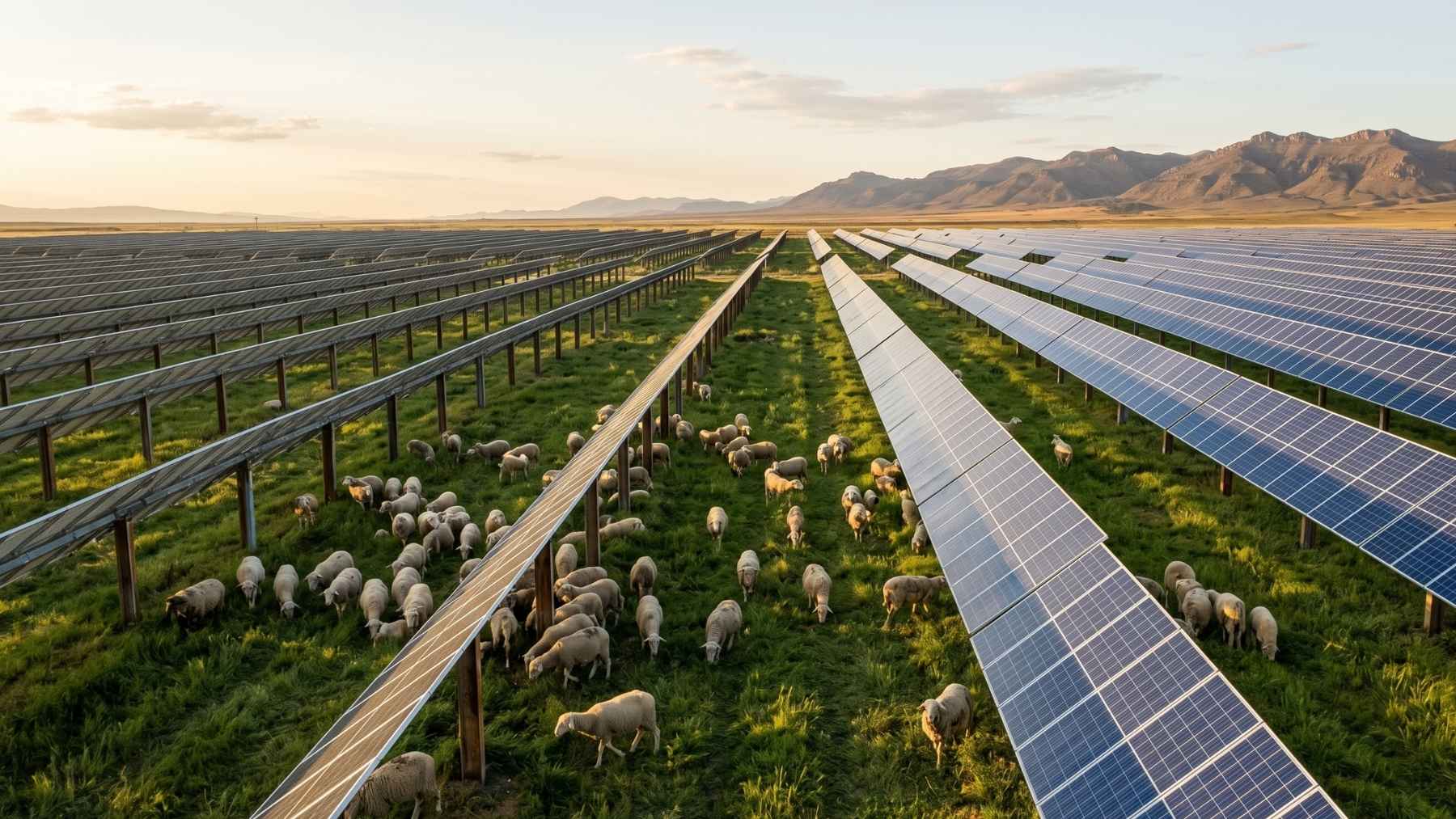

You’d expect a solar megaproject covering a chunk of high-altitude desert to be bad news for the people who graze sheep there. Fence off the land, install a few million panels, ship the locals somewhere else: that is the standard playbook for utility-scale anything. What’s happening at the Talatan complex in Qinghai, on the northeastern lip of the Tibetan Plateau, is the opposite. Three years after the panels went up at industrial scale, herders are running more sheep on more grass than they had before construction started.
The short version: panels block wind, cool the soil, and trap moisture. Grass grows. So much grass, in fact, that the solar operator now needs the sheep to keep it from shading the modules and turning into a winter fire risk. The herders get free pasture, the utility gets free landscaping, and a stretch of Gobi that used to be mostly sand is now a working grassland under glass, not unlike the way other clever renewable projects are repurposing land nobody else wanted.
The plant is bigger than your average city
Talatan sits in Gonghe County, Hainan Tibetan Autonomous Prefecture, and the scale is genuinely hard to picture. The complex is developed by Huanghe Hydropower, a subsidiary of the State Power Investment Corporation, and treated as a single facility it has been reported as the world’s largest solar plant by both footprint and output. Installed capacity has climbed fast: Chinese government figures put it around 8,430 megawatts in mid-2024, and by 2026 the complex was reported at roughly 21 gigawatts generating more than 18,000 gigawatt-hours a year. Once construction wraps, the photovoltaic park is slated to cover about 609 square kilometers, close to the size of the city of Chicago, with more than 7 million panels and over 60 separate solar operators inside the same fence line.
One slice of that cluster, the roughly 64-square-kilometer Gonghe Photovoltaic Park, is the part scientists have studied most closely. That is the patch where the strange thing happened.
How a desert grew a lawn
Before construction, the Talatan area was bad land. Chinese state media report that 98.5% of it was sand, with herders driving flocks long distances every year just to find enough grass to keep them alive. Then came the panels, and with them an accidental greenhouse effect at ground level. Less direct sun on the dirt means less evaporation. Maintenance crews wash the panels periodically, and that runoff drips into the soil. Wind speeds fall because the rows act as windbreaks.
The numbers the operator publishes are aggressive. Its own remote-sensing data, from a joint study with Xi’an University of Technology, claims wind speed dropped about 50%, soil evaporation fell roughly 30%, and vegetation cover hit 80% across three years. Those are utility-published figures, so squint at them. But a peer-reviewed assessment in Scientific Reports, run by researchers at Xi’an University of Technology and Qinghai University, scored conditions inside the Gonghe array clearly better than the surrounding desert on soil moisture, vegetation and microbial life, concluding the buildout had “a positive impact on the ecological environment.” The grass came back hard enough to start shading the modules.
The sheep are doing the mowing
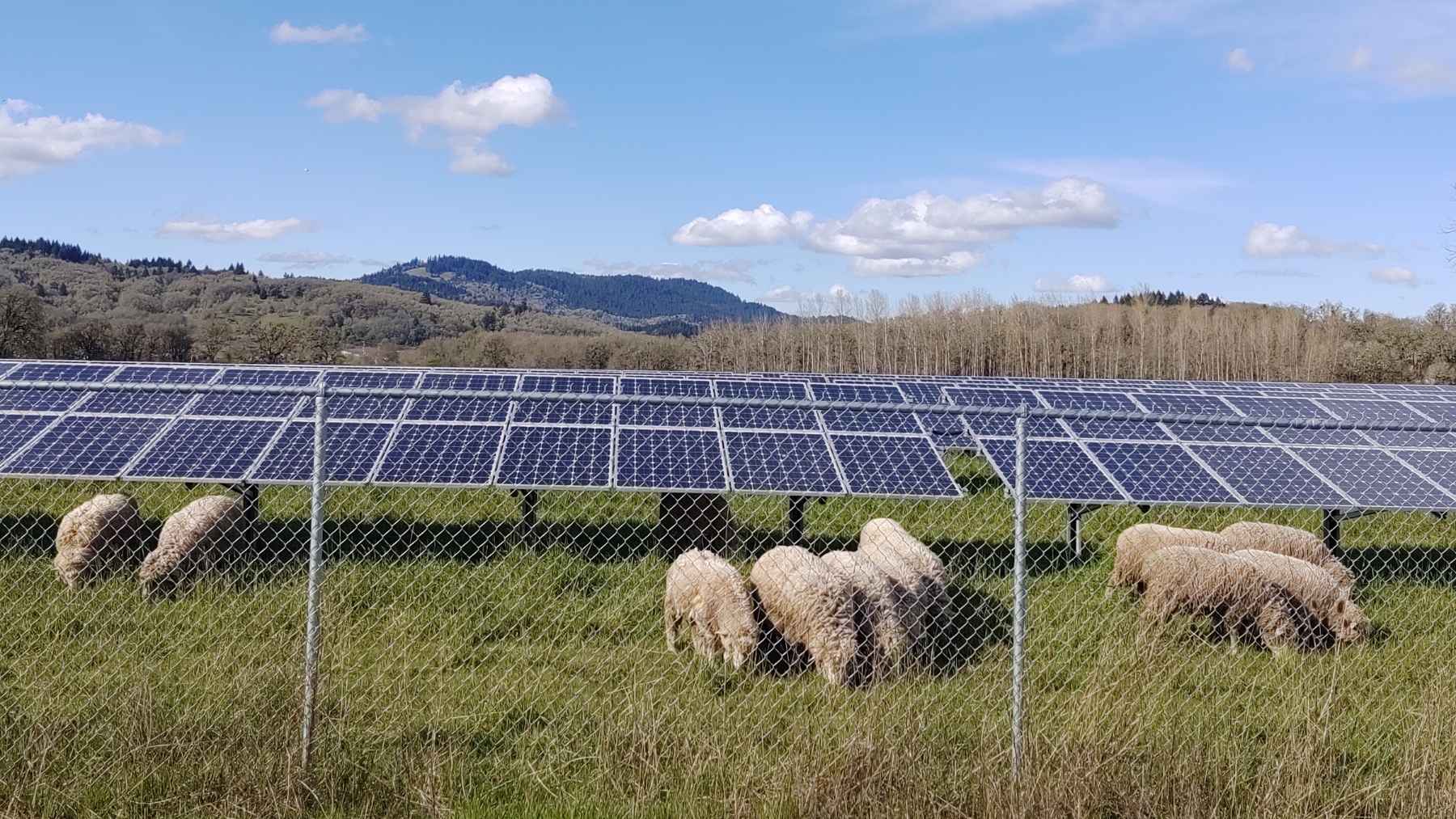
That’s where the herders re-enter the story. Grass that grows over a meter tall under the panels cuts output and turns into a winter fire hazard. In places it shot up past a meter, tall enough to block the panels and drag down power efficiency, according to a staffer at the local industrial park. Rather than pay crews to cut it or spray herbicide near drinking water, the operator cut deals with neighboring villages: bring your sheep in, eat the grass, don’t pay us.
The engineering got rewritten around the animals. Technicians widened the gap between panel rows from three to five meters and lifted the mounting height from 50 centimeters to between 1.5 and 1.8 meters, so sheep can walk underneath without crouching. The first 2012 arrays were too low; newer ones aren’t.
The grazing arrangement now looks like this:
- Free grazing runs June through October each year.
- Roughly 66 square kilometers (about 100,000 mu) of company-owned pasture inside the fence is open to herders.
- The prefecture has set up 32 photovoltaic eco-pastures and 56 centralized grazing sites.
- 18 nearby villages run more than 20,000 sheep through the park each year.
- Annual grass output runs around 110,000 tonnes, with one local official putting it at 118,000 tonnes, enough to feed 200,000 sheep.
What the herders are actually making
The income side is where the policy theater meets the bank account. Yehdor, a 49-year-old herder profiled repeatedly in Chinese state coverage, told Xinhua his family now pulls in “nearly 100,000 yuan (about 14,000 U.S. dollars) a year from raising sheep,” with his flock growing from 200 head to more than 300. An earlier 2024 account pegged his jump at roughly 20,000 yuan before the park to 70,000 to 80,000 after. State figures put the agrivoltaic setup at over 10,000 yuan per mu, roughly $1,398 per 0.07 hectares, and credit it with lifting 173 nearby villages out of poverty. That is official Chinese government framing, so read it knowing the source, but the broad-stroke trend of more grass, more sheep, more cash shows up in the peer-reviewed work too.
There is also a branding twist. Locals now market the meat as “photovoltaic sheep” and sell mutton nationwide via e-commerce, which sounds invented but apparently isn’t. Each animal carries a QR-coded ear tag storing its age, vaccination history and owner, so a buyer can scan the code and trace the lamb chop back to a specific flock under a specific row of panels.
Don’t yet declare the desert solved
The Talatan numbers are spectacular. They are also a single site, in a specific microclimate, with a utility that has obvious reasons to publish flattering data. Other researchers have already flagged the catch. A separate study of photovoltaic sites across the wider Qinghai-Tibet Plateau found that about 56% of installations saw vegetation cover improve, while 44% actually lost cover compared with surrounding land. Soil moisture explained roughly 62% of the difference, and more than half of the apparent restoration traced back to the water used to wash the panels. Cut the cleaning budget, or push into drier zones, and the lush patches disappear. Lean on them too hard in a truly arid area and the extra plant growth starts pulling water out of an aquifer that can’t refill it.
For the US solar industry, the Talatan result still matters because the dual-use idea is finally getting a serious case study. The American Solar Grazing Association has been pitching the same model since 2018, mostly to skeptical utilities, and it is the kind of approach the broader US clean-energy build-out keeps circling as it runs into its own cost and land fights. Talatan is what the pitch looks like at gigawatt scale: panels generate the power the grid needs, the soil underneath gets a microclimate it didn’t have, and the farmers who would have been pushed off the land are the ones being paid to maintain it.
The Chinese version comes wrapped in caveats about water budgets, state messaging, and a utility that completely controls the story. But the basic finding, that a properly engineered solar farm can leave the local agricultural economy bigger than it found it, is now a data point instead of a hope.
 @mfrost ROOKIE5 months ago